
Algorithmic Game Theory: Nash Equilibrium Computation, PPAD-Completeness, and the Computational Lens on Strategy
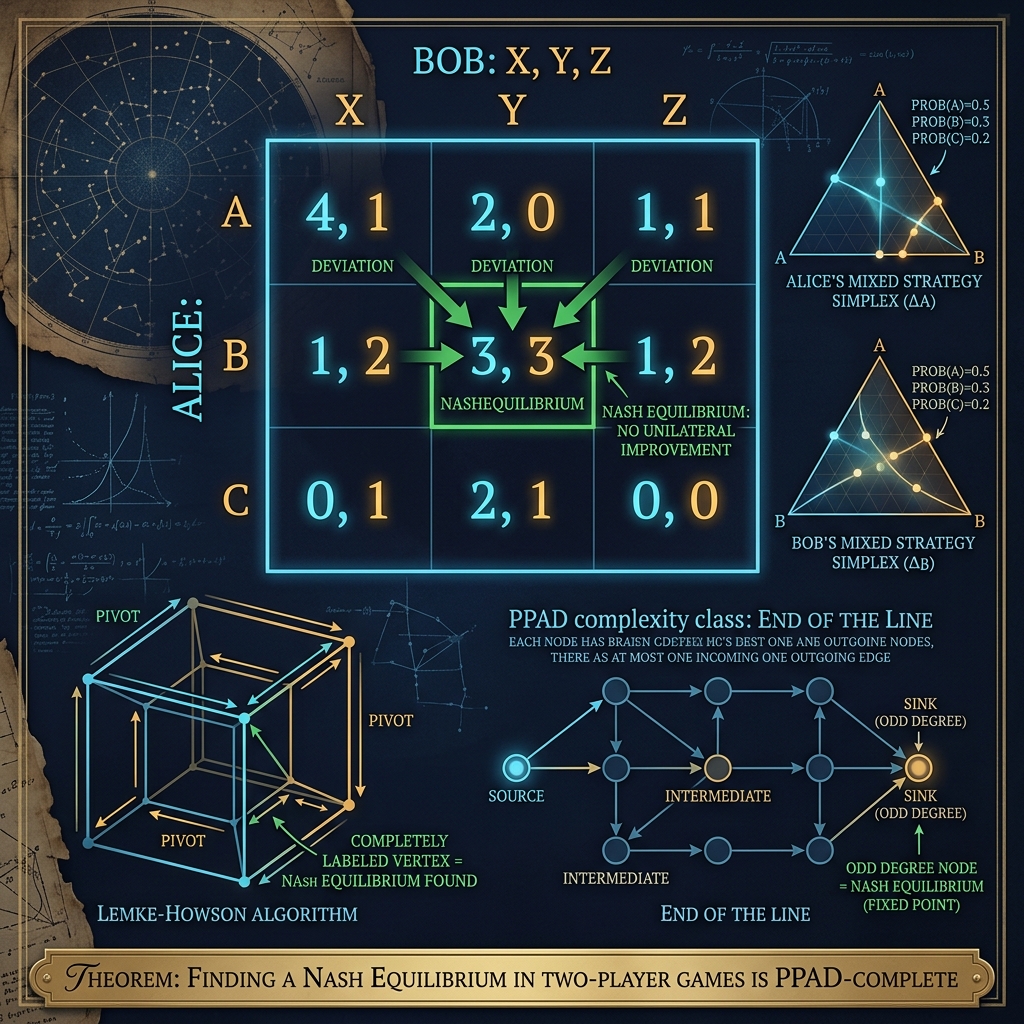
A rigorous look at algorithmic game theory—computing Nash equilibria, the PPAD complexity class, and how computational constraints reshape strategic reasoning.
John Nash proved in 1950 that every finite game has a mixed-strategy equilibrium—a probability distribution over strategies for each player such that no player can unilaterally deviate to improve her expected payoff. Nash’s proof used Brouwer’s fixed-point theorem, an existence argument that gives no algorithm for finding the equilibrium. For over half a century, economists treated Nash equilibrium as a descriptive tool—a prediction of what rational players would do—without worrying about how they would compute it. Algorithmic game theory, pioneered by the confluence of computer science and economics in the late 1990s, asks: can Nash equilibria be computed efficiently? The answer, it turns out, is surprisingly subtle.
In 2006, Daskalakis, Goldberg, and Papadimitriou proved that computing a Nash equilibrium in a game with three or more players is PPAD-complete—complete for a complexity class that captures the difficulty of finding fixed points. For two-player games, the problem is PPAD-complete as well (Chen and Deng, 2006). This means that Nash equilibrium computation is unlikely to be polynomial-time solvable (unless PPAD ⊆ P, which is considered unlikely) and is in fact as hard as any fixed-point problem. This result transforms game theory: Nash equilibrium is not merely an existence concept; it is a computationally intractable one, and the assumption that rational players can find it is questionable.
1. Nash Equilibrium: Definitions and Existence
A normal-form game consists of (k) players, each with a finite set of pure strategies (S_i). For each strategy profile (s = (s_1, \ldots, s_k)), player (i) receives a payoff (u_i(s)). A mixed strategy (\sigma_i) is a probability distribution over (S_i). A mixed-strategy profile (\sigma = (\sigma_1, \ldots, \sigma_k)) is a Nash equilibrium if for every player (i) and every alternative strategy (\sigma_i’):
[ \mathbb{E}{s \sim \sigma}[u_i(s)] \geq \mathbb{E}{s \sim (\sigmai’, \sigma{-i})}[u_i(s)] ]
Nash’s theorem guarantees existence via Kakutani’s fixed-point theorem: the best-response correspondence from the product of strategy simplices to itself has a fixed point, which is precisely a Nash equilibrium. For two-player zero-sum games, Nash equilibrium reduces to linear programming and is polynomial-time solvable (it is equivalent to von Neumann’s minimax theorem). For general-sum games with two or more players, the problem becomes combinatorial.
2. The Lemke-Howson Algorithm and the Path to PPAD
The Lemke-Howson algorithm (1964) computes a Nash equilibrium in a two-player game by following a path in a graph derived from the payoff matrices. The algorithm starts at an “artificial” equilibrium and pivots along edges, similar to the simplex method. The path is guaranteed to reach a Nash equilibrium, but—like simplex—it may take exponentially many steps in the worst case (Savani and von Stengel, 2004).
The Lemke-Howson algorithm is a member of the class PPAD (Polynomial Parity Arguments on Directed graphs). PPAD, introduced by Papadimitriou (1994), captures problems where the solution is guaranteed to exist by a parity argument on a directed graph. Specifically, a PPAD problem is defined by an exponentially large directed graph where every vertex has in-degree and out-degree at most 1. Given a source vertex (in-degree 0, out-degree 1), the problem asks for another vertex with in-degree + out-degree not equal to 2—either another source, a sink (out-degree 0), or the end of the path started from the given source.
The canonical PPAD-complete problem is End-of-the-Line: given circuits that compute predecessors and successors of vertices in a directed graph of maximum degree 2, and a designated source vertex, find a sink or another source. Nash equilibrium computation reduces to End-of-the-Line, and End-of-the-Line reduces to Nash, establishing PPAD-completeness.
3. The PPAD-Completeness Proof Architecture
The reduction from End-of-the-Line to Nash proceeds through several intermediate problems. The first step reduces End-of-the-Line to the computation of an approximate fixed point of a Brouwer function (a continuous function from the unit cube to itself). This uses Sperner’s lemma, a combinatorial analog of Brouwer’s fixed-point theorem: given a coloring of a triangulation of the simplex, there exists a panchromatic triangle (a triangle with all three colors). Finding a panchromatic triangle in an exponentially large triangulation described by circuits is PPAD-complete.
The second step reduces Brouwer fixed-point computation to Nash equilibrium. The key idea is to construct a game where strategies correspond to points in a discretized simplex, and payoffs encode the Brouwer function’s displacement. A Nash equilibrium of this game corresponds to a point where the displacement is zero—a fixed point. The construction is intricate but conceptually elegant: it programs a fixed-point computation into the payoffs of a game.
4. Two-Player vs. Multi-Player Nash
For two-player games, Nash equilibrium computation is PPAD-complete. The Lemke-Howson algorithm provides the PPAD upper bound, and the reduction from End-of-the-Line provides the lower bound. For three or more players, the problem is FIXP-complete (Etessami and Yannakakis, 2010) in the exact setting—harder than PPAD, because the equilibrium may involve algebraic (irrational) numbers. The FIXP class captures the difficulty of exact fixed-point computation over the reals.
This complexity distinction has practical implications. Two-player Nash equilibria can be approximated efficiently via algorithms like the quasi-polynomial algorithm of Lipton, Markakis, and Mehta (2003), which finds an (\epsilon)-approximate equilibrium in (n^{O(\log n / \epsilon^2)}) time. For three-player games, even approximate equilibrium is PPAD-complete. The boundary between tractable and intractable equilibrium computation lies between two and three players—a striking example of how algorithmic considerations reshape economic theory.
5. The Computational Lens on Game Theory
Algorithmic game theory applies a “computational lens” to traditional game-theoretic concepts. This lens asks: can an economic agent actually compute the strategy prescribed by theory? If not, the theory’s predictive power is limited. The PPAD-completeness of Nash equilibrium suggests that Nash equilibrium is not a plausible outcome of polynomial-time bounded rationality—agents cannot compute it efficiently, so they are unlikely to play it.
This insight has driven the search for alternative equilibrium concepts that are computationally tractable. Correlated equilibrium (Aumann, 1974) can be computed in polynomial time via linear programming (Papadimitriou and Roughgarden, 2008). Coarse correlated equilibrium is even easier—it can be learned by simple regret-minimization algorithms like multiplicative weights. These tractable equilibrium concepts provide a more “behaviorally plausible” foundation for game theory.
The price of anarchy framework (Koutsoupias and Papadimitriou, 1999; Roughgarden and Tardos, 2002) measures the degradation in social welfare caused by selfish behavior. For routing games (network congestion), the price of anarchy is bounded by 4/3 for affine latency functions—selfish routing loses at most 33% compared to optimal centralized routing. These bounds provide a “computationally grounded” justification for decentralized economic systems: even when agents act selfishly with bounded rationality, the outcome is not too far from optimal.
6. Summary
Algorithmic game theory bridges computer science and economics by asking: can strategic agents compute their optimal strategies? The PPAD-completeness of Nash equilibrium computation shows that the central solution concept of game theory is computationally intractable, challenging its status as a predictive model of rational behavior. The Lemke-Howson algorithm provides an exponential upper bound but no polynomial guarantee. The search for computationally tractable alternatives—correlated equilibrium, coarse correlated equilibrium, and price of anarchy bounds—has reshaped both the theory and practice of strategic reasoning.
The broader contribution of algorithmic game theory is the insight that computational constraints are not an implementation detail but a first-class consideration in economic theory. Rationality without computational feasibility is an empty promise. By incorporating the cost of computation into the definition of strategic behavior, algorithmic game theory provides a richer and more realistic account of economic interaction, applicable to internet auctions, routing protocols, and automated trading platforms where algorithms, not humans, are the strategic agents.
7. Market Equilibria and the Complexity of Exchange
Beyond games, algorithmic game theory studies market equilibria. In the Arrow-Debreu exchange model, agents have endowments of goods and utility functions; prices adjust until supply equals demand—a market (Walrasian) equilibrium. Computing an equilibrium for markets with linear utilities is polynomial-time solvable (Devanur, Papadimitriou, Saberi, Vazirani, 2008) via convex programming. For constant elasticity of substitution (CES) utilities, computing an equilibrium is PPAD-complete.
The computational lens reveals that Adam Smith’s “invisible hand”—the price mechanism that guides markets to equilibrium—is not computationally efficient in general. Markets with complex preferences may not reach equilibrium in polynomial time, challenging the classical economic assumption that prices naturally find their equilibrium level.
8. Mechanism Design for Sponsored Search Auctions
Sponsored search auctions—the auctions that determine which ads appear alongside Google search results—are a triumph of algorithmic mechanism design. The Generalized Second Price (GSP) auction allocates ad slots (ranked by position) to bidders who place per-click bids. The allocation is by decreasing bid, and each winner pays the bid of the next-highest bidder.
GSP is not truthful (unlike VCG), but it has an “envy-free” equilibrium that yields the same revenue as VCG (Edelman, Ostrovsky, Schwarz, 2007; Varian, 2007). The equilibrium analysis explains why GSP works in practice despite not being dominant-strategy truthful. Google’s transition from GSP to a VCG-like auction (in 2019) was driven by theoretical considerations but required careful engineering to maintain simplicity for advertisers.
9. The Sample Complexity of Learning in Games
How much data do players need to learn an equilibrium? In the classic fictitious play model, players track opponents’ historical frequencies and best-respond to the empirical distribution. Fictitious play converges to Nash equilibrium for zero-sum games but not for general-sum games. More recent work (Daskalakis, Deckelbaum, Kim, 2011) shows that Nash equilibria can be learned from polynomially many samples of play, using algorithms inspired by no-regret learning.
The sample complexity perspective connects algorithmic game theory to machine learning. Just as learning theory studies the number of training examples needed to generalize, game-theoretic learning studies the number of interactions needed to reach equilibrium. The answers inform the design of automated agents that learn to play optimally from experience—a central challenge in AI and multi-agent systems.
For further reading, Nisan, Roughgarden, Tardos, and Vazirani’s “Algorithmic Game Theory” (2007) is the comprehensive reference. Roughgarden’s “Twenty Lectures on Algorithmic Game Theory” (2016) provides an accessible introduction. Papadimitriou’s 2007 STOC survey “The Complexity of Finding Nash Equilibria” is a classic. The reader is encouraged to implement the Lemke-Howson algorithm and observe its pivoting path on random games—sometimes short, sometimes long—as a hands-on introduction to PPAD.
10. The Complexity of Refinements: Proper, Perfect, and Sequential Equilibrium
Nash equilibrium is a weak solution concept: it allows incredible threats and non-credible promises. Refinements—proper equilibrium (Myerson, 1978), perfect equilibrium (Selten, 1975), sequential equilibrium (Kreps and Wilson, 1982)—impose additional rationality constraints. Computing these refinements is generally harder than Nash: finding a proper equilibrium is (\Sigma_2^p)-complete (Hansen, Lund, 2018), meaning it requires two levels of the polynomial hierarchy. This formalizes the intuition that “more refined” equilibrium concepts are computationally more demanding.
The computational intractability of refinements challenges their use as predictive models. If even Nash equilibrium is PPAD-complete and thus unlikely to be polynomial-time computable, proper equilibrium (harder still) is even less plausible as a description of bounded-rational behavior. This has led to interest in “coarse” solution concepts—correlated equilibrium, coarse correlated equilibrium—that are computationally easier and have natural learning dynamics.
11. Extensive-Form Games and the Complexity of Poker
Extensive-form games model sequential decision-making with imperfect information, like poker or negotiation. The sequence form representation (Romanovskii, 1962; Koller, Megiddo, von Stengel, 1994) transforms an extensive-form game into a linear-sized matrix game, enabling polynomial-time computation of Nash equilibria for two-player zero-sum extensive-form games via linear programming.
The game of heads-up limit Texas Hold’em poker was essentially solved by Bowling, Burch, Johanson, and Tammelin (2015) using counterfactual regret minimization (CFR), an iterative algorithm that converges to Nash equilibrium in two-player zero-sum games. The resulting strategy, Cepheus, is provably within 0.001 big blinds per game of optimal. This represents one of the largest scale computations of a Nash equilibrium ever performed, involving terabytes of memory and months of CPU time.
The CFR algorithm updates strategies by minimizing “counterfactual regret”—the difference between the payoff of the chosen action and the average payoff, weighted by the opponent’s probability of reaching that information set. CFR converges to a Nash equilibrium at a rate of (O(1/\sqrt{T})) in the number of iterations, matching the rate of online gradient descent for convex optimization—a beautiful connection between game theory and convex optimization.
12. Summary
Algorithmic game theory bridges computer science and economics by asking: can strategic agents compute their optimal strategies? The PPAD-completeness of Nash equilibrium computation shows that the central solution concept of game theory is computationally intractable, challenging its status as a predictive model of rational behavior. The Lemke-Howson algorithm provides an exponential upper bound but no polynomial guarantee. The search for computationally tractable alternatives—correlated equilibrium, coarse correlated equilibrium, and price of anarchy bounds—has reshaped both the theory and practice of strategic reasoning.
The broader contribution of algorithmic game theory is the insight that computational constraints are not an implementation detail but a first-class consideration in economic theory. Rationality without computational feasibility is an empty promise. By incorporating the cost of computation into the definition of strategic behavior, algorithmic game theory provides a richer and more realistic account of economic interaction, applicable to internet auctions, routing protocols, and automated trading platforms where algorithms, not humans, are the strategic agents.
For further reading, Nisan, Roughgarden, Tardos, and Vazirani’s “Algorithmic Game Theory” (2007) is the comprehensive reference. Roughgarden’s “Twenty Lectures on Algorithmic Game Theory” (2016) provides an accessible introduction. Papadimitriou’s 2007 STOC survey “The Complexity of Finding Nash Equilibria” is a classic. The reader is encouraged to implement the Lemke-Howson algorithm and observe its pivoting path on random games—sometimes short, sometimes long—as a hands-on introduction to PPAD.
13. Summary and Further Perspectives
Algorithmic game theory bridges computer science and economics by asking: can strategic agents compute their optimal strategies? The PPAD-completeness of Nash equilibrium computation shows that the central solution concept of game theory is computationally intractable, challenging its status as a predictive model of rational behavior. The Lemke-Howson algorithm provides an exponential upper bound but no polynomial guarantee. The search for computationally tractable alternatives—correlated equilibrium, coarse correlated equilibrium, and price of anarchy bounds—has reshaped both the theory and practice of strategic reasoning.
The broader contribution of algorithmic game theory is the insight that computational constraints are not an implementation detail but a first-class consideration in economic theory. Rationality without computational feasibility is an empty promise. By incorporating the cost of computation into the definition of strategic behavior, algorithmic game theory provides a richer and more realistic account of economic interaction, applicable to internet auctions, routing protocols, and automated trading platforms where algorithms, not humans, are the strategic agents. The sample complexity of learning in games, the complexity of extensive-form games and poker, and the integration of mechanism design with privacy are vibrant frontiers where game theory meets computer science.
For further reading, Nisan, Roughgarden, Tardos, and Vazirani’s “Algorithmic Game Theory” (2007) is the comprehensive reference. Roughgarden’s “Twenty Lectures on Algorithmic Game Theory” (2016) provides an accessible introduction. Papadimitriou’s 2007 STOC survey “The Complexity of Finding Nash Equilibria” is a classic. The reader is encouraged to implement the Lemke-Howson algorithm and observe its pivoting path on random games—sometimes short, sometimes long—as a hands-on introduction to PPAD.
14. Connection to Auction Theory and Mechanism Design
Algorithmic game theory is the sibling of mechanism design, and the two fields share deep connections. An auction can be viewed as a game: bidders choose strategies (bids), and the auction rules determine allocations and payments. The revelation principle states that any equilibrium of any auction can be implemented by a truthful direct mechanism, but this raises the question: can bidders compute their equilibrium strategies in the original auction?
For combinatorial auctions with submodular valuations, the VCG mechanism is truthful, but computing the optimal allocation is NP-hard. The “demand query” model allows bidders to communicate their valuations through a polynomial number of queries, and the (1-1/e)-approximation via the greedy algorithm can be implemented as a truthful mechanism with demand queries. This connection between approximation algorithms, truthful mechanisms, and the computational complexity of equilibria is the central theme of algorithmic mechanism design.
15. The Learning Dynamics of Games: From Fictitious Play to Deep RL
Classical learning dynamics—fictitious play (Brown, 1951), replicator dynamics (Taylor and Jonker, 1978), and no-regret learning (Freund and Schapire, 1999)—describe how players might converge to equilibrium through repeated interaction. Fictitious play converges for zero-sum games and 2×2 games but fails for general-sum games (Shapley, 1964). No-regret dynamics (where each player’s average regret goes to zero over time) converge to the set of coarse correlated equilibria, a superset of Nash equilibria.
Deep reinforcement learning has revitalized the empirical study of learning in games. AlphaGo and AlphaZero learned superhuman strategies for Go and chess through self-play, which is essentially a learning dynamic converging to an approximate Nash equilibrium of the two-player zero-sum game of perfect information. In multi-agent reinforcement learning (MARL), agents learn simultaneously while adapting to each other’s changing strategies, a setting that combines the challenges of game theory (non-stationarity) with the challenges of deep RL (high-dimensional state spaces, sparse rewards).
16. Concluding Thoughts
Algorithmic game theory reveals that computation is a first-class constraint on strategic behavior. The PPAD-completeness of Nash equilibrium challenges the foundations of classical game theory. The development of computationally tractable solution concepts (correlated equilibrium, coarse correlated equilibrium) and the analysis of learning dynamics (no-regret, deep RL) provide alternative foundations. The synthesis of game theory, algorithms, and machine learning is an ongoing project with implications for auction design, multi-agent systems, and the governance of AI.
For further reading, Nisan, Roughgarden, Tardos, and Vazirani’s “Algorithmic Game Theory” (2007) is the comprehensive reference. Roughgarden’s “Twenty Lectures on Algorithmic Game Theory” (2016) provides an accessible introduction. Papadimitriou’s 2007 STOC survey “The Complexity of Finding Nash Equilibria” is a classic. The reader is encouraged to implement the Lemke-Howson algorithm and observe its pivoting path on random games—sometimes short, sometimes long—as a hands-on introduction to PPAD.
17. Algorithmic Game Theory and AI Safety
The computational lens on game theory has implications for AI safety and multi-agent systems. If autonomous agents (self-driving cars, trading bots, military drones) interact in strategic environments, they must compute equilibria in real time. The PPAD-completeness of Nash equilibrium suggests that perfect equilibrium play is computationally infeasible, and that agents will instead converge to computationally tractable solution concepts like correlated equilibrium or coarse correlated equilibrium via no-regret learning dynamics.
This has profound consequences. In a world of autonomous agents, the “rational outcome” is not the Nash equilibrium (which agents cannot compute) but the outcome of polynomial-time learning dynamics. Understanding these dynamics—their convergence properties, their welfare guarantees, their susceptibility to manipulation—is essential for designing safe multi-agent AI systems. The theory of “AI safety via game theory” (Critch, 2019) uses algorithmic game theory to analyze the strategic behavior of AI agents and to design mechanisms that align their incentives with human values.
18. The Convergence of Game Theory, Machine Learning, and Economics
The boundaries between game theory, machine learning, and economics are dissolving. Generative adversarial networks (GANs) are two-player zero-sum games where the generator and discriminator are neural networks trained via gradient descent. The equilibrium of this game is a generator that produces realistic samples, and the training dynamics are essentially no-regret learning. Multi-agent reinforcement learning (MARL) extends reinforcement learning to settings with multiple interacting agents, where the environment is non-stationary because other agents are simultaneously learning.
The theory of “mean-field games” (Lasry and Lions, 2007) analyzes games with a continuum of anonymous players, where each player’s payoff depends on the distribution of all players’ actions. Mean-field games are the infinite-player limit of finite games, and their equilibria can be computed by solving coupled PDEs (the Hamilton-Jacobi-Bellman equation for optimal control and the Fokker-Planck equation for the population distribution). The computational solution of mean-field games is an active area at the intersection of PDE numerics, optimization, and game theory.
19. Conclusion
Algorithmic game theory has transformed our understanding of strategic behavior by introducing computational constraints as a first-class consideration. The PPAD-completeness of Nash equilibrium, the tractability of correlated equilibrium, the learning dynamics of no-regret algorithms, and the practical applications to auctions and matching markets demonstrate the power of the computational lens. The synthesis of game theory, machine learning, and multi-agent systems is an ongoing intellectual project with implications for AI safety, economic design, and the governance of autonomous systems.
For further reading, Nisan, Roughgarden, Tardos, and Vazirani’s “Algorithmic Game Theory” (2007) is the comprehensive reference. Roughgarden’s “Twenty Lectures on Algorithmic Game Theory” (2016) provides an accessible introduction. Papadimitriou’s 2007 STOC survey “The Complexity of Finding Nash Equilibria” is a classic. The reader is encouraged to implement the Lemke-Howson algorithm and observe its pivoting path on random games—sometimes short, sometimes long—as a hands-on introduction to PPAD.
20. The Complexity of Strategic Voting and Social Choice
The Gibbard-Satterthwaite theorem (1973) proves that every non-dictatorial voting rule with at least three candidates is manipulable—some voter can benefit by misreporting her preferences. This impossibility result, like Arrow’s theorem in social choice, seems to doom the prospect of fair and truthful collective decision-making. But computational complexity offers an escape: if finding a beneficial manipulation is computationally hard, then manipulation may be deterred in practice.
Bartholdi, Tovey, and Trick (1989) initiated the study of the computational complexity of manipulating voting rules. They showed that for many natural voting rules (plurality, Borda, Copeland), finding a beneficial manipulation by a single voter is polynomial-time. However, for the Single Transferable Vote (STV) rule, manipulation is NP-hard (Bartholdi and Orlin, 1991). This suggests that STV is more resistant to manipulation than simpler rules—a “computational defense” of a voting rule.
The theory of “parameterized complexity of voting manipulation” (Betzler, Bredereck, Chen, Niedermeier, 2012) refines this picture: while manipulation may be NP-hard in general, it may be FPT when parameterized by the number of candidates (which is small in most elections). This means that for practical election sizes, manipulation may be easy even for rules that are NP-hard in general. The computational defense of voting rules is thus nuanced: it depends on the specific parameterization and the size of real-world elections.
21. The Coevolution of Game Theory and Computer Science
Game theory and computer science have coevolved since the 1990s. Computer science provided game theory with new questions (can equilibria be computed?), new tools (complexity classes like PPAD, algorithmic techniques like multiplicative weights), and new applications (internet auctions, routing protocols, multi-agent AI). Game theory provided computer science with new concepts (Nash equilibrium, mechanism design, price of anarchy) and new challenges (strategic behavior in distributed systems, incentive-compatible protocol design).
The synthesis continues with the rise of AI. AlphaGo’s victory over Lee Sedol in 2016 was a triumph of game-theoretic reasoning (Monte Carlo tree search for perfect-information games) combined with deep learning (policy and value networks). The successor, AlphaZero, learned superhuman strategies for Go, chess, and shogi entirely through self-play—a learning dynamic converging to a Nash equilibrium of the respective two-player zero-sum games. The success of these systems demonstrates the power of algorithmic game theory to produce not just theoretical insights but practical AI systems of remarkable capability.
22. Conclusion
Algorithmic game theory illuminates the computational foundations of strategic behavior. The PPAD-completeness of Nash equilibrium challenges the classical assumption that rational players can compute their optimal strategies. The tractable alternatives—correlated equilibrium, coarse correlated equilibrium—provide more plausible models of boundedly rational play. The applications—from spectrum auctions to online advertising to multi-agent AI—demonstrate the practical relevance of the theory. As AI systems increasingly interact strategically with each other and with humans, algorithmic game theory will be essential for understanding and designing these interactions.
For further reading, Nisan, Roughgarden, Tardos, and Vazirani’s “Algorithmic Game Theory” (2007) is the comprehensive reference. Roughgarden’s “Twenty Lectures on Algorithmic Game Theory” (2016) provides an accessible introduction. Papadimitriou’s 2007 STOC survey “The Complexity of Finding Nash Equilibria” is a classic. The reader is encouraged to implement the Lemke-Howson algorithm and observe its pivoting path on random games—sometimes short, sometimes long—as a hands-on introduction to PPAD.
23. The Broader Impact of Algorithmic Game Theory on Computer Science
Algorithmic game theory has transformed how computer scientists think about incentives, computation, and strategic behavior. Before the 1990s, computer science largely ignored incentives: the standard model assumed that computers and users would follow protocols as specified. The rise of the internet shattered this assumption. Internet protocols (TCP, BGP, DNS) were designed for a cooperative environment but were deployed in a competitive one, leading to strategic manipulation (spam, DDoS attacks, BGP hijacking). Algorithmic game theory provided the framework for understanding these phenomena and for designing protocols that are robust to strategic behavior.
The “price of anarchy” concept has been particularly influential. It quantifies the efficiency loss due to selfish behavior: for network routing with affine latency functions, the price of anarchy is 4/3 (Roughgarden and Tardos, 2002)—selfish routing loses at most 33% compared to optimal centralized routing. This elegant bound explains why decentralized internet routing, despite being uncoordinated, achieves near-optimal performance. The price of anarchy framework has been extended to scheduling, load balancing, spectrum allocation, and supply chain management, providing a theoretical justification for the efficiency of decentralized economic systems.
The influence extends to practical systems design. Google’s advertising auctions, Amazon’s marketplace algorithms, Uber’s surge pricing, and eBay’s reputation systems all incorporate insights from algorithmic game theory. The design of Bitcoin’s consensus mechanism is a game-theoretic problem. The allocation of cloud computing resources via DRF is a mechanism design problem. Algorithmic game theory is not a niche academic pursuit but an essential tool for building the economic infrastructure of the digital age.
24. Final Words
Algorithmic game theory reveals that computation and incentives are intertwined. You cannot design a protocol, a platform, or a market without considering how rational, strategic agents will behave within it—and whether they can even compute their optimal behavior. The PPAD-completeness of Nash equilibrium, the tractability of correlated equilibrium, and the price of anarchy bounds provide the theoretical vocabulary. The practical deployments—in advertising, cloud computing, and blockchain—demonstrate the real-world impact. The synthesis of game theory, algorithms, and machine learning is an ongoing intellectual project that will shape the future of AI, economics, and society.
For further reading, Nisan, Roughgarden, Tardos, and Vazirani’s “Algorithmic Game Theory” (2007) is the comprehensive reference. Roughgarden’s “Twenty Lectures on Algorithmic Game Theory” (2016) provides an accessible introduction. Papadimitriou’s 2007 STOC survey “The Complexity of Finding Nash Equilibria” is a classic. The reader is encouraged to implement the Lemke-Howson algorithm and observe its pivoting path on random games—sometimes short, sometimes long—as a hands-on introduction to PPAD.
The computational lens has transformed our understanding of strategic behavior. Before algorithmic game theory, the existence of Nash equilibrium was sufficient—economic theory did not concern itself with how agents might find the equilibrium. After PPAD-completeness, we know that computing Nash equilibrium is as hard as any fixed-point problem, and that rational agents, constrained by polynomial-time computation, cannot be expected to play Nash equilibrium in general. This insight has profound implications for the predictive power of game theory, for the design of economic mechanisms, and for the behavior of AI agents in strategic environments. Correlated equilibrium and coarse correlated equilibrium, which are computationally tractable and arise naturally from no-regret learning dynamics, provide alternative foundations for strategic reasoning. The price of anarchy quantifies the efficiency loss from selfish behavior, providing a theoretical justification for decentralized systems. Algorithmic game theory thus transforms game theory from a descriptive theory of rational behavior into a prescriptive theory of computationally feasible strategic interaction, with direct applications to the design of online platforms, cloud computing systems, and multi-agent AI.
The significance of the PPAD-completeness result extends beyond the technical complexity classification. It reveals that Nash equilibrium is fundamentally a fixed-point problem, and that computing it has the same complexity as any fixed-point problem—no harder, but also no easier. This places Nash equilibrium in a precise complexity class and establishes that it is unlikely to be polynomial-time solvable. The consequences ripple through economics and computer science. In economics, the result challenges the foundational assumption that rational agents play Nash equilibrium: if even computers cannot find Nash equilibria efficiently, how can bounded human agents be expected to do so? In computer science, the result motivates the search for alternative solution concepts—correlated equilibrium, coarse correlated equilibrium, price of anarchy—that are computationally tractable and have plausible learning dynamics. The PPAD-completeness of Nash equilibrium is thus not an endpoint but a starting point for a richer theory of strategic behavior that takes computational constraints seriously.
The learning dynamics of no-regret algorithms provide a constructive route to equilibrium. Multiplicative weights, discussed in the online algorithms post, ensures that a player’s regret—the difference between her cumulative payoff and the payoff of the best fixed action in hindsight—grows sublinearly in the number of rounds. When all players use no-regret algorithms, the time-averaged distribution of play converges to the set of coarse correlated equilibria, a superset of Nash equilibria. This convergence is robust: it does not require coordination among players, knowledge of opponents’ payoffs, or even knowledge of one’s own payoff function (bandit feedback suffices). The convergence of no-regret dynamics to coarse correlated equilibrium is a “constructive existence proof”—it demonstrates not just that equilibria exist, but that they can be reached by natural, decentralized learning processes. This connection between online learning and game theory is one of the most fruitful in theoretical computer science.
The relationship between computation and incentives is bidirectional. Computational complexity limits what strategic agents can achieve, but strategic behavior also complicates computation—when agents control parts of the input and may lie about it, algorithms must be robust to manipulation. This bidirectional relationship is the central theme of algorithmic game theory, and it has reshaped how computer scientists think about algorithms, networks, and systems in the presence of self-interested participants. The study of algorithmic game theory thus represents a fundamental shift in how we understand strategic interaction in the computational age, bridging the gap between economic theory and computational reality.