
Anonymous Communication: Onion Routing, Mix Networks, DC-Nets, and the Anonymity Trilemma
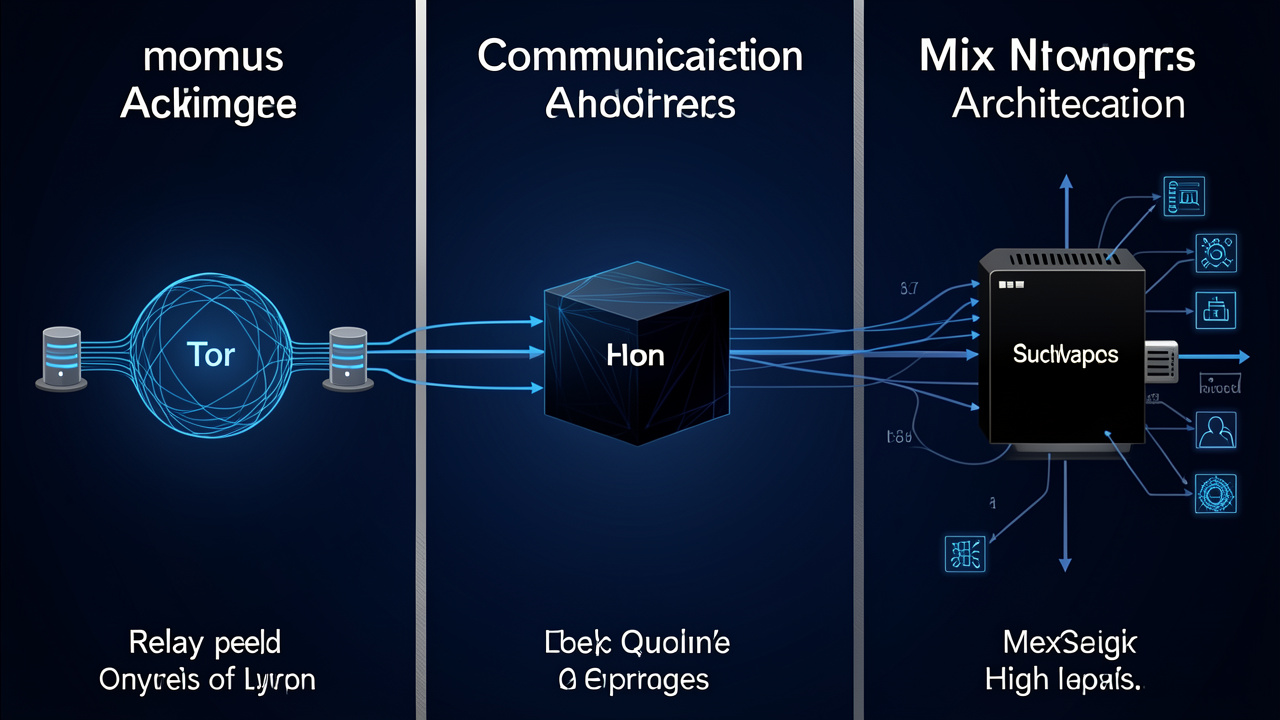
A rigorous analysis of anonymous communication systems from Tor's onion routing through mix networks like Loopix and Nym to DC-nets, exploring the anonymity trilemma and traffic analysis resistance.
Contents
Every packet you send across the Internet carries your IP address. Even when the packet’s content is encrypted, the metadata—who is communicating with whom, when, and how much—is exposed to every router along the path, to the destination, and to any passive observer of the network. This metadata is often more revealing than the content: a call to a suicide hotline, a visit to an abortion clinic website, a connection to a whistleblower submission server—the mere fact of communication is itself sensitive.
Anonymous communication systems aim to hide this metadata. They do not merely encrypt content; they obscure the relationship between sender and receiver, making it impossible (or at least computationally infeasible) for an adversary monitoring the network to determine who is talking to whom. This article covers the three major architectural families—onion routing (Tor), mix networks (Loopix, Nym), and DC-nets (dining cryptographers)—and the fundamental tradeoffs captured by the anonymity trilemma: no system can simultaneously provide strong anonymity, low latency, and low bandwidth overhead.
1. The Anonymity Trilemma
The anonymity trilemma, formulated by Das, Meiser, Mohammadi, and Kate (2018), states that any anonymous communication system can achieve at most two of the following three properties:
- Strong anonymity: The adversary’s advantage in linking senders to receivers is negligible, even against a global passive adversary (one who observes all network links).
- Low latency: Messages are delivered with delay comparable to direct Internet paths (milliseconds to a few seconds).
- Low bandwidth overhead: The total bytes transmitted by the network are within a small constant factor of the bytes of actual messages.
Tor achieves low latency and low bandwidth overhead, but provides only weak anonymity against a global adversary (who can perform traffic correlation at the network edges). Mix networks achieve strong anonymity and low bandwidth overhead, but at the cost of high latency (messages are deliberately delayed). DC-nets achieve strong anonymity and low latency, but at the cost of enormous bandwidth overhead (every participant must transmit continuously at the maximum rate of any participant).
Understanding how each architecture navigates this trilemma is the key to understanding the landscape of anonymous communication.
2. Onion Routing and Tor
Tor (The Onion Router) is the most widely deployed anonymity system, serving roughly 2-3 million daily users. Its core architecture is onion routing: a message is encrypted in multiple layers (“like an onion”), each layer decryptable only by a specific relay in a circuit of three nodes (guard, middle, exit).
2.1 Circuit Construction and Layered Encryption
When a Tor client wants to communicate anonymously with a destination, it constructs a circuit:
- The client establishes a TLS connection to the guard node and negotiates a symmetric key (K_1).
- Through the guard, the client establishes a connection to the middle node and negotiates (K_2) (the guard sees only encrypted traffic; it cannot learn (K_2)).
- Through the guard and middle, the client connects to the exit node and negotiates (K_3).
- The client now encrypts each message as (\text{Enc}{K_1}(\text{Enc}{K2}(\text{Enc}{K_3}(M)))) and sends it to the guard.
- The guard decrypts the outer layer, revealing the middle node’s address and the inner ciphertext. The middle decrypts the second layer, revealing the exit node and the innermost ciphertext. The exit decrypts the final layer and forwards the plaintext to the destination.
Each relay knows only its immediate predecessor and successor in the circuit. The guard knows the client but not the destination. The exit knows the destination but not the client. The middle knows neither. This is the onion routing property: no single relay can link client to destination.
2.2 Traffic Correlation and the Limits of Onion Routing
Tor’s critical vulnerability is traffic correlation: a global adversary who monitors both the client’s connection to the guard and the exit’s connection to the destination can correlate the timing and volume of traffic, linking client to destination despite the layered encryption. The adversary does not need to decrypt anything—the traffic patterns are sufficient.
The correlation attack is not theoretical. The NSA’s XKeyscore program and similar signals intelligence capabilities are believed to operate exactly this way, using the physical location of Internet exchange points to monitor traffic at both ends of Tor circuits. Defenses against correlation include padding traffic to uniform rates and introducing dummy cover traffic, but these measures increase bandwidth overhead, moving Tor toward the mix-net point on the trilemma.
2.3 Circuit Scheduling and Congestion Control
Tor’s performance is dominated by circuit scheduling: thousands of circuits multiplexed over a single TCP connection between relays. The original Tor scheduler used a simple round-robin, which caused head-of-line blocking: a slow circuit could delay all other circuits sharing the same connection. The KIST scheduler (2017) improved this by separating circuit queues and prioritizing interactive circuits, but Tor’s latency remains 10-100x higher than direct connections due to the triple-hop routing and the volunteer-operated nature of the relay network.
3. Mix Networks: Delay as a Defense
Mix networks, proposed by David Chaum in 1981, take a fundamentally different approach: instead of minimizing latency, they use deliberate delay and reordering to break the temporal correlation that enables traffic analysis.
3.1 The Classic Mix
A classic Chaumian mix collects messages from multiple senders, accumulates them until a threshold number is reached (or a timer expires), cryptographically transforms them (decrypting one layer of the onion), and then outputs them in a randomized order different from the arrival order. The output order is a permutation of the input messages, making it impossible for an observer to determine which input message corresponds to which output message.
By chaining multiple mixes in sequence (a mix cascade), each layer of reordering provides additional uncertainty. The anonymity set for a given message is the set of all messages that entered the same mix in the same batch. The larger the batch, the stronger the anonymity—but the longer the delay, because the mix must wait for the batch to fill.
3.2 Modern Mix Networks: Loopix and Nym
The classical mix network has been refined into practical systems:
Loopix (Piotrowska, Hayes, Elahi, Meiser, and Danezis, 2017) introduces cover traffic (dummy messages injected by clients at a Poisson rate) and loop messages (messages that circulate within the mix network, providing constant background traffic). These features make the traffic rate independent of the actual communication rate, thwarting intersection attacks that exploit idle periods to shrink the anonymity set.
Nym (2020-present) builds on Loopix with a cryptocurrency-based incentive layer: mix nodes are paid (in NYM tokens) for relaying traffic, and their reputation (and thus their earning potential) depends on their reliability. Nym’s mixnet uses a stratified topology with three layers of mixes, and cover traffic is generated at a rate calibrated to provide statistically strong anonymity even against a global adversary. Nym has been deployed as an overlay network with several thousand mix nodes and is used by privacy-focused applications (cryptocurrency wallets, messaging apps) that can tolerate 100-500 ms latency.
3.3 The Continuous-Time Mix and Poisson Mixing
The optimal mixing strategy, from an anonymity perspective, is the continuous-time mix: instead of batching messages into discrete rounds, the mix delays each message by a random time drawn from an exponential distribution (or a shifted exponential, to provide a minimum delay). The exponential distribution has the memoryless property: the probability that a message is output in the next interval is independent of how long it has waited. This makes the adversary’s temporal correlation maximally uncertain.
The continuous-time Poisson mix is analyzed via queueing theory. The anonymity set size is proportional to the product of the arrival rate and the mean delay, analogous to Little’s law ((L = \lambda W)): the number of messages “in the mix” at any time is the arrival rate times the mean sojourn time. To achieve a target anonymity set, the system tunes the delay to match the traffic rate. This is the fundamental tradeoff of mix networks: anonymity is measured in message-seconds.
4. DC-Nets: The Dining Cryptographers
The dining cryptographers (DC-net) protocol, introduced by David Chaum in 1988, achieves information-theoretically secure anonymous broadcast without any relays, mixes, or trusted third parties. It is the strongest possible anonymity guarantee: even a computationally unbounded adversary cannot determine who sent which message, provided the protocol is executed correctly.
4.1 The Basic Protocol
The metaphor: three cryptographers are dining at a restaurant. The waiter announces that their meal has been paid for anonymously—either by one of the cryptographers or by the NSA (the “master” who sometimes pays). The cryptographers want to determine whether the payer was one of them (and if so, to keep the payer’s identity secret) or the NSA.
Each pair of cryptographers flips a fair coin, visible only to the two of them. Each cryptographer then announces the XOR of the two coins they can see (or, if they are the payer, the XOR of the coins plus the message “I paid”). The global XOR of all announcements reveals whether any cryptographer paid: if the XOR is 0, the NSA paid; if the XOR is 1, a cryptographer paid—but which one is perfectly hidden, because each pair’s coin flip cancels out in the global XOR.
Generalizing to (n) participants: each participant shares a one-time pad with every other participant. To send a 1-bit message, a participant XORs their message with all their shared pads and broadcasts the result. The global XOR of all broadcasts yields the XOR of all sent messages. The sender’s identity is information-theoretically hidden.
4.2 The Bandwidth Problem and Dissent
The naive DC-net requires each participant to transmit at the maximum rate of any participant, because the broadcast channel must be shared, and if only one participant is sending, the others must transmit dummy traffic (their pads without a message) to maintain the anonymity set. This is the bandwidth overhead penalty in the trilemma: DC-nets have overhead (O(n)) per message bit.
Dissent (Corrigan-Gibbs and Ford, 2010; Wolinsky, Corrigan-Gibbs, Ford, and Johnson, 2012) adapts DC-nets to practical settings by using a client-server architecture where a set of servers collectively perform the DC-net protocol on behalf of many clients, reducing the per-client overhead. Dissent achieves millisecond latency and can scale to thousands of clients, but at the cost of requiring a trusted (or at least majority-honest) server set—moving the trust assumption from “no global adversary” to “fewer than one-third of servers are malicious,” which is a BFT-style assumption.
5. Traffic Analysis: The Persistent Adversary
All anonymous communication systems face traffic analysis: the inference of communication patterns from observable metadata. The adversary’s capabilities have grown with the scale of Internet surveillance:
- Flow correlation: Matching traffic flows by timing, volume, and packet size distribution.
- Intersection attacks: Identifying a sender by observing which receivers are active when the sender is active across multiple communication rounds. Over time, the set of possible receivers for a given sender shrinks until only one remains.
- Website fingerprinting: Identifying the specific web page a user is visiting based on the pattern of packet sizes and timings, even through Tor. Deep learning classifiers can identify pages from a closed set of monitored sites with over 90% accuracy.
- End-to-end correlation: A global adversary who monitors both the sender’s access link and the receiver’s access link can trivially correlate flows, regardless of the intermediate anonymization.
Defenses against traffic analysis form a research frontier:
- Padding and cover traffic to uniformize packet sizes and inter-packet timings.
- Adaptive padding (WTF-PAD, Front, Regula) that learns the traffic pattern of a target page and generates dummy traffic to mimic it.
- Decoy routing (Telex, Cirripede, TapDance) that hides the true destination among many decoy destinations.
- Split communication (Vuvuzela, Karaoke, Stadium) that uses multiple non-colluding servers, each seeing only a fraction of the traffic, and uses verifiable shuffles and DC-nets to break the linkability of senders and receivers.
6. Deployed Systems and Their Threat Models
| System | Architecture | Latency | Bandwidth Overhead | Anonymity Set | Adversary Model |
|---|---|---|---|---|---|
| Tor | Onion routing | 100-1000 ms | Low (~1.1x) | All Tor users | Partial (non-global) adversary |
| I2P | Garlic routing | 100-1000 ms | Low | All I2P users | Partial adversary |
| Nym | Continuous-time mixnet | 100-500 ms | Medium (~2-5x with cover traffic) | All Nym users | Global passive adversary |
| Vuvuzela | DC-net + mix | 10-30 seconds | High (each user sends constantly) | All active users in a round | Global active adversary (up to fraction of servers) |
| Signal sealed sender | Trusted server | < 1 second | Low | All Signal users sending to a recipient | Trusted server |
The trend is toward stronger adversary models (global passive, then global active) with increasing bandwidth and latency costs. For most users, Tor’s weak-but-practical anonymity is sufficient. For high-risk users (journalists, dissidents, whistleblowers), mix networks or DC-net-based systems provide stronger guarantees at acceptable latency cost (sub-second for Nym, seconds for Vuvuzela).
7. The Future: Integrated Anonymity and the Death of Metadata
The long-term vision for anonymous communication is that anonymity becomes a property of the network layer, not an overlay. This requires:
- Encrypted handshakes: Protocols like TLS 1.3’s Encrypted Client Hello (ECH) encrypt the Server Name Indication (SNI) field, hiding the destination hostname from passive observers.
- Oblivious DNS and oblivious HTTP: Proposals like Oblivious DNS over HTTPS (ODoH) and Oblivious HTTP (OHTTP) separate the identity of the querier from the query itself, using a relay that knows the client but not the query and a resolver that knows the query but not the client.
- MASQUE: The IETF’s MASQUE working group is standardizing HTTP/3 proxying that can tunnel arbitrary traffic through an intermediary, which can function as a low-latency onion router when combined with a multi-hop architecture.
- Integrated cover traffic: If ISPs or CDNs inject constant-rate cover traffic at the network edge, the baseline anonymity set expands to the entire Internet population, making traffic analysis vastly harder. This requires solving the incentive problem: who pays for the cover traffic?
The trajectory is clear: metadata protection is moving from application-specific overlays (Tor for web browsing, Signal for messaging) toward a generic network-layer service, much as encryption moved from application-specific tools (PGP for email) to a universal transport property (TLS for everything). When every packet is indistinguishable from every other packet, metadata surveillance becomes impossible—and the anonymity trilemma, while still mathematically true, becomes an engineering tradeoff rather than a fundamental barrier.
8. Information-Theoretic Metrics for Anonymity
To reason rigorously about anonymity, we need quantitative metrics. The intuition that a message is “more anonymous” in a larger crowd must be formalized into entropy, advantage, and indistinguishability measures.
8.1 Entropy-Based Measures: The Díaz-Serjantov-Danezis Framework
Díaz, Serjantov, and Danezis (2002) proposed measuring anonymity as the Shannon entropy of the probability distribution over possible senders. For a given message, let (p_i) be the probability (from the adversary’s perspective) that participant (i) is the sender. The anonymity of the message is:
[ A = -\sum_{i=1}^{n} p_i \log_2 p_i ]
Maximum anonymity is (\log2 n) (uniform distribution over all (n) participants). Minimum anonymity is 0 (the adversary knows exactly who sent the message). The _degree of anonymity is (d = A / \log_2 n), normalized to ([0, 1]).
This metric captures the adversary’s uncertainty but has a subtle flaw: it treats all participants equally, whereas in practice the adversary may have different priors. Tóth, Hornák, and Vajda (2004) refined this with mutual information: (I(S; O)) between the sender variable (S) and the observation (O). The anonymity is measured as the normalized mutual information (1 - I(S; O) / H(S)).
8.2 The Anonymity Trilemma Formalized
Das et al. (2018) formalized the trilemma as a set of impossibility theorems. For any protocol (\Pi) in a network with (n) parties and a global passive adversary:
Theorem 8.1 (Trilemma). If (\Pi) achieves (\delta)-indistinguishability (the adversary cannot distinguish any two senders with advantage greater than (\delta)) and has expected per-message latency (L), then the total bandwidth consumed satisfies:
[ B \geq \Omega\left(\frac{n \cdot \log(1/\delta)}{L \cdot \rho}\right) ]
where (\rho) is the network’s honest throughput. This formalizes the intuition: to achieve strong anonymity (small (\delta)) with low latency (small (L)), bandwidth (B) must grow linearly with (n).
8.3 Differential Privacy for Anonymity
Differential privacy (DP) provides an alternative framework. A protocol is (\epsilon)-differentially anonymous if, for any two possible senders (s_1, s_2) and any observable output (O):
[ \Pr[\Pi(s_1) = O] \leq e^{\epsilon} \cdot \Pr[\Pi(s_2) = O] ]
Mix networks with exponential delays satisfy (\epsilon)-differential anonymity with (\epsilon) inversely proportional to the mean delay. This connects the mixing delay to the formal DP guarantee: doubling the delay halves (\epsilon), strengthening anonymity at the cost of latency.
8.4 The Statistical Disclosure Attack
Danezis (2003) introduced the statistical disclosure attack (SDA): an adversary who observes the sets of receivers over many communication rounds can solve a linear algebra problem to recover each sender’s communication partners. If (\mathbf{X}) is the matrix of sender-receiver probabilities and (\mathbf{Y}) is the observed receiver set counts across rounds, then (\mathbf{Y} = \mathbf{X} \cdot \mathbf{v}) where (\mathbf{v}) is the vector of sender activity probabilities. With enough rounds (more than the number of possible receivers), the adversary can invert the linear system and recover (\mathbf{X}).
The SDA shows that even a perfect mix (which hides the sender-receiver mapping in each round) is vulnerable to long-term statistical analysis. Defenses include dynamic sender sets (senders change pseudonyms) and sufficiently large receiver sets (so the linear system is underdetermined).
9. Queueing Theory of Mix Networks: Optimal Mixing Strategies
The behavior of a mix network is a queueing system, and its anonymity properties follow from the laws of queueing theory. This section develops the formal correspondence.
9.1 The M/M/∞ Model of Continuous-Time Mixes
A continuous-time mix can be modeled as an M/M/∞ queue: messages arrive as a Poisson process with rate (\lambda), and each message’s sojourn time in the mix is exponentially distributed with mean (1/\mu). The number of messages in the mix at time (t) is a random variable (N(t)) with stationary distribution Poisson((\lambda/\mu)).
The anonymity set for a message exiting at time (t) is the set of messages that entered the mix during an interval before (t) and are still present. By the PASTA property (Poisson Arrivals See Time Averages), an exiting message sees the system in its stationary state. The expected anonymity set size is:
[ \mathbb{E}[|\text{AnonSet}|] = 1 + \frac{\lambda}{\mu} ]
The first term (1) accounts for the message itself; the second term ((\lambda/\mu)) is Little’s law for the mean number in the system. The expected latency is (1/\mu) plus the minimum path delay.
9.2 Stop-and-Go Mixes and the Optimal Batching Strategy
A stop-and-go mix (or synchronous batching mix) collects messages until a threshold (T) is reached or a timer (\tau) expires, then outputs all collected messages in random order. The optimal batching strategy depends on the traffic intensity:
- High traffic ((\lambda \tau \gg T)): The timer rarely expires; the batch size is always (T), and the anonymity set is exactly (T) with deterministic latency.
- Low traffic ((\lambda \tau \ll T)): The timer always expires; the batch size is Poisson((\lambda\tau)), and latency is exactly (\tau).
The tradeoff is tunable via (T) and (\tau). The optimal parameters minimize a cost function (C = w_1 \cdot \text{latency} + w_2 \cdot (1/\text{anonymity set size})) for desired weights (w_1, w_2).
9.3 The Pool Mix and Memory Effects
A pool mix (or threshold pool mix) retains a fraction of messages from each batch (the “pool”) and mixes them with incoming messages in the next batch. This introduces memory: a message can linger in the pool for multiple rounds, increasing its anonymity set at the cost of increased and variable latency.
The expected sojourn time in a pool mix with pool fraction (p) is geometrically distributed: a message has probability (1-p) of exiting each round, so the expected number of rounds is (1/(1-p)). The anonymity set includes messages from multiple rounds, which thwarts timing correlation attacks but makes latency unpredictable.
9.4 The Optimal Mix: Exponential vs. Pareto Delays
While the exponential distribution (memoryless) is the standard choice for mix delays, some researchers argue for heavy-tailed distributions (Pareto, log-normal). A heavy-tailed delay distribution creates more variability in sojourn times, making it harder for an adversary to bound the interval during which a message could have entered. The optimal delay distribution from an information-theoretic perspective is the one that maximizes the adversary’s uncertainty about the input-output mapping, subject to a mean delay constraint.
Formally, let (f(t)) be the delay distribution and (X_t) be the adversary’s posterior probability that a given input matches a given output. The optimization problem is:
[ \maxf H(X_t) \text{ subject to } \mathbb{E}_f[t] \leq D{\max} ]
Under the constraint that the adversary uses maximum likelihood estimation, the uniform distribution (over all possible input-output pairs) maximizes entropy, which is achieved by an exponential delay with a sufficiently large mean. This is another manifestation of the memoryless property’s optimality for anonymity.
10. Advanced Traffic Analysis: Deep Learning and Formal Limits
Traffic analysis has evolved from simple timing correlation to sophisticated machine learning attacks. Understanding these attacks is essential for designing effective defenses.
10.1 Website Fingerprinting with Deep Neural Networks
Website fingerprinting (WF) is the problem of identifying which web page a user is visiting from the encrypted traffic trace alone. Modern WF attacks use deep neural networks:
- SDAE (Stacked Denoising Autoencoders) extract features from packet timing sequences without manual feature engineering.
- DF (Deep Fingerprinting) uses a CNN architecture modeled after VGG, achieving over 98% accuracy on Tor traces in closed-world settings (1,000 monitored pages).
- Tik-Tok extends DF to the open-world setting (distinguishing monitored pages from unmonitored background traffic) with 85% TPR at 1% FPR.
WF attacks exploit the fact that different web pages have different resource counts, sizes, and loading orders. Even with Tor’s packetization (Tor uses fixed-size cells of 514 bytes), the sequence of cell counts reveals the page’s structure: an HTML page followed by CSS, JavaScript, and image fetches produces a distinctive pattern of bursts and pauses.
10.2 Defenses: Padding, Pacing, and Decoy Traffic
WF defenses modify the traffic trace to obscure these patterns:
- CS-BuFLO: Transmits at a constant rate with padding to a maximum bandwidth cap, achieving near-perfect WF resistance but with enormous bandwidth overhead (10-100x).
- WTF-PAD: Uses Generative Adversarial Networks (GANs) to learn the traffic distribution of a target page and generate padding that makes the trace look like that distribution. Overhead is 30-50%.
- Front: Adds dummy requests for decoy pages that share similar resource patterns with the true page, making the trace ambiguous. Overhead is 20-40%.
- RegulaTor: Shapes traffic to a per-site template, where each site’s template is the median traffic pattern across many visits. The overhead is 15-25%.
The fundamental tension is that any deterministic transformation of the trace can be learned by the adversary. The only provably secure defense is to make all traffic traces indistinguishable from each other (by padding to a universal maximum), which has overhead proportional to the ratio of the maximum page size to the typical page size—roughly 10-100x for the modern web.
10.3 Intersection Attacks and the Role of Cover Traffic
Intersection attacks exploit long-term observation: an adversary who observes that sender (S) is online during time slots (t_1, t_2, \ldots, t_k) can intersect the sets of possible receivers for each slot, progressively narrowing the anonymity set. If (S) communicates with exactly one receiver (R), then (R) must be in every slot where (S) is active, and after enough observations, only (R) remains.
Cover traffic (dummy messages sent when the sender has no real traffic) defeats intersection attacks by ensuring that (S) appears active even during idle periods, so the adversary cannot determine which time slots correspond to real communication. The Loopix and Nym systems use Poisson cover traffic: each client generates cover traffic according to a Poisson process with rate (\lambdac), so the total traffic rate is (\lambda{\text{real}} + \lambda_c). The real traffic is “hidden in the noise” of the cover traffic.
10.4 The Fundamental Limits of Traffic Analysis Resistance
Troncoso, Danezis, Kosta, and Preneel (2007) proved a lower bound on the overhead of traffic-analysis-resistant systems: to achieve (\delta)-indistinguishability against an adversary who can observe traffic for time (T), the system must inject cover traffic at a rate proportional to (\log(1/\delta) / T). In the long run ((T \to \infty)), finite-rate cover traffic cannot provide bounded indistinguishability—the adversary can always eventually identify the sender-receiver mapping.
This is the asymptotic impossibility of perfect traffic analysis resistance: no finite-overhead system can prevent an infinitely patient adversary from de-anonymizing the participants. Practical systems rely on bounded adversary patience and continuous participant turnover (churn) to maintain anonymity in the long term.
11. Cryptographic Constructions: Verifiable Shuffles and Anonymous Credentials
Beyond the network architecture, anonymous communication relies on sophisticated cryptographic primitives. This section explores the cryptographic machinery underlying modern mix networks and anonymous systems.
11.1 Verifiable Mix-Net Shuffles
A mix node receives a batch of ciphertexts and outputs a permutation of the decrypted plaintexts. The challenge is to prove, without revealing the permutation, that each output is the correct decryption of some input—i.e., the mix did not insert, delete, or modify messages. This is a verifiable shuffle (or mix-net proof).
The most efficient construction is due to Bayer and Groth (2012), using zero-knowledge proofs based on pairing-based cryptography. The proof size is (O(\sqrt{N})) for (N) inputs and can be verified in (O(N)) time. Bayer-Groth proofs are used in the Nym mixnet and in verifiable voting systems (Helios, Civitas).
An alternative is the Neff shuffle (2001, 2003), which uses a novel permutation representation: any permutation can be written as a product of transpositions, and each transposition can be verified without revealing which elements are swapped. The Neff shuffle has (O(N \log N)) proof size and is simpler to implement but less efficient asymptotically.
11.2 Threshold Decryption and Distributed Trust
Mix networks typically use threshold encryption: messages are encrypted under a public key whose corresponding private key is shared among the mix nodes via a ((t, n))-threshold scheme. Decryption requires (t) of (n) nodes to cooperate, so no single mix can decrypt messages unilaterally.
The threshold ElGamal cryptosystem is the standard choice:
- Key generation: Each of (n) nodes generates a private key share (x_i), and the public key is (y = \prod g^{x_i}).
- Decryption: To decrypt ciphertext ((c_1, c_2)), each node computes a partial decryption (d_i = c_1^{x_i}) and a zero-knowledge proof of correct decryption. Any (t) partial decryptions can be combined (via Lagrange interpolation) to recover the plaintext: (m = c_2 / \prod d_i^{\lambda_i}).
11.3 Blind Signatures and Anonymous Credentials
Beyond communication anonymity, many applications require anonymous authentication: proving that you are authorized (e.g., a subscribed user, a resident of a country) without revealing your identity. The cryptographic tools are:
- Blind signatures (Chaum, 1982): A signer signs a message without seeing its content. The requester blinds the message (m) as (m’ = m \cdot r^e \bmod N) (for RSA), gets (s’ = (m’)^d \bmod N), and unblinds to obtain (s = s’ \cdot r^{-1} \bmod N = m^d \bmod N). Used in anonymous e-cash and anonymous credentials.
- Anonymous credentials (Camenisch-Lysyanskaya, 2001): A generalization of blind signatures where a user can prove possession of a credential (signed by an issuer) with selective disclosure of attributes. For example, proving “I am over 18” without revealing name, birth date, or any other attribute.
The CL signature scheme (Camenisch and Lysyanskaya, 2004) supports efficient zero-knowledge proofs of possession and has been deployed in Microsoft’s U-Prove, IBM’s Identity Mixer, and the W3C’s Verifiable Credentials standard.
11.4 Sphinx: Compact Onion Encryption for Mix Networks
The Sphinx packet format (Danezis and Goldberg, 2009) is the standard cryptographic construction for mix network messages. Each mix node sees a fixed-size packet (typically 256-1024 bytes) and cannot distinguish real messages from cover traffic or determine the path length.
Sphinx uses a nested encryption scheme where each layer is encrypted with the mix node’s public key using a hybrid construction: an ephemeral Diffie-Hellman key exchange establishes a shared secret, which is expanded (via a KDF) into a symmetric key for a stream cipher, a MAC key for integrity, and a blinding factor for the next hop’s ephemeral public key. The construction ensures that (a) the packet size is constant across all hops, (b) the processing at each hop is fast (one DH operation plus symmetric crypto), and (c) the path is unlinkable (each hop sees only its own layer and cannot determine the packet’s origin, destination, or position in the path).
12. The Economics of Anonymity: Incentives, Reputation, and Sustainability
Anonymous networks face a severe economic challenge: they are public goods. Users benefit from anonymity but have no incentive to contribute resources (relay bandwidth, cover traffic) unless the system is designed to reward contribution. This section analyzes the economic sustainability of anonymity networks.
12.1 The Free Rider Problem in Anonymity Networks
In Tor, relays are operated by volunteers who donate bandwidth and face legal risk (exit relays may receive abuse complaints or law enforcement inquiries). The asymmetry is stark: Tor users receive anonymity but contribute nothing unless they also run relays. The result is a persistent shortage of relay bandwidth, which limits Tor’s capacity and increases latency.
Mechanism design for anonymity networks must address this free rider problem. Proposed solutions include:
- Proof-of-bandwidth tokens: Relays earn cryptographic tokens for forwarding traffic, which can be spent to send their own traffic anonymously. This creates a symmetric contribution-benefit relationship.
- Subscription models: Users pay a small fee (in fiat or cryptocurrency) that is distributed to relay operators, creating a market for relay bandwidth.
- Reputation systems: Relays with higher uptime and lower latency build reputation, attracting more traffic routing and thus more compensation.
12.2 Nym’s Tokenomic Model
Nym implements an explicit tokenomic model: mix nodes stake NYM tokens as collateral, earn NYM tokens for relaying traffic, and can be slashed (lose their stake) for misbehavior (e.g., dropping packets, failing to provide verifiable shuffle proofs). Users “bond” NYM tokens to access the mixnet, with access rate proportional to the bonded stake, creating a direct relationship between contribution and consumption.
The Nym tokenomic design draws on proof-of-stake consensus mechanisms: the total stake in the system provides economic security, and the reward rate balances supply (mix node capacity) and demand (user traffic). This is the first attempt to build a self-sustaining, market-driven anonymity network with cryptoeconomic incentives.
12.3 The Social Cost of Cover Traffic
Cover traffic, essential for strong anonymity, consumes bandwidth without delivering user value—it is pure overhead from the user’s perspective. The social optimum (for anonymity) requires each user to generate cover traffic at a rate comparable to their real traffic, effectively doubling the network’s total bandwidth consumption.
This raises a coordination problem: each user would prefer that other users generate cover traffic (increasing the anonymity set for everyone) while minimizing their own cover traffic (saving bandwidth). In game-theoretic terms, cover traffic generation is a voluntary contribution public goods game, which has a well-known “tragedy of the commons” equilibrium: in the absence of coordination or enforcement, contributions converge to zero.
Proposed solutions include:
- Mandatory cover traffic: The protocol enforces a minimum cover traffic rate for all participants, backed by cryptographic proofs of generation.
- Cover traffic subsidies: The protocol rewards cover traffic generation with tokens, aligning individual incentives with the social optimum.
- Cover traffic as a service: Specialized nodes (“cover traffic providers”) generate bulk cover traffic on behalf of many users, achieving economies of scale.
12.4 Legal and Regulatory Sustainability
The legal landscape for anonymity networks is contested. Exit relays may be subject to intermediary liability laws (similar to ISPs), but the legal status of mix nodes and DC-net participants is less clear. The European Union’s GDPR recognizes anonymity and pseudonymity as privacy-protective measures, but the tension between anonymity and law enforcement access (the “going dark” debate) continues to shape the legal environment.
Technological responses to legal pressure include:
- Warrant canaries: Relay operators publish statements that are updated regularly; if the update ceases, it implies a secret legal order has been received.
- Jurisdictional arbitrage: Relays are concentrated in jurisdictions with strong privacy protections and limited surveillance agreements.
- Decentralized autonomous organizations (DAOs): Relay operations are governed by smart contracts, distributing legal risk across a diffuse set of token holders rather than a single identifiable operator.
13. Loopix and the Next Generation of Mix Networks: Cover Traffic and Poisson Mixing
The fundamental challenge for mix networks is that real users do not send messages at steady, uniform rates—they send messages in bursts, with long idle periods between activity bursts. This traffic pattern enables intersection attacks: an adversary who observes a user’s message entering the mix network and a message of the same size exiting the network can link the two, even if the mix introduces delay, by noting that only a few other messages entered during the same time window. Loopix (Piotrowska et al., USENIX Security 2017) and its successors address this with continuous cover traffic, fundamentally changing the anonymity calculus.
13.1 The Loopix Architecture
Loopix is a stratified mix network where each message traverses a fixed number of intermediate mixes (typically 3-5) before reaching its destination. The key innovation is loop cover traffic: each client continuously sends dummy messages (loops) to itself through the mix network. These loops are indistinguishable from real messages—they have the same size, use the same routing algorithm, and traverse the same number of mixes. The client generates loops according to a Poisson process with rate (\lambda_{\text{loop}}), which is chosen to ensure that the client’s total sending rate (real messages + loops) is constant and independent of the user’s actual messaging behavior.
The Poisson distribution is critical: it is memoryless, meaning the time until the next message (real or loop) is always exponentially distributed with the same parameter, regardless of when the last message was sent. This eliminates the timing signature that enables intersection attacks. When a user wants to send a real message, she replaces the next scheduled loop with the real message—the external observer sees no change in the client’s sending pattern, only that a message eventually arrives at some destination.
Client sending schedule:

Time: ----L----L----L----R----L----L----R----L---->
         loop loop loop real loop loop real loop

External observer sees: identical messages, identical timing, identical routing
-> Cannot distinguish loops from real messages
-> Cannot determine when real communication is occurring
13.2 The Nym Network and Proof-of-Mixing
Nym (Diaz et al., 2023) extends Loopix with a proof-of-mixing mechanism that makes the mix network verifiable and economically sustainable. Each mix node in the Nym network is required to produce a mixing proof—a zero-knowledge proof that it correctly mixed its input messages (applying the correct cryptographic transformations, shuffling the order, and forwarding to the next hop) without revealing which input corresponds to which output. The mixing proof uses a verifiable shuffle (Bayer and Groth, Eurocrypt 2012), which proves that the output batch is a permutation of the re-encrypted input batch, with proof size (O(\sqrt{N})) and verification time (O(N)) for a batch of (N) messages.
Nym mix nodes are compensated with NYM tokens for producing valid mixing proofs—this is the “proof-of-mixing” consensus. Node reputation is tracked on-chain: nodes that consistently produce valid proofs earn higher reputation scores and are selected more frequently for routing paths; nodes that fail to produce proofs or produce invalid proofs lose reputation and are excluded from the routing topology.
13.3 Continuous-Time Mixing and the Information-Theoretic Limit
The continuous-time model of Loopix and Nym approaches the information-theoretic limit of anonymity: if the client emits messages as a Poisson process of rate (\lambda), and each message (real or loop) is delayed independently by the mix network with delay distribution (D), the adversary’s optimal strategy is to match input messages to output messages by minimizing the total discrepancy between observed arrival times and expected arrival times. The anonymity set size for a given message is proportional to (\lambda \cdot \mathbb{E}[D])—the expected number of messages from the same client that are in the mix network simultaneously. By increasing the cover traffic rate (\lambda_{\text{loop}}) and the mix delay, the anonymity set can be made arbitrarily large, but at the cost of increased bandwidth overhead (each loop consumes network resources) and increased latency (each message is delayed by the mix). The engineering challenge is to set (\lambda) and (D) to achieve an acceptable anonymity set while keeping bandwidth and latency within practical bounds.
14. Anonymous Cryptocurrencies: Zerocash, Monero, and the Privacy-Pool Approach
Anonymity in cryptocurrency transactions is a distinct but related problem: users want to transfer value without revealing sender, receiver, or amount. The two dominant approaches—Zcash’s zero-knowledge proofs and Monero’s ring signatures—represent different points on the tradeoff between anonymity guarantees and computational cost.
14.1 Zerocash and zk-SNARK-Based Anonymity
Zerocash (Ben-Sasson et al., S&P 2014), the protocol underlying Zcash, achieves the strongest possible anonymity guarantee: transactions reveal nothing about sender, receiver, or amount, and the blockchain reveals only that some valid transaction occurred. This is achieved through zk-SNARKs (zero-knowledge Succinct Non-interactive ARguments of Knowledge). Each shielded transaction includes a SNARK proof that:
- The input notes exist in the Merkle tree of all previous notes (proving the sender owns the funds without revealing which notes).
- The nullifiers (unique identifiers for spent notes) are correctly computed (preventing double-spending without linking to the original notes).
- The output notes are correctly formed and the sum of input values equals the sum of output values (conservation of value, without revealing the values).
The SNARK proof is approximately 192 bytes (for the Groth16 proving system used in Sapling, Zcash’s third-generation shielded pool) and can be verified in ~5 ms on a modern CPU. The proving time is approximately 2-3 seconds for a single-input, two-output transaction on a consumer laptop—acceptable for interactive use but not for high-frequency trading.
Zcash’s anonymity set is all shielded notes ever created, which is the maximum possible—an anonymity set of tens of millions. However, the practical anonymity is limited by voluntary transparency: users can choose transparent transactions (which are Bitcoin-like and fully public), and the co-existence of shielded and transparent pools creates a linkability surface that can reduce the effective anonymity set. As of 2024, approximately 30% of ZEC transactions are shielded, and the effective anonymity set for shielded transactions is estimated at 5-10 million notes.
14.2 Monero’s RingCT and Decoy-Based Anonymity
Monero’s approach is decoy-based: each transaction input is accompanied by 15 decoy inputs (ring size 16), and a ring signature proves that the sender knows the private key for one of the 16 inputs without revealing which one. The decoys are selected from the set of all previous transaction outputs using a non-uniform distribution that matches real spending patterns (to avoid decoy selection heuristics that could identify the real input). Monero also uses stealth addresses (the receiver’s address is a one-time key derived from the receiver’s public key and a random nonce, so only the receiver can recognize the payment) and RingCT (confidential transactions that hide the amount via Pedersen commitments and bulletproofs).
Monero’s anonymity set is the ring size (16), which is much smaller than Zcash’s, but the anonymity is mandatory—all transactions use ring signatures, so there is no transparent pool that can degrade anonymity. Monero’s transaction size is approximately 2.5 KB (with bulletproofs), and verification time is ~1 ms per input, making it practical for consumer hardware. Monero handles approximately 20,000-30,000 transactions per day, with a cumulative anonymity set of millions of outputs (since each output can appear as a decoy in many later transactions).
15. Summary
Anonymous communication is a field defined by tradeoffs. The anonymity trilemma—strong anonymity, low latency, low bandwidth overhead: pick two—is not a failure of engineering but a reflection of a fundamental tension. Hiding the relationship between sender and receiver requires either adding noise (dummy traffic, which increases bandwidth), adding delay (mixing, which increases latency), or relying on a weaker adversary model (partial instead of global).
Tor remains the pragmatic choice for everyday anonymity: low latency, low overhead, strong enough for most threat models. Mix networks (Nym, Loopix) provide stronger guarantees against global adversaries, at the cost of higher latency. DC-nets (Dissent, Vuvuzela) provide the strongest possible guarantees—information-theoretic anonymity—at the cost of high bandwidth overhead. The choice among them is a risk assessment: what adversary do you face, what latency can you tolerate, and what bandwidth can you afford?
For the systems researcher, anonymous communication offers a beautiful interplay of queueing theory (for analyzing mix delays), information theory (for quantifying anonymity sets), cryptography (for constructing verifiable shuffles and anonymous credentials), and distributed systems (for building robust, decentralized networks of volunteer-operated relays). It is a field where the stakes are measured in human lives—dissidents who depend on Tor to evade surveillance, whistleblowers who rely on SecureDrop’s anonymity guarantees—and where every design decision has moral weight. That combination of intellectual depth and practical consequence is rare and precious.