
B-Trees and LSM-Trees: The Foundations of Modern Storage Engines
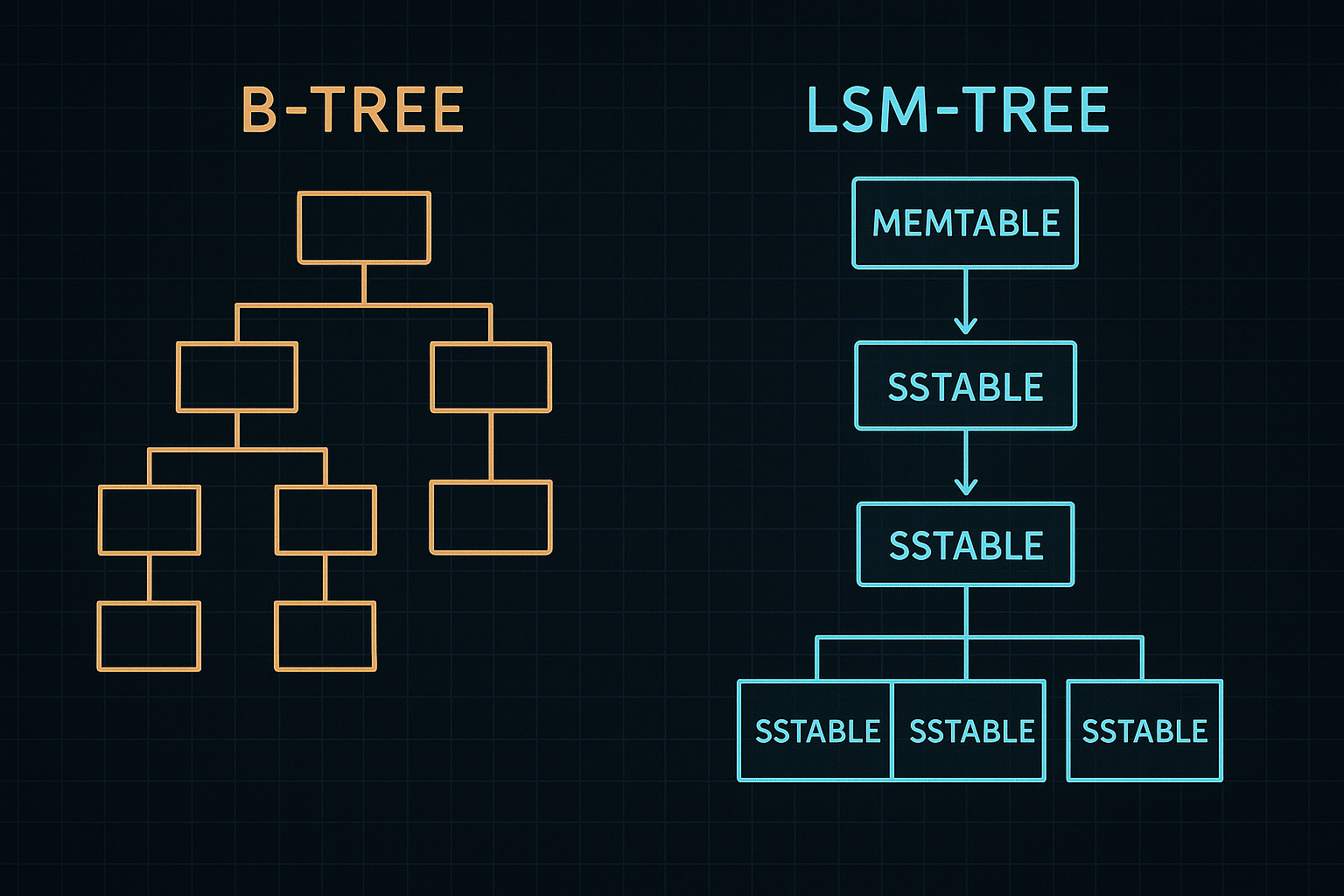
An in-depth exploration of B-Trees and LSM-Trees, the two dominant data structures powering databases from PostgreSQL to RocksDB. Learn their trade-offs, internal mechanics, and when to choose each for your workload.
Every database faces the same fundamental challenge: how do you organize data on disk so that both reads and writes are fast? Two data structures have emerged as the dominant answers—B-Trees and LSM-Trees. Understanding their trade-offs is essential for anyone building or operating data-intensive systems. This post explores both in depth, from their internal mechanics to their real-world implementations.
1. The Storage Engine Problem
Before diving into specific data structures, let’s understand what we’re optimizing for.
1.1 The Read-Write Trade-off
Disk storage has fundamentally different characteristics than memory:
- Sequential access is fast: Reading or writing data in order is 100-1000x faster than random access on HDDs, and still 10x faster on SSDs
- Random access is slow: Seeking to arbitrary locations has high latency
- Writes are especially expensive: SSDs wear out with writes, and HDDs have mechanical seek overhead
This creates a fundamental tension:
- Optimize for reads: Keep data sorted and organized for fast lookups
- Optimize for writes: Append data sequentially to avoid random I/O
No data structure can be optimal for both. B-Trees and LSM-Trees represent different points on this trade-off spectrum.
1.2 Key Operations
Storage engines must support these operations efficiently:
class StorageEngine:
    def put(self, key: bytes, value: bytes) -> None:
        """Insert or update a key-value pair."""
        pass

    def get(self, key: bytes) -> Optional[bytes]:
        """Retrieve the value for a key, or None if not found."""
        pass

    def delete(self, key: bytes) -> None:
        """Remove a key-value pair."""
        pass

    def scan(self, start_key: bytes, end_key: bytes) -> Iterator[Tuple[bytes, bytes]]:
        """Iterate over all key-value pairs in a range."""
        pass
The relative frequency of these operations determines which data structure is optimal.
1.3 Metrics That Matter
When evaluating storage engines:
- Write amplification: How many times is data written to disk for each logical write?
- Read amplification: How many disk reads are needed for each logical read?
- Space amplification: How much extra disk space is used beyond the logical data size?
- Latency distribution: Not just averages, but P99 and P999 latencies
B-Trees and LSM-Trees make different trade-offs across these metrics.
2. B-Trees: The Read-Optimized Classic
B-Trees have powered relational databases for over 50 years. They’re the default choice for PostgreSQL, MySQL InnoDB, SQL Server, and Oracle.
2.1 Structure and Invariants
A B-Tree is a self-balancing tree where:
- Each node contains multiple keys in sorted order
- Internal nodes contain pointers to child nodes
- All leaves are at the same depth
- Nodes are sized to match disk pages (typically 4KB-16KB)
                    [30 | 60]
                   /    |    \
                  /     |     \
          [10|20]    [40|50]   [70|80|90]
          /  |  \    /  |  \    /  |  |  \
        [...] [...] [...] [...] [...] [...]
Key invariants for a B-Tree of order m:
- Each node has at most
mchildren - Each node (except root) has at least
⌈m/2⌉children - The root has at least 2 children (if not a leaf)
- All leaves appear at the same level
2.2 B+ Trees: The Practical Variant
Most databases use B+ Trees, which differ from B-Trees:
- Only leaves contain values: Internal nodes contain only keys and pointers
- Leaves are linked: A doubly-linked list connects all leaves for efficient range scans
- Higher fanout: More keys per internal node means shallower trees
Internal nodes (keys only):
                    [30 | 60]
                   /    |    \
          [10|20]    [40|50]   [70|80|90]

Leaf nodes (keys + values, linked):
[10:v1|20:v2] <-> [30:v3|40:v4|50:v5] <-> [60:v6|70:v7|80:v8|90:v9]
2.3 Point Lookup
Finding a key in a B+ Tree:
def get(self, key):
    node = self.root

    while not node.is_leaf:
        # Binary search within the node
        i = binary_search(node.keys, key)
        node = node.children[i]

    # Binary search in leaf
    i = binary_search(node.keys, key)
    if i < len(node.keys) and node.keys[i] == key:
        return node.values[i]
    return None
With pages sized to match disk blocks, each level requires one disk read. A B+ Tree with 1000 keys per node and 1 billion entries needs only 3 levels—just 3 disk reads for any lookup.
2.4 Insertion
Inserting a key-value pair:
def put(self, key, value):
    # Find the leaf where this key belongs
    leaf, path = self.find_leaf_with_path(key)

    # Insert into leaf
    leaf.insert(key, value)

    # If leaf is too full, split
    if leaf.is_overfull():
        self.split_and_propagate(leaf, path)

def split_and_propagate(self, node, path):
    # Split the node in half
    mid = len(node.keys) // 2
    left_node = node.keys[:mid]
    right_node = node.keys[mid:]
    middle_key = node.keys[mid]

    # Propagate split to parent
    if path:
        parent = path.pop()
        parent.insert_child(middle_key, right_node)

        if parent.is_overfull():
            self.split_and_propagate(parent, path)
    else:
        # Split the root - tree grows taller
        new_root = Node([middle_key], [left_node, right_node])
        self.root = new_root
Splits cascade upward, potentially all the way to the root. The tree grows from the bottom up, maintaining balance.
2.5 Deletion
Deletion is more complex because nodes might become underfull:
def delete(self, key):
    leaf, path = self.find_leaf_with_path(key)
    leaf.remove(key)

    if leaf.is_underfull() and path:
        self.rebalance(leaf, path)

def rebalance(self, node, path):
    parent = path[-1]
    sibling = self.get_sibling(node, parent)

    if sibling.can_lend():
        # Borrow from sibling
        self.redistribute(node, sibling, parent)
    else:
        # Merge with sibling
        merged = self.merge(node, sibling)
        parent.remove_child(node)

        if parent.is_underfull() and len(path) > 1:
            self.rebalance(parent, path[:-1])
2.6 Concurrency Control
B-Trees require careful locking for concurrent access:
Latch crabbing: Hold a latch on the parent while acquiring the child’s latch, then release the parent:
def get_concurrent(self, key):
    node = self.root
    node.acquire_read_latch()

    while not node.is_leaf:
        child_idx = binary_search(node.keys, key)
        child = node.children[child_idx]

        child.acquire_read_latch()
        node.release_read_latch()  # Safe to release parent
        node = child

    result = node.get(key)
    node.release_read_latch()
    return result
Optimistic locking: For writes, optimistically assume no splits will cascade to the root:
def put_optimistic(self, key, value):
    # First, try optimistic path (no root latch)
    leaf, path = self.find_leaf_with_latches(key, write_latch=True)

    leaf.insert(key, value)

    if leaf.is_overfull():
        if self.can_handle_locally(leaf, path):
            self.split_and_propagate(leaf, path)
        else:
            # Restart with pessimistic locking from root
            self.release_all_latches(path)
            self.put_pessimistic(key, value)

    self.release_all_latches(path)
2.7 Write-Ahead Logging
B-Tree modifications must be crash-safe. Write-ahead logging (WAL) ensures durability:
def put_with_wal(self, key, value):
    # 1. Write to WAL first
    log_record = LogRecord(
        type="INSERT",
        key=key,
        value=value,
        page_id=target_page.id,
        old_value=target_page.get(key)
    )
    self.wal.append(log_record)
    self.wal.flush()  # Ensure on disk

    # 2. Modify the page in memory
    target_page.insert(key, value)

    # 3. Eventually write dirty pages to disk (checkpoint)
    # Pages can be written in any order - WAL ensures recoverability
3. LSM-Trees: The Write-Optimized Alternative
Log-Structured Merge-Trees (LSM-Trees) were designed for write-heavy workloads. They power RocksDB, LevelDB, Cassandra, HBase, and many modern databases.
3.1 Core Idea
Instead of modifying data in place, LSM-Trees:
- Buffer writes in memory (memtable)
- Flush full memtables to disk as immutable sorted files (SSTables)
- Periodically merge SSTables in the background (compaction)
Writes → [Memtable] → Flush → [L0 SSTables] → Compact → [L1] → ... → [Ln]

Memory:
┌─────────────────┐
│   Memtable      │  ← All writes go here first
│ (sorted, mutable)│
└─────────────────┘

Disk:
┌─────────────────┐
│   Level 0       │  ← Recently flushed, may overlap
│ SST SST SST     │
├─────────────────┤
│   Level 1       │  ← Compacted, non-overlapping
│ SST SST SST SST │
├─────────────────┤
│   Level 2       │  ← Larger, non-overlapping
│ SST SST SST ... │
└─────────────────┘
3.2 The Memtable
The memtable is an in-memory sorted data structure—typically a skip list or red-black tree:
class Memtable:
    def __init__(self, max_size):
        self.data = SkipList()  # Or RedBlackTree
        self.size = 0
        self.max_size = max_size
        self.wal = WriteAheadLog()

    def put(self, key, value):
        # Write to WAL for durability
        self.wal.append(key, value)

        # Insert into sorted structure
        self.data.insert(key, value)
        self.size += len(key) + len(value)

    def get(self, key):
        return self.data.get(key)

    def is_full(self):
        return self.size >= self.max_size

    def flush_to_sstable(self, path):
        # Write sorted data to disk
        with SSTableWriter(path) as writer:
            for key, value in self.data.iterate():
                writer.write(key, value)

        # Clear WAL after successful flush
        self.wal.truncate()
3.3 SSTables (Sorted String Tables)
SSTables are immutable files containing sorted key-value pairs:
SSTable File Structure:
┌─────────────────────────────────────────┐
│ Data Block 1                            │
│   key1:value1, key2:value2, ...         │
├─────────────────────────────────────────┤
│ Data Block 2                            │
│   key100:value100, key101:value101, ... │
├─────────────────────────────────────────┤
│ ...                                     │
├─────────────────────────────────────────┤
│ Index Block                             │
│   block1_last_key → offset              │
│   block2_last_key → offset              │
├─────────────────────────────────────────┤
│ Bloom Filter                            │
│   (probabilistic membership test)       │
├─────────────────────────────────────────┤
│ Footer (metadata)                       │
└─────────────────────────────────────────┘
Key features:
- Block-based: Data is organized into fixed-size blocks for efficient I/O
- Sparse index: Only boundary keys are indexed, not every key
- Bloom filter: Quickly determine if a key might exist (avoiding disk reads)
- Compression: Blocks are typically compressed (LZ4, Snappy, Zstd)
3.4 Point Lookup
Reading from an LSM-Tree requires checking multiple levels:
class LSMTree:
    def get(self, key):
        # 1. Check memtable first (most recent data)
        value = self.memtable.get(key)
        if value is not None:
            return None if value == TOMBSTONE else value

        # 2. Check immutable memtables (being flushed)
        for imm in reversed(self.immutable_memtables):
            value = imm.get(key)
            if value is not None:
                return None if value == TOMBSTONE else value

        # 3. Check SSTables from newest to oldest
        for level in self.levels:
            for sstable in level.get_candidates(key):
                # Check bloom filter first
                if not sstable.bloom_filter.might_contain(key):
                    continue

                value = sstable.get(key)
                if value is not None:
                    return None if value == TOMBSTONE else value

        return None
This is the read amplification problem: a single lookup might check many SSTables.
3.5 Compaction
Compaction merges SSTables to reduce read amplification and reclaim space:
def compact_level(self, level):
    """Merge SSTables from level L into level L+1."""
    # Select SSTables to compact
    input_sstables = self.select_for_compaction(level)

    # Find overlapping SSTables in next level
    key_range = self.get_key_range(input_sstables)
    target_sstables = self.levels[level + 1].get_overlapping(key_range)

    # Merge-sort all inputs
    merged = MergingIterator(input_sstables + target_sstables)

    # Write new SSTables
    new_sstables = []
    writer = SSTableWriter()

    for key, value in merged:
        # Skip older versions of the same key
        if key == last_key:
            continue

        # Skip tombstones at the bottom level
        if value == TOMBSTONE and level + 1 == self.max_level:
            continue

        writer.write(key, value)

        if writer.size >= self.target_sstable_size:
            new_sstables.append(writer.finish())
            writer = SSTableWriter()

    # Atomically swap old SSTables for new ones
    self.apply_compaction(
        level=level,
        old_sstables=input_sstables + target_sstables,
        new_sstables=new_sstables
    )
3.6 Compaction Strategies
Different strategies trade off write amplification, space amplification, and read performance:
Leveled Compaction (LevelDB, RocksDB default):
- Each level is 10x larger than the previous
- Non-overlapping SSTables within each level (except L0)
- Low space amplification (~1.1x)
- Higher write amplification (10-30x)
L0: [SST] [SST] [SST]     ← Overlapping, recently flushed
L1: [--|--|--]            ← 10MB total, non-overlapping
L2: [--|--|--|--|--|--]   ← 100MB total, non-overlapping
L3: [--|--|--|--|--|...] ← 1GB total, non-overlapping
Size-Tiered Compaction (Cassandra, HBase):
- Group SSTables by size
- Merge SSTables of similar size together
- Lower write amplification (4-8x)
- Higher space amplification (up to 2x)
Tier 1: [small] [small] [small] [small] → merge → [medium]
Tier 2: [medium] [medium] [medium]      → merge → [large]
Tier 3: [large] [large]                 → merge → [huge]
FIFO Compaction:
- Simply delete oldest SSTables
- Useful for time-series data with TTL
Universal Compaction (RocksDB):
- Hybrid approach balancing write and space amplification
- Adapts based on workload characteristics
3.7 Bloom Filters
Bloom filters dramatically reduce read amplification:
class BloomFilter:
    def __init__(self, expected_items, false_positive_rate=0.01):
        # Calculate optimal size and hash count
        self.size = self.optimal_size(expected_items, false_positive_rate)
        self.num_hashes = self.optimal_hashes(self.size, expected_items)
        self.bits = bitarray(self.size)

    def add(self, key):
        for i in range(self.num_hashes):
            idx = self.hash(key, i) % self.size
            self.bits[idx] = 1

    def might_contain(self, key):
        for i in range(self.num_hashes):
            idx = self.hash(key, i) % self.size
            if not self.bits[idx]:
                return False  # Definitely not present
        return True  # Might be present (possible false positive)
With a 1% false positive rate, a bloom filter uses about 10 bits per key. For an SSTable with 1 million keys, the bloom filter is only ~1.2MB—easily cached in memory.
3.8 Deletions and Tombstones
LSM-Trees handle deletions with tombstones—special markers indicating a key is deleted:
def delete(self, key):
    # Write a tombstone marker
    self.put(key, TOMBSTONE)
Tombstones are removed during compaction at the bottom level:
def should_keep_during_compaction(self, key, value, level):
    if value != TOMBSTONE:
        return True

    # Keep tombstones until they reach the bottom level
    # (to shadow older versions in lower levels)
    if level < self.max_level:
        return True

    # At bottom level, tombstone can be removed
    return False
This means deleted data isn’t immediately reclaimed—space is freed only after compaction propagates tombstones to the bottom.
4. B-Trees vs. LSM-Trees: The Trade-offs
4.1 Write Performance
LSM-Trees win for writes:
- Sequential I/O for all writes (memtable flush, compaction)
- Batching amortizes overhead
- Write amplification: 10-30x (leveled) or 4-8x (size-tiered)
B-Trees have higher write cost:
- Random I/O for in-place updates
- Each write modifies a specific page
- Write amplification: ~2x (page + WAL)
However, B-Trees have lower tail latency—no background compaction causing jitter.
4.2 Read Performance
B-Trees win for point reads:
- Guaranteed O(log n) with ~3-4 disk reads for billion-key datasets
- No need to check multiple files
- Consistent, predictable latency
LSM-Trees have higher read cost:
- Must check multiple levels
- Bloom filters help but aren’t perfect
- Read amplification can be 10x+ without careful tuning
4.3 Space Efficiency
LSM-Trees can be more efficient:
- Compression is more effective on sorted, immutable blocks
- No page fragmentation
- But tombstones and multiple versions consume space temporarily
B-Trees have consistent space usage:
- Pages can be partially filled (typically 70-80%)
- No temporary space overhead from compaction
- Fragmentation over time requires rebuilding
4.4 Summary Table
| Metric | B-Tree | LSM-Tree |
|---|---|---|
| Write throughput | Lower | Higher |
| Write latency | Consistent | Variable (compaction) |
| Point read | Faster | Slower |
| Range scan | Fast | Fast |
| Write amplification | ~2x | 10-30x |
| Read amplification | 1x | 1-10x |
| Space amplification | 1.3-1.5x | 1.1-2x |
| Concurrency | Complex | Simpler |
5. Advanced B-Tree Techniques
5.1 Prefix Compression
Many keys share common prefixes. Compress them:
Without compression:
  "user:alice:profile"
  "user:alice:settings"
  "user:bob:profile"

With prefix compression:
  "user:alice:profile"
  [8]"settings"        ← Share 8 bytes with previous key
  [5]"bob:profile"     ← Share 5 bytes with previous key
This can reduce index size by 50% or more for certain key patterns.
5.2 Suffix Truncation
Internal nodes only need enough of the key to distinguish children:
Full keys in leaves:
  "application_server_1"
  "application_server_2"

Truncated separator in internal node:
  "application_server_1" vs "application_server_2"
  Can use just "application_server_2" as separator
  Or even just "2" if context is clear
5.3 Bulk Loading
Building a B-Tree from sorted data is much faster than individual inserts:
def bulk_load(sorted_data, page_size):
    """Build a B-Tree from sorted data, bottom-up."""
    # Create leaf pages
    leaves = []
    current_page = Page()

    for key, value in sorted_data:
        if current_page.is_full():
            leaves.append(current_page)
            current_page = Page()
        current_page.add(key, value)

    if not current_page.is_empty():
        leaves.append(current_page)

    # Link leaves
    for i in range(len(leaves) - 1):
        leaves[i].next = leaves[i + 1]

    # Build internal nodes bottom-up
    current_level = leaves
    while len(current_level) > 1:
        next_level = []
        current_page = InternalPage()

        for page in current_level:
            if current_page.is_full():
                next_level.append(current_page)
                current_page = InternalPage()
            current_page.add_child(page.first_key(), page)

        if not current_page.is_empty():
            next_level.append(current_page)

        current_level = next_level

    return BTree(root=current_level[0])
Bulk loading achieves 100% page fill factor and optimal layout.
5.4 Copy-on-Write B-Trees
Instead of in-place updates, create new pages:
def put_cow(self, key, value):
    """Copy-on-write insertion."""
    path = self.find_path(key)

    # Create new leaf with the update
    new_leaf = path[-1].copy()
    new_leaf.insert(key, value)

    # Propagate new pages up to root
    for i in range(len(path) - 2, -1, -1):
        new_node = path[i].copy()
        new_node.replace_child(path[i + 1], new_pages[-1])
        new_pages.append(new_node)

    # Atomic root pointer swap
    self.root = new_pages[-1]

    # Old pages can be garbage collected
Benefits:
- Crash safety: No torn writes (old tree is always consistent)
- Snapshots: Keep old root for point-in-time reads
- Concurrency: Readers never block writers
Used by LMDB, BoltDB, and some file systems (Btrfs, ZFS).
6. Advanced LSM-Tree Techniques
6.1 Partitioned Indexes
Instead of one global index, partition by key range:
class PartitionedLSM:
    def __init__(self, num_partitions):
        self.partitions = [LSMTree() for _ in range(num_partitions)]

    def get_partition(self, key):
        # Consistent hashing or range-based partitioning
        return self.partitions[hash(key) % len(self.partitions)]

    def put(self, key, value):
        self.get_partition(key).put(key, value)

    def get(self, key):
        return self.get_partition(key).get(key)
Benefits:
- Parallel compaction across partitions
- Better cache locality
- Isolation of hot key ranges
6.2 Tiered + Leveled Hybrid
Combine size-tiered compaction at L0-L1 with leveled compaction below:
L0: [SST] [SST] [SST] [SST]  ← Size-tiered (fast ingestion)
L1: [SST] [SST] [SST]        ← Size-tiered (buffer)
L2: [--|--|--|--|--|--]      ← Leveled (good read performance)
L3: [--|--|--|--|--|...]     ← Leveled
This balances write throughput (size-tiered at top) with read performance (leveled at bottom).
6.3 Remote Compaction
Offload compaction to dedicated servers:
class RemoteCompaction:
    def compact(self, sstables):
        # Upload SSTables to compaction server
        uploaded = self.upload_to_remote(sstables)

        # Request compaction
        job_id = self.compaction_service.submit(uploaded)

        # Wait for result
        result = self.compaction_service.wait(job_id)

        # Download compacted SSTables
        return self.download_result(result)
Benefits:
- Compaction doesn’t consume local CPU/IO
- Better resource isolation
- Scales compaction independently
Used by Neon (Postgres), TiDB, and cloud-native databases.
6.4 Learned Indexes
Replace bloom filters with machine learning models:
class LearnedBloomFilter:
    def __init__(self, keys):
        # Train a model to predict key membership
        self.model = train_classifier(keys)

        # Backup bloom filter for false negatives
        self.backup_bloom = BloomFilter(false_negative_keys)

    def might_contain(self, key):
        if self.model.predict(key) > 0.5:
            return True
        return self.backup_bloom.might_contain(key)
Learned filters can achieve the same false positive rate with less memory—up to 70% savings in some workloads.
7. Hybrid Approaches
7.1 Bw-Tree (Microsoft)
Combines B-Tree structure with log-structured updates:
- Base B-Tree pages are immutable
- Updates are appended as delta records
- Deltas are periodically consolidated
Page 42:
┌─────────────────┐
│  Delta: DEL(k5) │ → ┌─────────────────┐
└─────────────────┘   │  Delta: PUT(k3) │ → ┌─────────────────┐
                      └─────────────────┘   │  Base Page      │
                                            │  k1, k2, k3, k5 │
                                            └─────────────────┘
Benefits:
- No write-ahead log needed (deltas are the log)
- Latch-free operation using CAS
- Used by Microsoft SQL Server Hekaton
7.2 Bε-Trees
Bε-Trees (B-epsilon trees) are a middle ground:
- Like B-Trees, but internal nodes have buffers
- Writes accumulate in buffers and trickle down
- Asymptotically optimal for both reads and writes
Internal node:
┌─────────────────────────────────┐
│ Keys: [30 | 60]                 │
│ Children: [ptr1 | ptr2 | ptr3] │
│ Buffer: [(k15, v15), (k45, v45), (k72, v72)] │
└─────────────────────────────────┘

When buffer fills, flush entries to appropriate children.
Used by TokuDB (Percona), BetrFS.
7.3 COLA (Cache-Oblivious Lookahead Array)
Achieves optimal write performance without knowing cache/memory hierarchy:
- Array of arrays, each double the previous size
- Fractional cascading for efficient searches
- Automatic adaptation to any cache size
8. Choosing the Right Storage Engine
8.1 Workload Analysis
Ask these questions:
- Read/write ratio: >80% reads? B-Tree. Write-heavy? LSM-Tree.
- Key access patterns: Hot keys? Uniform? Time-ordered?
- Latency requirements: Need consistent P99? B-Tree. Can tolerate jitter? LSM-Tree.
- Data size: Fits in memory? Either works. Much larger? Consider compaction I/O.
- Durability requirements: Synchronous writes? Both can do it, but with different trade-offs.
8.2 Decision Matrix
| Workload | Recommended | Reason |
|---|---|---|
| OLTP (transactions) | B-Tree | Consistent latency, point queries |
| Time-series | LSM-Tree | Sequential writes, range scans |
| Analytics | Columnar (not covered) | Aggregations, compression |
| Key-value cache | LSM-Tree | High write throughput |
| Mixed | Depends | Profile your workload |
8.3 Tuning Parameters
For B-Trees:
- Page size: Match filesystem/storage block size
- Fill factor: Trade insert performance for space efficiency
- Checkpoint frequency: Balance durability vs. I/O
For LSM-Trees:
- Memtable size: Larger = fewer flushes, more memory
- Level size ratio: 10x is typical; lower = more levels, less write amplification
- Compaction threads: More parallelism, more I/O contention
- Bloom filter bits per key: 10 bits ≈ 1% false positive
9. Debugging and Monitoring
9.1 Key Metrics
B-Tree:
class BTreeMetrics:
    def report(self):
        return {
            "height": self.tree.height(),
            "total_pages": self.tree.page_count(),
            "fill_factor": self.tree.average_fill_factor(),
            "cache_hit_rate": self.buffer_pool.hit_rate(),
            "checkpoint_lag": self.wal.checkpoint_lag(),
            "page_splits_per_sec": self.split_counter.rate(),
        }
LSM-Tree:
class LSMMetrics:
    def report(self):
        return {
            "memtable_size": self.memtable.size,
            "levels": [len(level.sstables) for level in self.levels],
            "pending_compaction_bytes": self.compaction_queue.total_bytes(),
            "write_stall_duration": self.stall_counter.total_ms(),
            "bloom_filter_useful": self.bloom_useful / self.bloom_checks,
            "read_amplification": self.disk_reads / self.logical_reads,
        }
9.2 Common Problems
B-Tree issues:
- Page splits cascading: Bulk loading sorted data causes worst-case splits
- Lock contention: Hot pages become bottlenecks
- Checkpoint storms: Large buffer pools take long to flush
LSM-Tree issues:
- Write stalls: Compaction can’t keep up with writes
- Space amplification spikes: During compaction, old and new SSTables coexist
- Read amplification: Too many L0 files or missing bloom filters
10. Real-World Implementations
10.1 PostgreSQL (B-Tree)
PostgreSQL’s B-Tree implementation is a masterclass in production engineering:
-- Create a B-Tree index
CREATE INDEX idx_users_email ON users (email);

-- Examine index structure
SELECT * FROM bt_metap('idx_users_email');
-- Returns: magic, version, root, level, fastroot, fastlevel, ...

-- Page-level inspection
SELECT * FROM bt_page_stats('idx_users_email', 1);
-- Returns: blkno, type, live_items, dead_items, avg_item_size, ...
Key implementation details:
- MVCC integration: Index entries point to heap tuples, visibility checked at read time
- HOT updates: Heap-Only Tuples avoid index updates for non-indexed column changes
- Deferred splits: Splits are logged and can be replayed during recovery
- Right-link pointers: Allow lock-free traversal of siblings during splits
10.2 RocksDB (LSM-Tree)
RocksDB is Facebook’s production LSM-Tree, used by TiKV, CockroachDB, and many others:
// Basic RocksDB usage
rocksdb::DB* db;
rocksdb::Options options;
options.create_if_missing = true;
options.write_buffer_size = 64 * 1024 * 1024;  // 64MB memtable
options.max_write_buffer_number = 3;
options.level0_file_num_compaction_trigger = 4;

rocksdb::Status status = rocksdb::DB::Open(options, "/tmp/testdb", &db);

db->Put(rocksdb::WriteOptions(), "key1", "value1");
std::string value;
db->Get(rocksdb::ReadOptions(), "key1", &value);
Key features:
- Column families: Multiple LSM-Trees sharing one WAL
- Prefix bloom filters: Efficient prefix scans
- Rate limiter: Control compaction I/O impact
- Blob storage: Large values stored separately for efficiency
- Transactions: Optimistic and pessimistic transaction support
10.3 WiredTiger (Hybrid)
MongoDB’s WiredTiger combines B-Tree structure with LSM-like techniques:
- Lookaside table: Buffers updates to reduce page churn
- Hazard pointers: Lock-free concurrent access
- Page reconciliation: Converts in-memory pages to on-disk format
- Checkpoint curse prevention: Evicts pages incrementally
# MongoDB WiredTiger statistics
db.serverStatus().wiredTiger.cache
# Returns: bytes currently in cache, tracked dirty bytes, pages read/written
10.4 LMDB (Copy-on-Write B-Tree)
Lightning Memory-Mapped Database uses memory-mapped files with CoW B-Trees:
MDB_env *env;
mdb_env_create(&env);
mdb_env_set_mapsize(env, 10485760);  // 10MB
mdb_env_open(env, "./testdb", 0, 0644);

MDB_txn *txn;
MDB_dbi dbi;
mdb_txn_begin(env, NULL, 0, &txn);
mdb_dbi_open(txn, NULL, 0, &dbi);

MDB_val key = {3, "foo"};
MDB_val value = {3, "bar"};
mdb_put(txn, dbi, &key, &value, 0);
mdb_txn_commit(txn);
Key benefits:
- Zero-copy reads: Direct memory access, no serialization
- Single-writer, multi-reader: Simple concurrency model
- Crash-proof: CoW ensures consistent state at all times
- Small footprint: Minimal runtime dependencies
11. Storage Engine Evolution
11.1 Historical Context
The evolution of storage engines reflects changing hardware and workloads:
1970s-1990s: B-Tree Dominance
- Disk seeks were expensive (10ms)
- Sequential bandwidth was limited
- B-Trees minimized seeks with high fanout
- ISAM, B-Tree variants in mainframe databases
2000s: Log-Structured Renaissance
- SSDs changed the calculus (no seek penalty)
- Write amplification became critical (SSD wear)
- LSM-Trees enabled write-heavy workloads
- BigTable, LevelDB pioneered practical LSM implementations
2010s: Hybrid and Specialized
- Cloud storage added network latency considerations
- Tiered storage (memory, SSD, HDD) required adaptation
- Learned indexes emerged from ML research
- Persistent memory (Intel Optane) blurred memory/storage boundary
2020s: Disaggregated and Cloud-Native
- Compute and storage separation
- Remote compaction offloading
- Object storage as primary persistence
- Serverless databases with pay-per-query
11.2 Emerging Trends
Persistent Memory (PMEM):
Traditional assumptions break down with byte-addressable persistent memory:
// Intel Optane PMEM access
void *pmem_addr = pmem_map_file("/pmem/db", size, ...);
pmem_memcpy_persist(pmem_addr + offset, data, len);
// Data is durable after memcpy returns!
New data structures emerge:
- FAST&FAIR: B-Tree variant for PMEM
- SLM-DB: Single-level merge for PMEM
- FPTree: Fingerprint-based tree for hybrid DRAM/PMEM
GPU-Accelerated Storage:
GPUs can accelerate certain storage operations:
// GPU-accelerated binary search
__global__ void parallel_lookup(Key* keys, int n, Key target, int* result) {
    int tid="blockIdx.x" * blockDim.x + threadIdx.x;
    // Each thread searches a portion
    int left = tid * (n / NUM_THREADS);
    int right = (tid + 1) * (n / NUM_THREADS) - 1;
    // Binary search in assigned range
    ...
}
Programmable Storage (Computational Storage):
Push computation to storage devices:
# Computational storage pseudo-code
def query_on_device(ssd, predicate):
    # Filter runs on SSD controller, not host CPU
    return ssd.execute(
        operation="SCAN",
        filter=predicate,
        projection=["id", "name"]
    )
    # Only matching rows cross the PCIe bus
11.3 The Future of Storage Engines
Several trends will shape storage engines:
- Automatic tuning: ML-based configuration optimization
- Workload-adaptive structures: Data structures that morph based on access patterns
- Cross-layer optimization: Co-designing storage engine, file system, and device firmware
- Sustainable storage: Energy-aware algorithms as data centers face power constraints
- Verified implementations: Formal verification to eliminate subtle bugs
12. Implementing a Minimal Storage Engine
Let’s build a simple LSM-Tree from scratch to solidify understanding:
import os
import json
import struct
from collections import OrderedDict
from typing import Optional, Iterator, Tuple

class Memtable:
    """In-memory sorted buffer using an ordered dictionary."""

    def __init__(self, max_size: int = 1024 * 1024):
        self.data = OrderedDict()
        self.size = 0
        self.max_size = max_size

    def put(self, key: str, value: str) -> None:
        old_size = len(self.data.get(key, "")) + len(key) if key in self.data else 0
        self.data[key] = value
        self.size += len(key) + len(value) - old_size
        # Keep sorted
        self.data = OrderedDict(sorted(self.data.items()))

    def get(self, key: str) -> Optional[str]:
        return self.data.get(key)

    def delete(self, key: str) -> None:
        self.put(key, "__TOMBSTONE__")

    def is_full(self) -> bool:
        return self.size >= self.max_size

    def items(self) -> Iterator[Tuple[str, str]]:
        return iter(self.data.items())


class SSTable:
    """Immutable sorted string table on disk."""

    def __init__(self, path: str):
        self.path = path
        self.index = {}  # Sparse index: first key of each block
        self._load_index()

    @classmethod
    def create(cls, path: str, items: Iterator[Tuple[str, str]]) -> 'SSTable':
        """Create a new SSTable from sorted key-value pairs."""
        with open(path, 'wb') as f:
            for key, value in items:
                # Simple format: key_len (4 bytes), key, value_len (4 bytes), value
                key_bytes = key.encode('utf-8')
                value_bytes = value.encode('utf-8')
                f.write(struct.pack('I', len(key_bytes)))
                f.write(key_bytes)
                f.write(struct.pack('I', len(value_bytes)))
                f.write(value_bytes)

        return cls(path)

    def _load_index(self) -> None:
        """Load sparse index for faster lookups."""
        if not os.path.exists(self.path):
            return

        with open(self.path, 'rb') as f:
            offset = 0
            while True:
                pos = f.tell()
                key_len_bytes = f.read(4)
                if not key_len_bytes:
                    break

                key_len = struct.unpack('I', key_len_bytes)[0]
                key = f.read(key_len).decode('utf-8')
                value_len = struct.unpack('I', f.read(4))[0]
                f.seek(value_len, 1)  # Skip value

                # Index every 100th key for sparse index
                if offset % 100 == 0:
                    self.index[key] = pos
                offset += 1

    def get(self, key: str) -> Optional[str]:
        """Look up a key in the SSTable."""
        # Find starting position using sparse index
        start_pos = 0
        for indexed_key, pos in self.index.items():
            if indexed_key <= key:
                start_pos = pos
            else:
                break

        with open(self.path, 'rb') as f:
            f.seek(start_pos)
            while True:
                key_len_bytes = f.read(4)
                if not key_len_bytes:
                    break

                key_len = struct.unpack('I', key_len_bytes)[0]
                current_key = f.read(key_len).decode('utf-8')
                value_len = struct.unpack('I', f.read(4))[0]
                value = f.read(value_len).decode('utf-8')

                if current_key == key:
                    return None if value == "__TOMBSTONE__" else value
                if current_key > key:
                    break  # Key not found (data is sorted)

        return None

    def items(self) -> Iterator[Tuple[str, str]]:
        """Iterate over all key-value pairs."""
        with open(self.path, 'rb') as f:
            while True:
                key_len_bytes = f.read(4)
                if not key_len_bytes:
                    break

                key_len = struct.unpack('I', key_len_bytes)[0]
                key = f.read(key_len).decode('utf-8')
                value_len = struct.unpack('I', f.read(4))[0]
                value = f.read(value_len).decode('utf-8')

                yield key, value


class SimpleLSM:
    """A minimal LSM-Tree implementation."""

    def __init__(self, directory: str, memtable_size: int = 1024 * 1024):
        self.directory = directory
        os.makedirs(directory, exist_ok=True)

        self.memtable = Memtable(memtable_size)
        self.sstables = []
        self._load_sstables()

    def _load_sstables(self) -> None:
        """Load existing SSTables from disk."""
        for filename in sorted(os.listdir(self.directory)):
            if filename.endswith('.sst'):
                path = os.path.join(self.directory, filename)
                self.sstables.append(SSTable(path))

    def put(self, key: str, value: str) -> None:
        """Insert or update a key-value pair."""
        self.memtable.put(key, value)

        if self.memtable.is_full():
            self._flush()

    def get(self, key: str) -> Optional[str]:
        """Retrieve the value for a key."""
        # Check memtable first (most recent)
        value = self.memtable.get(key)
        if value is not None:
            return None if value == "__TOMBSTONE__" else value

        # Check SSTables from newest to oldest
        for sstable in reversed(self.sstables):
            value = sstable.get(key)
            if value is not None:
                return value

        return None

    def delete(self, key: str) -> None:
        """Delete a key by writing a tombstone."""
        self.memtable.delete(key)

        if self.memtable.is_full():
            self._flush()

    def _flush(self) -> None:
        """Flush memtable to disk as an SSTable."""
        timestamp = len(self.sstables)
        path = os.path.join(self.directory, f"{timestamp:08d}.sst")

        sstable = SSTable.create(path, self.memtable.items())
        self.sstables.append(sstable)

        self.memtable = Memtable(self.memtable.max_size)

    def compact(self) -> None:
        """Merge all SSTables into one (simple full compaction)."""
        if len(self.sstables) <= 1:
            return

        # Merge all SSTables
        merged = {}
        for sstable in self.sstables:
            for key, value in sstable.items():
                merged[key] = value

        # Remove tombstones and sort
        items = sorted(
            ((k, v) for k, v in merged.items() if v != "__TOMBSTONE__"),
            key=lambda x: x[0]
        )

        # Write new SSTable
        new_path = os.path.join(self.directory, "compacted.sst")
        new_sstable = SSTable.create(new_path, iter(items))

        # Remove old SSTables
        for sstable in self.sstables:
            os.remove(sstable.path)

        # Rename compacted file
        final_path = os.path.join(self.directory, "00000000.sst")
        os.rename(new_path, final_path)

        self.sstables = [SSTable(final_path)]


# Usage example
if __name__ == "__main__":
    db = SimpleLSM("/tmp/simple_lsm", memtable_size=1024)

    # Write some data
    for i in range(1000):
        db.put(f"key{i:04d}", f"value{i}")

    # Read it back
    print(db.get("key0042"))  # value42

    # Delete a key
    db.delete("key0042")
    print(db.get("key0042"))  # None

    # Compact
    db.compact()
This implementation demonstrates the core concepts while being readable. Production systems add:
- Write-ahead logging for durability
- Bloom filters for faster negative lookups
- Block-based storage with compression
- Concurrent access support
- Leveled compaction with size thresholds
13. Summary
B-Trees and LSM-Trees represent two fundamental approaches to the storage engine problem:
B-Trees:
- Optimized for reads with O(log n) guaranteed
- In-place updates with write-ahead logging
- Consistent latency, complex concurrency
- Best for read-heavy OLTP workloads
LSM-Trees:
- Optimized for writes with sequential I/O
- Immutable SSTables with background compaction
- Higher write throughput, variable latency
- Best for write-heavy and time-series workloads
Key insights:
- There is no free lunch: Every optimization trades off something else
- Measure your workload: Synthetic benchmarks lie; profile production traffic
- Hybrid approaches exist: Bw-Tree, Bε-Trees, and others blend the best of both
- Tuning matters: Default configurations rarely match your specific needs
- The right choice can change: As your workload evolves, re-evaluate
Understanding these data structures is foundational for anyone working with databases. Whether you’re choosing a database, tuning performance, or building storage systems, this knowledge transforms how you think about data persistence.