
Compiler Optimizations: From Source Code to Fast Machine Code
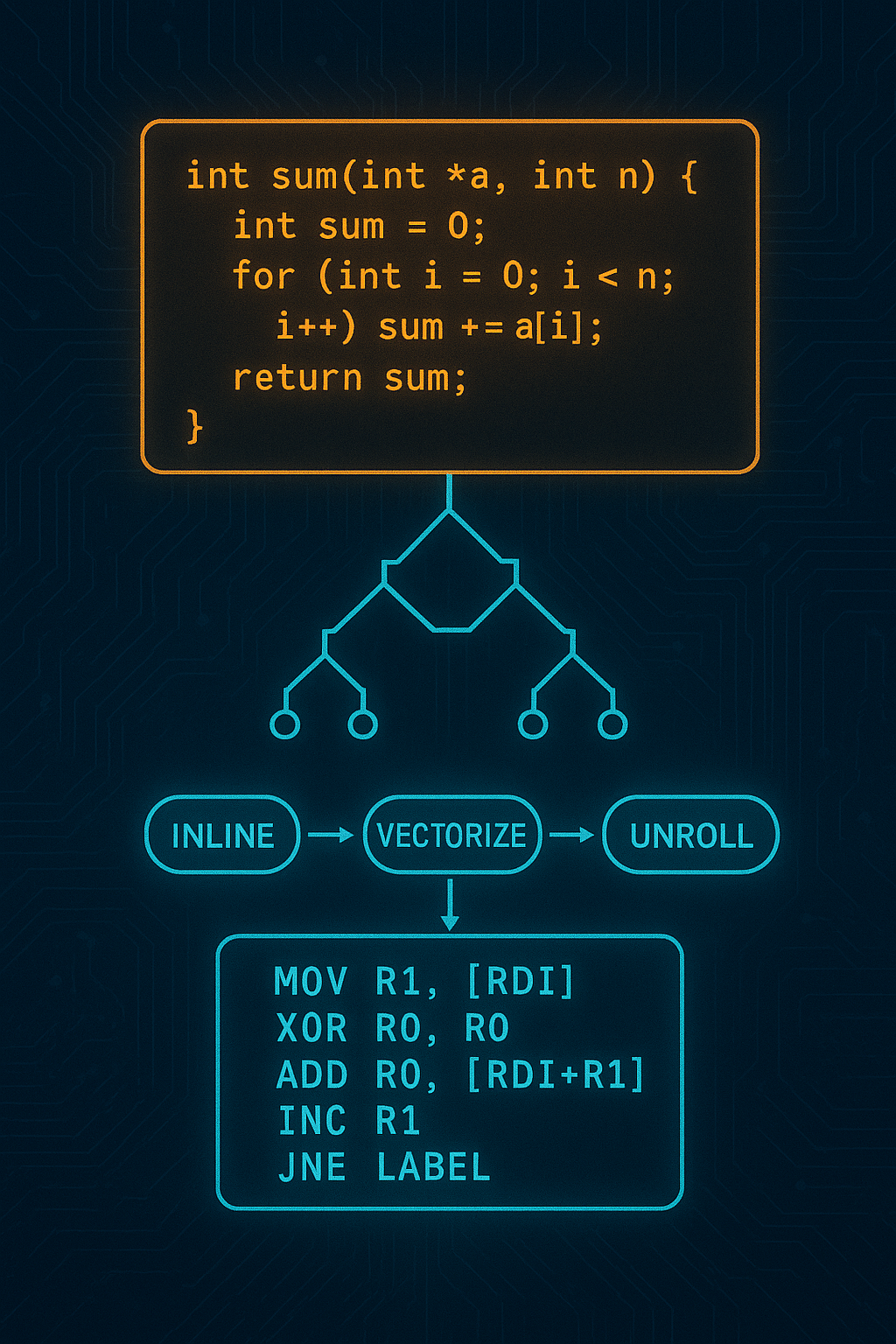
A deep dive into how modern compilers transform your code into efficient machine code. Explore optimization passes from constant folding to loop vectorization, and learn how to write code that compilers can optimize effectively.
When you compile your code with -O2 or -O3, something magical happens. The compiler applies dozens of optimization passes that can make your program run 10x faster—or more. Understanding these optimizations helps you write faster code and debug mysterious performance issues. Let’s explore how modern compilers transform source code into efficient machine code.
1. The Compilation Pipeline
Before diving into optimizations, let’s understand where they happen.
1.1 Compiler Phases
Source Code
    │
    ▼
┌─────────────────┐
│   Front-end     │  Parsing, type checking, AST generation
│  (Language-     │  C, C++, Rust, Swift → IR
│   specific)     │
└────────┬────────┘
         │
         ▼
┌─────────────────┐
│  Middle-end     │  ★ MOST OPTIMIZATIONS HAPPEN HERE ★
│  (IR-based      │  Constant folding, inlining, loop opts
│   optimization) │  Dead code elimination, vectorization
└────────┬────────┘
         │
         ▼
┌─────────────────┐
│   Back-end      │  Instruction selection, register allocation
│  (Target-       │  Instruction scheduling, peephole opts
│   specific)     │
└────────┬────────┘
         │
         ▼
   Machine Code
1.2 Intermediate Representation (IR)
LLVM IR is a popular intermediate representation:
; Source: int square(int x) { return x * x; }

define i32 @square(i32 %x) {
entry:
  %result = mul i32 %x, %x
  ret i32 %result
}
IR enables language-agnostic optimization: the same optimization passes work for C, C++, Rust, Swift, and other LLVM-based languages.
1.3 Optimization Levels
# GCC/Clang optimization levels
-O0  # No optimization (fast compile, slow code)
-O1  # Basic optimizations
-O2  # Most optimizations (production default)
-O3  # Aggressive (may increase code size)
-Os  # Optimize for size
-Ofast  # O3 + unsafe math optimizations

# View applied passes (Clang)
clang -O2 -mllvm -print-pipeline-passes file.c
2. Scalar Optimizations
The simplest optimizations work on individual values and expressions.
2.1 Constant Folding
Evaluate constant expressions at compile time:
// Before
int x = 2 + 3;
int y = 60 * 60 * 24;

// After constant folding
int x = 5;
int y = 86400;
This extends to function calls with constant arguments:
// Before
double pi_squared = pow(3.14159, 2);

// After (with -O2)
double pi_squared = 9.869587728099999;
2.2 Constant Propagation
Substitute known constant values:
// Before
int a = 5;
int b = a + 3;
int c = b * 2;

// After constant propagation
int a = 5;
int b = 8;    // 5 + 3
int c = 16;   // 8 * 2
2.3 Dead Code Elimination
Remove code that doesn’t affect output:
// Before
int compute(int x) {
    int unused = x * x * x;  // Never used
    int result = x * 2;
    return result;
}

// After DCE
int compute(int x) {
    return x * 2;
}
2.4 Common Subexpression Elimination (CSE)
Compute repeated expressions once:
// Before
double distance = sqrt(x*x + y*y);
double normalized_x = x / sqrt(x*x + y*y);
double normalized_y = y / sqrt(x*x + y*y);

// After CSE
double temp = sqrt(x*x + y*y);
double distance = temp;
double normalized_x = x / temp;
double normalized_y = y / temp;
2.5 Strength Reduction
Replace expensive operations with cheaper equivalents:
// Before
int y = x * 2;
int z = x * 8;
int w = x / 4;
int v = x % 8;

// After strength reduction
int y = x << 1;      // Shift instead of multiply
int z = x << 3;      // Shift instead of multiply
int w = x >> 2;      // Shift instead of divide (for positive x)
int v = x & 7;       // AND instead of modulo (for power of 2)
2.6 Algebraic Simplification
Apply mathematical identities:
// Before
int a = x + 0;
int b = x * 1;
int c = x * 0;
int d = x - x;
int e = x | 0;
int f = x & x;

// After simplification
int a = x;
int b = x;
int c = 0;
int d = 0;
int e = x;
int f = x;
3. Control Flow Optimizations
Optimizations that restructure how code executes.
3.1 Inlining
Replace function calls with function body:
// Before
static inline int square(int x) { return x * x; }

int compute(int a, int b) {
    return square(a) + square(b);
}

// After inlining
int compute(int a, int b) {
    return a * a + b * b;
}
Inlining eliminates:
- Function call overhead
- Argument passing
- Return handling
- Enables further optimizations
// Inlining enables more optimization
int process(int x) {
    if (x > 0) {
        return abs(x);  // abs() inlined
    }
    return 0;
}

// After inlining + simplification
int process(int x) {
    if (x > 0) {
        return x;  // We know x > 0, so abs(x) = x
    }
    return 0;
}
3.2 Tail Call Optimization
Convert tail recursion to iteration:
// Before (recursive)
int factorial(int n, int acc) {
    if (n <= 1) return acc;
    return factorial(n - 1, n * acc);  // Tail call
}

// After TCO (effectively)
int factorial(int n, int acc) {
    while (n > 1) {
        acc = n * acc;
        n = n - 1;
    }
    return acc;
}
This prevents stack overflow and improves performance.
3.3 Branch Elimination
Remove branches with known outcomes:
// Before
void process(int *ptr) {
    if (ptr == NULL) {
        // Handle null
    } else {
        *ptr = 42;
    }

    if (ptr != NULL) {  // Redundant check
        printf("%d\n", *ptr);
    }
}

// After branch elimination (in else branch context)
void process(int *ptr) {
    if (ptr == NULL) {
        // Handle null
    } else {
        *ptr = 42;
        printf("%d\n", *ptr);  // We know ptr != NULL
    }
}
3.4 Loop-Invariant Code Motion
Move computations out of loops:
// Before
for (int i = 0; i < n; i++) {
    result[i] = data[i] * (a + b) / c;
}

// After LICM
int temp = (a + b) / c;  // Moved out of loop
for (int i = 0; i < n; i++) {
    result[i] = data[i] * temp;
}
3.5 Jump Threading
Eliminate unnecessary jumps:
// Before
if (x > 0) {
    flag = true;
}
if (flag) {  // Redundant when x > 0
    do_something();
}

// After jump threading (when x > 0)
if (x > 0) {
    flag = true;
    do_something();  // Directly threaded
}
if (flag && x <= 0) {  // Only check when needed
    do_something();
}
4. Loop Optimizations
Loops are where programs spend most of their time, so they receive special attention.
4.1 Loop Unrolling
Execute multiple iterations per loop:
// Before
for (int i = 0; i < 100; i++) {
    sum += array[i];
}

// After unrolling (factor of 4)
for (int i = 0; i < 100; i += 4) {
    sum += array[i];
    sum += array[i + 1];
    sum += array[i + 2];
    sum += array[i + 3];
}
Benefits:
- Fewer branch instructions
- Better instruction-level parallelism
- Enables more CSE opportunities
4.2 Loop Fusion
Combine adjacent loops:
// Before
for (int i = 0; i < n; i++) {
    a[i] = b[i] + 1;
}
for (int i = 0; i < n; i++) {
    c[i] = a[i] * 2;
}

// After fusion
for (int i = 0; i < n; i++) {
    a[i] = b[i] + 1;
    c[i] = a[i] * 2;  // Better cache locality
}
4.3 Loop Fission (Distribution)
Split a loop into multiple loops:
// Before (poor vectorization due to dependency)
for (int i = 0; i < n; i++) {
    a[i] = b[i] + 1;      // Can vectorize
    c[i] = c[i-1] * 2;    // Cannot vectorize (dependency)
}

// After fission
for (int i = 0; i < n; i++) {
    a[i] = b[i] + 1;      // Now vectorizable
}
for (int i = 0; i < n; i++) {
    c[i] = c[i-1] * 2;    // Sequential
}
4.4 Loop Interchange
Swap nested loop order for better memory access:
// Before (poor cache behavior - column-major access)
for (int j = 0; j < N; j++) {
    for (int i = 0; i < M; i++) {
        sum += matrix[i][j];  // Strided access
    }
}

// After interchange (row-major access)
for (int i = 0; i < M; i++) {
    for (int j = 0; j < N; j++) {
        sum += matrix[i][j];  // Sequential access
    }
}
4.5 Loop Vectorization
Use SIMD instructions to process multiple elements:
// Before
for (int i = 0; i < n; i++) {
    c[i] = a[i] + b[i];
}

// After vectorization (conceptually)
for (int i = 0; i < n; i += 8) {  // Process 8 floats at once
    __m256 va = _mm256_load_ps(&a[i]);
    __m256 vb = _mm256_load_ps(&b[i]);
    __m256 vc = _mm256_add_ps(va, vb);
    _mm256_store_ps(&c[i], vc);
}
Modern compilers auto-vectorize when possible:
# Enable vectorization reports
clang -O2 -Rpass=loop-vectorize file.c
gcc -O2 -fopt-info-vec-optimized file.c
4.6 Loop Tiling (Blocking)
Improve cache utilization for nested loops:
// Before (matrix multiply - poor cache use)
for (int i = 0; i < N; i++) {
    for (int j = 0; j < N; j++) {
        for (int k = 0; k < N; k++) {
            C[i][j] += A[i][k] * B[k][j];
        }
    }
}

// After tiling (64x64 blocks fit in L1 cache)
#define TILE 64
for (int ii = 0; ii < N; ii += TILE) {
    for (int jj = 0; jj < N; jj += TILE) {
        for (int kk = 0; kk < N; kk += TILE) {
            for (int i = ii; i < ii + TILE; i++) {
                for (int j = jj; j < jj + TILE; j++) {
                    for (int k = kk; k < kk + TILE; k++) {
                        C[i][j] += A[i][k] * B[k][j];
                    }
                }
            }
        }
    }
}
5. Memory Optimizations
Optimizations targeting memory access patterns.
5.1 Scalar Replacement of Aggregates (SROA)
Break structs into individual variables:
// Before
struct Point { int x, y; };

int distance_squared(struct Point p) {
    return p.x * p.x + p.y * p.y;
}

// After SROA (at call site)
int distance_squared(int p_x, int p_y) {
    return p_x * p_x + p_y * p_y;
}
This enables register allocation for struct members.
5.2 Memory to Register Promotion
Keep variables in registers instead of memory:
// Before (conceptual C, showing memory operations)
void compute(int *result) {
    int temp;            // On stack
    temp = 5;            // Store to memory
    temp = temp + 3;     // Load, add, store
    *result = temp * 2;  // Load, multiply, store
}

// After mem2reg
void compute(int *result) {
    int temp = 5;        // In register
    temp = temp + 3;     // Register operation
    *result = temp * 2;  // Single store
}
5.3 Load/Store Elimination
Remove redundant memory operations:
// Before
void update(int *ptr) {
    *ptr = 10;       // Store
    int x = *ptr;    // Load (redundant - we just stored 10)
    *ptr = x + 1;    // Store
}

// After elimination
void update(int *ptr) {
    *ptr = 11;       // Single store
}
5.4 Alias Analysis
Determine if pointers can refer to the same memory:
// Can these be optimized?
void compute(int *a, int *b, int *c) {
    *a = *b + *c;
    *a = *b + *c;  // Redundant if a doesn't alias b or c
}

// With restrict keyword (C99)
void compute(int *restrict a, int *restrict b, int *restrict c) {
    *a = *b + *c;  // Compiler knows a, b, c don't overlap
    // Second assignment definitely redundant
}
5.5 Prefetching
Insert prefetch instructions for predictable access:
// Compiler may insert prefetches for:
for (int i = 0; i < n; i++) {
    // __builtin_prefetch(&data[i + 16]);  // Implicit
    sum += data[i];
}
6. Interprocedural Optimizations
Optimizations across function boundaries.
6.1 Link-Time Optimization (LTO)
Optimize across compilation units:
# Compile with LTO
clang -O2 -flto file1.c file2.c -o program

# Benefits:
# - Cross-file inlining
# - Whole-program dead code elimination
# - Better alias analysis
6.2 Interprocedural Constant Propagation
Propagate constants across functions:
// file1.c
int get_multiplier() { return 4; }

// file2.c
int scale(int x) {
    return x * get_multiplier();
}

// After IPCP with LTO
int scale(int x) {
    return x * 4;  // Or: x << 2
}
6.3 Devirtualization
Replace virtual calls with direct calls:
// Before
class Base { virtual void foo() = 0; };
class Derived : public Base { void foo() override { /*...*/ } };

void call_foo(Base* b) {
    b->foo();  // Virtual call through vtable
}

// After devirtualization (when type is known)
void call_foo(Derived* d) {
    d->Derived::foo();  // Direct call
}
6.4 Function Cloning
Create specialized versions for specific call sites:
// Original
void process(int *data, int n, bool reverse) {
    if (reverse) {
        for (int i = n-1; i >= 0; i--) process_item(data[i]);
    } else {
        for (int i = 0; i < n; i++) process_item(data[i]);
    }
}

// After cloning
void process_forward(int *data, int n) {
    for (int i = 0; i < n; i++) process_item(data[i]);
}
void process_reverse(int *data, int n) {
    for (int i = n-1; i >= 0; i--) process_item(data[i]);
}
// Call site uses appropriate clone based on known value
7. Target-Specific Optimizations
Optimizations that depend on the target architecture.
7.1 Instruction Selection
Choose optimal instructions for the target:
// Source
int count_ones(unsigned int x) {
    int count = 0;
    while (x) {
        count += x & 1;
        x >>= 1;
    }
    return count;
}

// On x86 with POPCNT support
int count_ones(unsigned int x) {
    return __builtin_popcount(x);  // Single instruction
}
7.2 Register Allocation
Assign variables to physical registers:
Virtual registers:       Physical registers (x86-64):
v1 = load a              rax = load a
v2 = load b              rbx = load b
v3 = v1 + v2             rcx = rax + rbx
v4 = v3 * v1             rcx = rcx * rax
store v4 → result        store rcx → result
Register pressure can force spills to memory, impacting performance.
7.3 Instruction Scheduling
Reorder instructions to hide latency:
; Before (stalls waiting for load)
mov rax, [ptr1]      ; Load (latency: 4 cycles)
add rax, 1           ; Must wait for load
mov rbx, [ptr2]      ; Load
add rbx, 2           ; Must wait for load

; After scheduling (overlap latencies)
mov rax, [ptr1]      ; Start load 1
mov rbx, [ptr2]      ; Start load 2 (parallel)
add rax, 1           ; Load 1 ready by now
add rbx, 2           ; Load 2 ready by now
7.4 SIMD Instruction Selection
Choose appropriate vector instructions:
// Compiler chooses based on target
float sum = a + b;  // scalar: addss
                    // SSE: addps (4 floats)
                    // AVX: vaddps (8 floats)
                    // AVX-512: vaddps (16 floats)
# Target specific architectures
clang -march=skylake file.c      # Use Skylake instructions
clang -march=native file.c       # Use current CPU's features
clang -mavx2 -mfma file.c        # Enable specific extensions
8. Profile-Guided Optimization (PGO)
Use runtime data to guide optimization decisions.
8.1 How PGO Works
# Step 1: Build instrumented binary
clang -O2 -fprofile-generate file.c -o program_instrumented

# Step 2: Run with representative workload
./program_instrumented < typical_input.txt

# Step 3: Build optimized binary using profile
clang -O2 -fprofile-use=default.profdata file.c -o program_optimized
8.2 PGO Benefits
// Without PGO: compiler guesses
if (rarely_true) {     // Compiler assumes 50/50
    cold_path();
} else {
    hot_path();
}

// With PGO: compiler knows actual frequencies
if (rarely_true) {     // Profile shows 0.1% taken
    cold_path();       // Moved to separate cache line
} else {
    hot_path();        // Inlined, optimized aggressively
}
PGO improves:
- Branch prediction hints
- Function inlining decisions
- Basic block layout
- Register allocation priorities
8.3 Feedback-Directed Optimization
Modern PGO uses sampling for low overhead:
# AutoFDO with Linux perf
perf record -b ./program  # Sample branches
create_llvm_prof --binary=./program --profile=perf.data --out=program.afdo
clang -O2 -fprofile-sample-use=program.afdo file.c
9. Writing Optimizer-Friendly Code
Help the compiler help you.
9.1 Use const and restrict
// Help alias analysis
void add_arrays(
    float *restrict result,    // result doesn't alias others
    const float *restrict a,   // a is read-only
    const float *restrict b,   // b is read-only
    int n
) {
    for (int i = 0; i < n; i++) {
        result[i] = a[i] + b[i];
    }
}
// Enables vectorization without runtime alias checks
9.2 Prefer Local Variables
// Harder to optimize (could alias through ptr)
void bad(int *ptr) {
    for (int i = 0; i < 100; i++) {
        *ptr += i;
    }
}

// Easier to optimize
void good(int *ptr) {
    int sum = *ptr;  // Load once
    for (int i = 0; i < 100; i++) {
        sum += i;    // Register operation
    }
    *ptr = sum;      // Store once
}
9.3 Avoid Pointer Aliasing
// May not vectorize (a and b might overlap)
void copy_bad(int *a, int *b, int n) {
    for (int i = 0; i < n; i++) {
        a[i] = b[i] * 2;
    }
}

// Will vectorize
void copy_good(int *restrict a, int *restrict b, int n) {
    for (int i = 0; i < n; i++) {
        a[i] = b[i] * 2;
    }
}
9.4 Use Appropriate Types
// size_t for array indexing
void sum(int *arr, size_t n) {
    int sum = 0;
    for (size_t i = 0; i < n; i++) {  // No sign extension needed
        sum += arr[i];
    }
}

// Appropriate width for data
void process(uint8_t *data, int n) {  // 8-bit data
    for (int i = 0; i < n; i++) {
        data[i] = data[i] >> 1;
    }
}
9.5 Structure Data for Vectorization
// Array of Structures (AoS) - harder to vectorize
struct Particle { float x, y, z, mass; };
struct Particle particles[N];

// Structure of Arrays (SoA) - easier to vectorize
struct Particles {
    float x[N], y[N], z[N], mass[N];
};
9.6 Mark Unlikely Branches
#define unlikely(x) __builtin_expect(!!(x), 0)
#define likely(x)   __builtin_expect(!!(x), 1)

void process(int *data) {
    if (unlikely(data == NULL)) {
        handle_error();
        return;
    }
    // Hot path continues here
}
10. Debugging Compiler Optimizations
When optimizations cause problems or you want to understand what’s happening.
10.1 Viewing Optimization Passes
# LLVM: print all optimization passes
clang -O2 -mllvm -debug-pass=Arguments file.c

# GCC: dump optimization info
gcc -O2 -fdump-tree-all -fdump-rtl-all file.c

# View generated assembly
clang -O2 -S -fverbose-asm file.c -o file.s

# Compare optimization levels
diff <(clang -O0 -S file.c -o -) <(clang -O2 -S file.c -o -)
10.2 Optimization Reports
# Clang optimization remarks
clang -O2 -Rpass=inline -Rpass-missed=inline file.c
clang -O2 -Rpass=loop-vectorize file.c

# GCC optimization info
gcc -O2 -fopt-info-vec-all file.c
gcc -O2 -fopt-info-inline-all file.c
10.3 Online Tools
Compiler Explorer (godbolt.org) is invaluable:
Features:
- Compare compilers and versions
- View assembly in real-time
- Diff different optimization levels
- See which source maps to which assembly
10.4 Preventing Optimization (for debugging)
// Prevent optimization of a variable
volatile int keep = result;

// Memory barrier (prevent reordering)
asm volatile("" ::: "memory");

// Prevent function inlining
__attribute__((noinline)) void debug_function() { ... }

// Prevent all optimizations for a function
__attribute__((optnone)) void debug_function() { ... }  // Clang
__attribute__((optimize("O0"))) void debug_function() { ... }  // GCC
11. Advanced Topics
11.1 Polyhedral Optimization
For complex loop nests, polyhedral compilation can find optimal transformations:
// Complex loop nest
for (int i = 0; i < N; i++)
    for (int j = 0; j < M; j++)
        for (int k = 0; k < K; k++)
            C[i][j] += A[i][k] * B[k][j];

// Polyhedral model represents as:
// { [i,j,k] : 0 <= i < N ∧ 0 <= j < M ∧ 0 <= k < K }
// Can automatically derive tiling, interchange, etc.
Tools like PLUTO and Polly (LLVM) use this approach.
11.2 Auto-Parallelization
Compilers can automatically parallelize some loops:
// With OpenMP
#pragma omp parallel for
for (int i = 0; i < n; i++) {
    c[i] = a[i] + b[i];
}

// Auto-parallelization (GCC)
// gcc -O2 -ftree-parallelize-loops=4 file.c
11.3 Sanitizer-Aware Optimization
Compilers adjust optimizations when sanitizers are enabled:
# AddressSanitizer reduces some optimizations
clang -O2 -fsanitize=address file.c

# UndefinedBehaviorSanitizer affects transformations
clang -O2 -fsanitize=undefined file.c
Some optimizations are disabled because they would mask bugs.
11.4 Whole-Program Optimization Challenges
Challenges:
- Compilation time scales with program size
- Memory usage can be extreme
- Incremental rebuilds are slow
- Debug info generation is complex

Mitigations:
- ThinLTO: scalable LTO with summary-based approach
- Distributed LTO: parallelize across machines
- Incremental LTO: cache and reuse work
12. The Evolution of Compiler Optimizations
12.1 Historical Perspective
1950s: First optimizing compilers (FORTRAN)
1970s: SSA form, dataflow analysis
1980s: Interprocedural optimization
1990s: Profile-guided optimization, SPEC benchmarks
2000s: JIT compilation, LLVM emergence
2010s: Auto-vectorization, polyhedral optimization
2020s: ML-guided optimization, domain-specific compilation
12.2 Modern Trends
Machine Learning for Compilation:
# ML can learn optimization heuristics
# Instead of hand-tuned rules:
if loop_size > 100 and estimated_benefit > threshold:
    inline()

# Learn from data:
inline_probability = ml_model.predict(loop_features)
if inline_probability > 0.7:
    inline()
Domain-Specific Compilers:
TensorFlow XLA:   ML computation graphs → optimized GPU/TPU code
Halide:           Image processing → optimized parallel code
MLIR:             Multi-level IR for domain-specific optimization
12.3 Compiler Correctness
Optimizations must preserve semantics:
// This transformation is WRONG
// Before: x - 1 > y
// After:  x > y + 1  (incorrect if y + 1 overflows!)

// Compilers use formal verification and extensive testing
// - Translation validation
- Random testing (Csmith)
// - Differential testing across compilers
13. Real-World Optimization Stories
13.1 The Famous Bounds Check Elimination
In a tight loop processing array elements, bounds checking can be expensive:
// Java-style array access with bounds checks
for (int i = 0; i < array.length; i++) {
    sum += array[i];  // Implicit bounds check every iteration
}
Modern JIT compilers (HotSpot, V8) recognize this pattern and eliminate redundant checks:
Analysis:
- Loop bounds: 0 to array.length
- Array index: i
- Since 0 <= i < array.length, bounds check always passes
- Hoist check outside loop or eliminate entirely
This optimization can provide 2-3x speedups in array-heavy code.
13.2 String Interning Gone Wrong
A production system exhibited puzzling performance characteristics:
// Original code
for (String s : data) {
    if (s.equals("ACTIVE")) {
        activeCount++;
    }
}
After profiling, the team discovered the JIT compiler wasn’t optimizing equals() as expected. The solution was explicit string interning:
private static final String ACTIVE = "ACTIVE".intern();

for (String s : data) {
    if (s == ACTIVE) {  // Reference comparison after interning
        activeCount++;
    }
}
The lesson: understanding optimization limitations helps find workarounds.
13.3 Auto-Vectorization Failures
A team optimized image processing code expecting auto-vectorization:
void brighten(uint8_t *pixels, int n, int amount) {
    for (int i = 0; i < n; i++) {
        int val = pixels[i] + amount;
        pixels[i] = val > 255 ? 255 : val;  // Saturation
    }
}
Checking compiler output revealed no vectorization. The issue was the saturation check creating control flow. The fix used intrinsics:
void brighten(uint8_t *pixels, int n, int amount) {
    __m128i vamount = _mm_set1_epi16(amount);
    for (int i = 0; i < n; i += 16) {
        __m128i vpix = _mm_loadu_si128((__m128i*)&pixels[i]);
        // ... SIMD saturation arithmetic
    }
}
13.4 The Inlining Cliff
A performance regression appeared after a “minor” code change:
// Before: 15 lines, always inlined
int fastPath(Data& d) {
    // Simple computation
    return d.x + d.y * d.z;
}

// After: 52 lines, not inlined
int fastPath(Data& d) {
    // Added validation, logging
    if (!d.valid) { log("invalid"); return -1; }
    // ... more code ...
    return d.x + d.y * d.z;
}
The function exceeded the inlining threshold, causing a 3x slowdown in the hot loop that called it. Solution: split into fast path (inlined) and slow path (not inlined).
inline int fastPath(Data& d) {
    if (__builtin_expect(!d.valid, 0)) {
        return slowPath(d);  // Outlined error handling
    }
    return d.x + d.y * d.z;
}
13.5 LTO Unlocks Cross-Module Inlining
A microservices framework showed surprising speedups with LTO:
Before LTO:
- Each module compiled separately
- Interface calls go through function pointers
- Virtual dispatch for polymorphism
- 15% CPU in call overhead

After LTO:
- Whole-program visibility
- Devirtualization of common patterns
- Cross-module inlining
- Call overhead reduced to 2%

Result: 18% overall performance improvement
The key insight: modular code design doesn’t mean modular compilation.
14. Compiler Optimization Pitfalls
14.1 Undefined Behavior Exploitation
Compilers exploit undefined behavior aggressively:
int foo(int x) {
    if (x + 1 > x) {
        return 1;
    }
    return 0;
}

// Optimized to (assuming signed overflow is UB):
int foo(int x) {
    return 1;  // Always true if no overflow
}
This can remove security checks:
void vulnerable(char *buf, int len) {
    if (len > MAX_LEN) return;  // Bounds check
    if (len < 0) return;        // Negativity check

    // len + HEADER_SIZE might overflow!
    char *p = malloc(len + HEADER_SIZE);
    // Compiler might optimize assuming no overflow
}
14.2 Floating-Point Optimization Dangers
// -ffast-math can change results
float sum = 0;
for (int i = 0; i < n; i++) {
    sum += data[i];
}

// With -ffast-math, compiler might reorder:
// (a + b) + c != a + (b + c) in floating point!
// This can cause reproducibility issues
Guidelines for floating-point:
- Use
-ffast-mathonly when precision isn’t critical - Consider
-ffp-contract=fastfor FMA without full fast-math - Test numerical stability after enabling optimizations
14.3 Memory Model Violations
Optimizers assume single-threaded execution unless told otherwise:
// Broken without synchronization
int flag = 0;
int data = 0;

void producer() {
    data = 42;      // Might be reordered after flag
    flag = 1;
}

void consumer() {
    while (flag == 0);  // Might be optimized to if (flag == 0) while(1);
    use(data);
}
The fix requires proper atomics or volatile:
#include <stdatomic.h>

atomic_int flag = 0;
int data = 0;

void producer() {
    data = 42;
    atomic_store_explicit(&flag, 1, memory_order_release);
}

void consumer() {
    while (atomic_load_explicit(&flag, memory_order_acquire) == 0);
    use(data);
}
14.4 Debug vs Release Differences
Code that works in debug can break in release:
// Uninitialized in release, zero in debug
int compute() {
    int result;  // Uninitialized
    // Forgot assignment on some path
    return result;  // UB in release, often 0 in debug
}

// Order-of-evaluation issues
map[key] = process(map[key]);
// Debug: predictable order
// Release: order undefined, map might rehash
14.5 The Observer Effect
Measuring performance can change it:
void hot_function() {
    // Very tight loop
    for (int i = 0; i < 1000000; i++) {
        result += data[i];
    }
}

// Adding timing code:
void hot_function() {
    auto start = now();  // Prevents some optimizations
    for (int i = 0; i < 1000000; i++) {
        result += data[i];
    }
    auto end = now();
    log(end - start);  // Side effect changes optimization
}
Solutions include:
- Use sampling profilers (perf, VTune)
- Profile release builds
- Minimize instrumentation
15. The Future of Compiler Optimization
15.1 Machine Learning Integration
Modern compilers are beginning to incorporate ML:
Traditional approach:
- Hand-tuned heuristics
- if (loop_count > 100 && benefit > cost) inline()
- Requires expert knowledge, often suboptimal

ML approach:
- Learn from millions of programs
- Predict optimal decisions
- Adapt to new architectures automatically

Research examples:
- Google's ML inlining for LLVM
- Microsoft's learning-based register allocation
- Intel's ML-guided code generation
15.2 Domain-Specific Compilation
Specialized compilers for specific domains:
# TensorFlow XLA compiles computation graphs
@tf.function(jit_compile=True)
def model(x):
    return tf.matmul(x, w) + b

# XLA optimizations:
# - Fuse operations (matmul + add → single kernel)
# - Optimize memory layout for hardware
# - Generate code for GPU/TPU
Similar patterns exist for:
- Image processing (Halide)
- Database queries (query compilers)
- Cryptography (specialized constant-time compilation)
15.3 Hardware-Software Co-Design
As hardware becomes more specialized, compilers adapt:
Modern challenges:
- Heterogeneous systems (CPU + GPU + TPU + FPGA)
- Memory hierarchies (L1/L2/L3/HBM/DRAM/SSD)
- Power constraints (frequency scaling, dark silicon)

Compiler responses:
- Unified IR across accelerators (MLIR)
- Automatic data placement and movement
- Power-aware optimization passes
15.4 Security-Focused Compilation
Compilers increasingly target security:
// Stack canaries
void vulnerable() {
    char buffer[64];
    // Compiler inserts: canary = random_value
    gets(buffer);
    // Compiler inserts: if (canary != expected) abort()
}

// Control-Flow Integrity
void call_function(void (*fptr)()) {
    // Compiler inserts: verify fptr in allowed targets
    fptr();
}
Emerging techniques:
- Pointer authentication (ARM PA)
- Shadow stacks
- Memory tagging (MTE)
15.5 Verified Compilation
Ensuring optimizations preserve correctness:
CompCert: Formally verified C compiler
- Mathematical proof of correctness
- Guarantees: compiled code behaves like source
- Used in safety-critical domains (aviation, medical)

Challenges:
- Verification effort is substantial
- Performance gap with production compilers
- Limited optimization scope

Future: combining formal methods with aggressive optimization
16. Summary
Modern compilers apply sophisticated transformations to make code fast:
Scalar optimizations:
- Constant folding and propagation
- Dead code elimination
- Common subexpression elimination
- Strength reduction
Control flow optimizations:
- Function inlining
- Branch elimination
- Tail call optimization
Loop optimizations:
- Unrolling and vectorization
- Fusion, fission, and interchange
- Loop-invariant code motion
- Tiling for cache
Memory optimizations:
- Register promotion
- Load/store elimination
- Alias analysis
Interprocedural optimizations:
- Link-time optimization
- Devirtualization
- Cross-module inlining
Target-specific optimizations:
- Instruction selection
- Register allocation
- SIMD vectorization
Key takeaways:
- Trust the compiler: Modern compilers are remarkably good
- Write clear code: Let the compiler optimize; focus on readability
- Help when needed: Use restrict, const, and hints judiciously
- Profile first: Don’t optimize blindly; measure
- Understand limits: Some optimizations need source-level changes
Understanding compiler optimizations makes you a better programmer. You’ll write code that compilers can optimize effectively, diagnose performance issues more quickly, and appreciate the incredible engineering in modern compilation systems.