
Hypervisor Internals: VT-x, AMD-V/SVM, Nested Paging, and the Mechanics of Trap-and-Emulate
A deep exploration of hardware virtualization support — how Intel VT-x and AMD-V enable efficient hypervisors through VM control structures, nested paging, and the clever elimination of slow trap-and-emulate paths.
Contents
In 2005, Intel dropped a bombshell on the systems community. The Pentium 4 “Prescott” processor shipped with a new set of instruction set extensions called VT-x — Vanderpool Technology for the x86 architecture, later branded as Intel Virtualization Technology. For the first time, x86 had hardware support for running unmodified guest operating systems under the control of a hypervisor. AMD followed in 2006 with AMD-V (SVM, Secure Virtual Machine). Before VT-x, x86 virtualization was a heroic exercise in binary translation and paravirtualization, requiring either modified guest kernels (Xen’s paravirtualized Linux) or dynamic binary rewriting of sensitive instructions (VMware’s pioneering approach). VT-x and AMD-V changed everything.
This post dives deep into the hardware mechanisms that make modern virtualization possible. We’ll examine the VM control structures that mediate transitions between guest and hypervisor, the nested paging that eliminates the need for shadow page tables, and the clever engineering that makes all of this fast enough for production datacenter workloads running millions of VMs.
1. The Fundamental Problem: Why x86 Was Hard to Virtualize
To understand why VT-x was such a big deal, we need to understand why x86 resisted virtualization for so long. The problem traces to a 1974 paper by Gerald Popek and Robert Goldberg, which established the formal requirements for a virtualizable architecture. Popek and Goldberg proved that an architecture can support efficient virtual machines if all instructions that access or modify privileged state (sensitive instructions) are also privileged — meaning they trap when executed in user mode. If all sensitive instructions are privileged, a hypervisor can run the guest OS in user mode, catch the traps when the guest tries to execute privileged instructions, and emulate them.
x86 violated the Popek and Goldberg criteria. The architecture had a set of “non-trapping sensitive instructions” — instructions that read or wrote privileged state but did not trap when executed in user mode. The most notorious examples:
POPF: The pop-flags instruction. In kernel mode, POPF could modify the interrupt enable flag (IF). In user mode, POPF silently ignored modifications to IF. So a guest OS executing POPF to enable interrupts would not trap, and the hypervisor wouldn’t know that the guest had (in its own view) enabled interrupts.
SGDT/SIDT/SLDT: Store Global/Interrupt/Local Descriptor Table Register. These instructions read privileged state (the GDTR, IDTR, or LDTR) and could be executed in user mode. A guest OS could discover that its GDTR pointed to a different physical address than expected, breaking the illusion of virtualization.
PUSHFD: Push flags. Similar to POPF, this instruction could read the interrupt flag in user mode without trapping, revealing the true state of the IF bit to the guest.
MOV from CR3: Reading the page table base register. In user mode, this instruction did not trap, so a guest OS could discover the true physical address of the page table.
These non-trapping sensitive instructions made it impossible to implement a pure trap-and-emulate hypervisor on x86. The hypervisor couldn’t reliably intercept all privileged operations, so it couldn’t maintain the illusion of a private machine for each guest. This is why early x86 virtualization required binary translation: VMware’s VMM would scan guest code before execution, identify sensitive instructions, and replace them with calls to the VMM. This was brilliantly engineered but inherently complex and incurred significant overhead.
VT-x and AMD-V solved this problem at the hardware level by introducing a new CPU mode — VMX root mode for Intel, “host mode” for AMD — with its own set of privileged operations and a new data structure, the Virtual Machine Control Structure (VMCS) or Virtual Machine Control Block (VMCB), that defines what the guest can and cannot do without hypervisor intervention.
2. The VMCS: The Heart of Intel VT-x
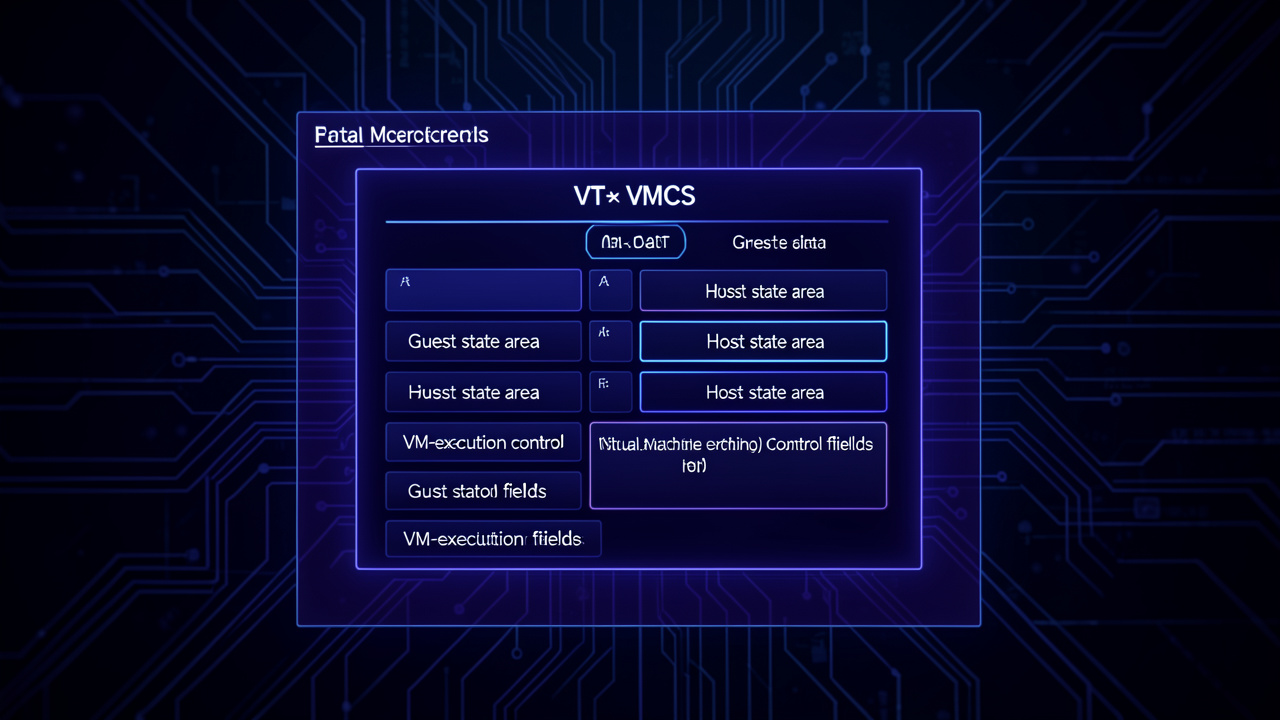
The VMCS is a 4 KB data structure (one page) that contains everything the processor needs to know about a virtual machine: the guest’s architectural state (registers, control registers, MSRs), the host’s state (where to return on VM exit), and a set of control fields that determine which guest operations cause VM exits. There is one VMCS per virtual CPU, and the VMCS is the primary interface between the hypervisor and the hardware virtualization support.
The VMCS is divided into six logical sections:
Guest-state area: The processor loads these fields on every VM entry. They include the guest’s control registers (CR0, CR3, CR4), debug registers (DR7), segment registers (CS, SS, DS, ES, FS, GS, LDTR, TR), general-purpose registers (RIP, RSP, RFLAGS), and model-specific registers that affect guest operation (SYSENTER_CS, SYSENTER_ESP, SYSENTER_EIP, EFER).
Host-state area: The processor loads these fields on every VM exit. They are the hypervisor’s execution context and include the host’s control registers, segment registers, and the host’s RIP (the entry point for VM exit handling). Crucially, the host state is loaded atomically — the processor saves guest state and restores host state in a single, non-interruptible sequence.
VM-execution control fields: These bitmaps determine which guest operations cause VM exits. There are dozens of controls, each corresponding to a specific event that the hypervisor might want to intercept: external interrupts, NMI, interrupt-window exiting (VM exit when the guest is ready to receive interrupts), CR3 accesses, CR8 accesses (TPR for APIC virtualization), MSR reads and writes, I/O port accesses, and more. By setting the appropriate bits, the hypervisor can achieve any desired level of visibility into guest execution.
VM-exit control fields: These control how the processor behaves on VM exit. They include the VM-exit MSR-store count (how many MSRs to save on exit), VM-exit MSR-load count (how many MSRs to load on entry), and whether to acknowledge interrupts on exit.
VM-entry control fields: These control how the processor behaves on VM entry. They include the VM-entry MSR-load count and whether to inject events (interrupts, exceptions) into the guest.
VM-exit information fields: These are read-only fields that the processor fills in on VM exit to tell the hypervisor why the exit occurred. They include the exit reason (a numeric code identifying the event), the exit qualification (additional detail about the event, such as the memory address that caused an EPT violation), and the guest-linear and guest-physical addresses associated with the exit.
The VMCS is managed through a pair of instructions: VMCLEAR (initializes a VMCS), VMPTRLD (loads a VMCS as the current one), VMREAD (reads a field from the current VMCS), and VMWRITE (writes a field to the current VMCS). The hypervisor uses these instructions to configure the VMCS before launching a guest and to read the exit information when the guest exits.
A VM entry (VMLAUNCH for the first entry, VMRESUME for subsequent entries) loads the guest state from the VMCS and transfers control to the guest. A VM exit (triggered by any condition specified in the VM-execution control fields) saves guest state to the VMCS, loads host state from the VMCS, and transfers control to the hypervisor’s exit handler. The entire round-trip — VM exit, hypervisor processing, VM entry — is what we call a “VM exit” in practice, though the term technically refers only to the hardware transition from guest to host.
3. AMD-V/SVM: The Alternative Approach
AMD’s virtualization extensions, branded AMD-V and implemented as Secure Virtual Machine (SVM), take a similar but architecturally distinct approach. Instead of a single VMCS, AMD uses a Virtual Machine Control Block (VMCB) that occupies one 4 KB page and contains the guest’s architectural state, plus a set of control bits that determine which events cause #VMEXIT.
The key differences between VT-x and AMD-V reflect different design philosophies:
Nested paging name: AMD calls it NPT (Nested Page Tables); Intel calls it EPT (Extended Page Tables). The mechanism is essentially identical: a second level of address translation that maps guest-physical addresses to host-physical addresses, eliminating the need for shadow page tables.
Tagged TLB: AMD-V includes an ASID (Address Space Identifier) in the VMCB that the processor uses to tag TLB entries. This means that VM entries and exits don’t need to flush the TLB — entries from different guests (and the host) coexist in the TLB, distinguished by their ASIDs. Intel VT-x added a similar feature later, the VPID (Virtual Processor Identifier).
Instruction intercept: AMD-V’s VMCB has a more fine-grained set of instruction intercept controls, allowing the hypervisor to specify exactly which instructions cause VM exits. Intel’s VM-execution controls are more coarse-grained in some areas but were expanded in later VT-x revisions.
VMRUN vs. VMLAUNCH/VMRESUME: AMD uses a single VMRUN instruction for both initial and subsequent VM entries, while Intel distinguishes between VMLAUNCH (first entry) and VMRESUME (subsequent entries) for security reasons (preventing certain attacks that manipulate the VMCS state between entries).
The performance characteristics of VT-x and AMD-V are similar. VM exit latencies on modern hardware (Skylake/Zen and later) are typically 500-1000 cycles for a round-trip, depending on the exit reason and what state needs to be saved and restored. This is dramatically faster than the binary translation approaches that preceded hardware virtualization (which could cost tens of thousands of cycles per intercepted operation), but it’s still a significant overhead for workloads that trigger frequent VM exits.
4. Nested Paging: The End of Shadow Page Tables
Before nested paging, hypervisors used shadow page tables to virtualize memory. The guest OS maintained its own page tables, mapping guest-virtual addresses to guest-physical addresses. The hypervisor maintained a separate set of shadow page tables, mapping guest-virtual addresses directly to host-physical addresses. Every time the guest modified its page tables, the hypervisor had to intercept the modification and update the shadow tables accordingly. This was complex, bug-prone, and incurred significant overhead for page-table-intensive workloads.
Nested paging eliminates shadow page tables by introducing a second level of address translation. The guest’s page tables map guest-virtual addresses to guest-physical addresses, as before. The hypervisor maintains a separate set of “nested” page tables (EPT in Intel terminology, NPT in AMD) that map guest-physical addresses to host-physical addresses. When the CPU needs to translate a guest-virtual address, it first walks the guest’s page tables to get a guest-physical address, then walks the hypervisor’s nested page tables to get the host-physical address. This is a two-dimensional page walk.
The two-dimensional page walk is implemented in hardware. The processor’s MMU, when operating in guest mode with nested paging enabled, performs both walks transparently. From the guest’s perspective, it’s writing directly to physical memory — the guest page tables define “physical” addresses that are actually guest-physical, and the processor translates them to host-physical using the nested page tables. The guest never sees the host-physical addresses.
The performance implications of nested paging depend on workload characteristics. For workloads with good TLB locality, nested paging adds minimal overhead — the TLB caches the complete translation (guest-virtual to host-physical), so the two-dimensional walk is amortized over many memory accesses. For workloads with poor TLB locality (random memory access patterns), the two-dimensional walk can double the page walk cost, which is a significant overhead.
Modern processors mitigate this overhead through several mechanisms:
Large pages: Both EPT and NPT support 2 MB and 1 GB page sizes at the nested level. If the hypervisor maps a 2 MB contiguous region of guest-physical memory to a 2 MB contiguous region of host-physical memory, the nested page walk terminates at the 2 MB level, avoiding the final level of the page table hierarchy.
TLB caching: Modern TLBs can cache nested translations. On Intel processors, the TLB stores the complete guest-virtual to host-physical mapping along with the VPID, so VM entries and exits don’t invalidate cached translations.
PML (Page Modification Logging): Intel introduced PML to reduce the overhead of tracking dirty pages during live migration. Without PML, the hypervisor must write-protect all guest pages and trap every first write to track which pages have been modified. PML allows the processor to log writes directly to a buffer, which the hypervisor reads periodically, avoiding the write-protection traps.
5. VM Exit and Entry: A Detailed Microarchitectural View
Let’s trace through a VM exit and entry in detail, at the microarchitectural level, to understand where the cycles go.
When a condition triggers a VM exit (say, the guest executes a CPUID instruction, which the hypervisor has configured to cause VM exits), the processor performs the following sequence:
1. Save guest state to VMCS
   - Store guest RIP, RSP, RFLAGS to VMCS guest-state area
   - Store guest CR0, CR3, CR4 to VMCS guest-state area
   - Store guest segment registers (CS, SS, DS, ES, FS, GS, LDTR, TR)
   - Store guest MSRs (EFER, SYSENTER_*)

2. Load host state from VMCS
   - Load host CR0, CR3, CR4 from VMCS host-state area
   - Load host segment registers
   - Load host RIP (the hypervisor's VM exit handler address)
   - Load host RSP

3. Set VM-exit information fields
   - Exit reason = CPUID (value 10)
   - Exit qualification = 0 (no memory access involved)
   - Guest-physical address = 0 (not relevant)

4. Transfer control to host
   - Jump to host RIP
   - Now executing in host (root) mode
The save and load operations are the primary source of latency. State that must be saved includes not just the user-visible registers but also internal processor state: the descriptor cache (the processor’s cached copies of segment descriptor information), the TLB (unless tagged with VPID), and various microarchitectural structures that affect execution correctness. On early VT-x implementations (Merom/Penryn), this state save and restore cost approximately 1000-2000 cycles. On modern implementations (Skylake/Ice Lake), it costs about 500-1000 cycles.
The hypervisor’s exit handler then processes the exit. For a CPUID exit, the handler reads the guest’s EAX and ECX registers to determine which CPUID leaf is being requested, executes CPUID instruction itself (in host mode, where it returns the physical CPU’s capabilities), and stores the result in the guest’s EAX, EBX, ECX, EDX registers (as stored in the VMCS). The handler then increments the guest’s RIP past the CPUID instruction (otherwise the guest would re-execute it and trigger another exit) and issues VMRESUME.
The VM entry sequence mirrors the exit:
1. Load guest state from VMCS
   - Load guest RIP, RSP, RFLAGS
   - Load guest CR0, CR3, CR4
   - Load guest segment registers
   - Load guest MSRs

2. Transfer control to guest
   - Jump to guest RIP
   - Now executing in guest (non-root) mode
Total round-trip latency for a simple CPUID exit on modern hardware: roughly 1000-1500 cycles for the exit and entry, plus whatever time the hypervisor spends processing the exit (which can vary widely). For comparison, the CPUID instruction itself completes in about 100 cycles. The virtualization overhead is about 10-15x the cost of the instruction being virtualized.
This is why hypervisor design focuses so heavily on minimizing VM exits. Every exit costs a thousand cycles or more. Techniques like paravirtualized I/O (virtio), interrupt coalescing, and large-page mappings all aim to reduce the frequency of VM exits.
6. Virtualizing I/O: From Emulation to Paravirtualization to Direct Assignment
I/O virtualization illustrates the evolution of VM exit reduction strategies. Early hypervisors emulated real hardware — a NE2000 network card, an IDE disk controller — so the guest OS could use its existing drivers. Every I/O operation involved a VM exit. The guest wrote to an I/O port or a memory-mapped I/O region; the processor trapped the access; the hypervisor’s device model emulated the hardware behavior.
This was functional but slow. Emulating a network card requires multiple VM exits per packet, each costing thousands of cycles. A 10 Gbps network link can deliver a minimum-sized packet every 67 nanoseconds (at 1.5 KB per packet, approximately 822,000 packets per second). Each packet requires at least one VM exit for the guest to signal “packet ready” and at least one for the hypervisor to signal “packet received.” At 1000 cycles per exit, 1.6 million exits per second consume about 500 million cycles, or half of one CPU core at 3 GHz — just for the VM exit overhead, not counting any actual packet processing.
Paravirtualization (virtio) addresses this by defining a clean, efficient interface between guest and hypervisor that minimizes exits. The virtio specification defines a set of virtual devices (network, block, console, entropy, etc.) that communicate through shared memory rings (virtqueues). The guest places requests into a virtqueue and signals the hypervisor with a single I/O write (one VM exit). The hypervisor processes multiple requests from the queue and signals the guest with an interrupt (or, more efficiently, the guest polls the used ring). Batching reduces VM exits per I/O operation by orders of magnitude.
Direct device assignment (PCI passthrough, SR-IOV) eliminates VM exits for I/O entirely. The hypervisor assigns a physical device (or a virtual function of an SR-IOV-capable device) directly to a guest. The guest’s driver programs the device’s registers directly, without hypervisor intervention. DMA from the device goes directly to guest memory, using the IOMMU (VT-d on Intel, AMD-Vi on AMD) to ensure that the device cannot access memory belonging to other guests or the hypervisor.
SR-IOV (Single Root I/O Virtualization) takes this further by allowing a single physical device to expose multiple “virtual functions” (VFs), each of which can be assigned to a different guest. A 40 Gbps network card can expose 64 VFs, each looking like an independent network interface, each assigned to a different guest. The physical function (PF) manages the shared resources; the VFs provide isolated I/O paths. This is how hyperscale cloud providers achieve near-native network performance in virtualized environments.
7. Nested Virtualization: Running Hypervisors Inside Guests
A particularly mind-bending capability of modern virtualization hardware is nested virtualization: running a hypervisor inside a guest, which in turn runs its own guests. This is essential for cloud providers that offer “bare metal” instances (which are actually VMs that can host their own VMs) and for development and testing of hypervisor software.
Nested virtualization requires the L0 hypervisor (the one running on bare metal) to expose VT-x or AMD-V capabilities to the L1 hypervisor (running inside a guest). This means the L0 hypervisor must virtualize the VMCS/VMCB, VM entries and exits, and nested paging. When the L1 hypervisor executes VMLAUNCH or VMRESUME to enter its guest (L2), the processor traps to the L0 hypervisor, which must merge the L1’s VMCS with its own, creating an effective VMCS that controls L2 execution.
Intel introduced VMCS shadowing to accelerate nested virtualization. With VMCS shadowing, the processor can handle many VM entries and exits of the L1 hypervisor without trapping to L0. The L0 hypervisor configures a “shadow VMCS” that the processor uses when the L1 hypervisor is running. When the L1 hypervisor executes VMRESUME, the processor merges the L1’s VMCS with the shadow VMCS in hardware, enters L2, and only exits to L0 if L2 does something that the L0 hypervisor needs to handle.
AMD introduced a similar mechanism called “nested paging acceleration” (also known as “virtualized VMCB” or “vVMCB”), which allows the L0 hypervisor to specify which fields of the VMCB should cause VM exits when accessed by the L1 hypervisor, reducing the number of exits needed for L1 to manage its guests.
Nested virtualization performance is still significantly worse than non-nested: a VM exit from L2 to L0 that requires L1 processing can cost tens of thousands of cycles, because the exit must be processed by L0, which may need to inject it into L1, which processes it and returns to L0, which then re-enters L2. Each transition adds its own state save/restore overhead. But for many workloads, the overhead is acceptable, and nested virtualization enables important use cases like running containers (which use virtualization for isolation) inside cloud VMs.
8. Side Channels and the Spectre/Meltdown Era
Virtualization hardware has been profoundly affected by the discovery of speculative execution side-channel attacks. Spectre, Meltdown, and their variants exploit the fact that speculative execution leaves traces in the microarchitectural state (caches, branch predictors, TLBs) that can be observed by attackers, even across VM boundaries.
The core problem is that processors speculate past security boundaries. When a guest kernel executes code that should be protected by a privilege check, the processor may speculatively execute instructions beyond that check before the check completes, leaving cache traces that reveal the protected data. Since the cache is shared across VMs, a malicious guest can prime the cache, trigger speculative execution in another guest (or the hypervisor), and then probe the cache to infer the victim’s data.
Intel and AMD have responded with a series of hardware and microcode mitigations:
IBRS/STIBP (Indirect Branch Restricted Speculation / Single Thread Indirect Branch Predictors): These microcode-updated MSRs control how branch predictions are isolated between privilege levels and hyperthreads. When IBRS is set, indirect branches in kernel mode cannot be influenced by predictions set up in user mode, preventing cross-privilege-level branch target injection.
L1D Flush: On VM entry, the hypervisor can flush the L1 data cache to prevent a guest from accessing data that the hypervisor speculatively loaded during the previous VM exit handling. This is expensive but necessary for certain classes of attacks.
L1TF (L1 Terminal Fault) mitigations: The L1TF vulnerability allowed a guest to read the hypervisor’s L1 data cache if a speculation error caused a terminal fault while accessing a guest virtual address that mapped to sensitive host memory. Mitigations include not mapping sensitive host memory in the same address space as the guest (when possible) and flushing L1 on VM entry.
SMT (Simultaneous Multithreading) considerations: Because hyperthreads share nearly all microarchitectural state (caches, TLBs, branch predictors), a malicious thread can observe the speculative execution of a co-resident thread. Cloud providers increasingly disable SMT or ensure that threads from different customers never share a physical core.
These mitigations impose significant performance costs. L1D flushing on every VM entry alone can cost 200-500 cycles. Combined with IBRS and other mitigations, VM exit latency has increased substantially from the pre-Spectre era. The systems community is still grappling with the trade-off between security and performance in virtualized environments.
9. IOMMU: Making DMA Safe for Virtualization
The IOMMU (I/O Memory Management Unit), branded VT-d by Intel and AMD-Vi by AMD, is the unsung hero of virtualization security. Before IOMMUs, a device assigned to a guest could DMA to any physical memory address, including memory belonging to the hypervisor or other guests. The only protection was trust: the hypervisor trusted the guest not to program its assigned device to access unauthorized memory. A malicious or buggy guest driver could compromise the entire system.
The IOMMU solves this by providing page-table-based address translation for DMA requests, just as the MMU provides page-table-based translation for CPU memory accesses. When a device initiates a DMA transfer, the IOMMU intercepts the request, looks up the device’s source identifier (PCI bus/device/function) in its translation tables, and translates the DMA address (an I/O virtual address, or IOVA) to a physical address. If the translation exists and the permissions allow the operation, the DMA proceeds. If not, the IOMMU blocks the DMA and reports a fault.
The IOMMU translation tables are configured by the hypervisor, not the guest. When the hypervisor assigns a device to a guest, it creates IOMMU page table entries mapping the guest’s “physical” DMA addresses (which are actually guest-physical) to host-physical pages that have been allocated to the guest. The guest’s driver programs DMA addresses that are within the guest’s view of physical memory; the IOMMU remaps them to the correct host-physical pages. The guest cannot use DMA to access memory outside its allocation because the IOMMU tables don’t have entries for those addresses.
IOMMU also enables two important features beyond basic protection. First, interrupt remapping: the IOMMU can remap device MSI/MSI-X interrupts, translating them so that a device assigned to a guest can only generate interrupts targeted at that guest’s virtual CPUs. Without interrupt remapping, a malicious device could inject interrupts into other guests or the hypervisor. Second, Shared Virtual Memory (SVM): recent IOMMU implementations support two-level translation, similar to nested paging for CPUs, allowing a device to use the guest’s virtual addresses directly for DMA. This enables efficient user-space DMA, where a user process can pass its virtual address to a device and have the device DMA directly into that process’s memory.
The IOMMU also plays a critical role in protecting against DMA attacks from malicious peripherals. A compromised Thunderbolt device, for instance, could attempt to DMA into kernel memory to gain code execution. With the IOMMU enabled and properly configured, the device can only access memory that has been explicitly mapped for it, which typically is none by default. This is why modern operating systems enable IOMMU protection by default for external-facing ports.
10. Interrupt Virtualization: APICv and Posted Interrupts
Interrupt delivery in virtualized environments has historically been a major source of VM exits. Every external interrupt — a network packet arriving, a disk I/O completing — causes a VM exit because the processor must transfer control to the hypervisor, which determines which guest should receive the interrupt and injects it via the virtual APIC.
Intel’s APICv (APIC virtualization) and AMD’s AVIC (Advanced Virtual Interrupt Controller) address this by virtualizing the APIC in hardware. With APICv, the processor maintains a virtual APIC page for each guest, containing the virtualized local APIC registers — the task priority register, the interrupt request register, the in-service register, and the end-of-interrupt register. When a device (or another guest) generates an interrupt targeted at a guest’s virtual APIC, the processor can evaluate the interrupt acceptance criteria — Is the guest ready? Is the interrupt priority higher than the current task priority? — and deliver the interrupt directly to the guest without a VM exit.
The most aggressive form of interrupt virtualization is “posted interrupts.” With posted interrupts, an external interrupt targeted at a running guest is delivered by the processor without any VM exit at all. The mechanism works as follows: the interrupt controller (IOAPIC or MSI) writes a notification to a memory location designated as the “posted interrupt descriptor.” The processor, at the next instruction boundary or interrupt window, observes the notification and delivers the interrupt to the guest by invoking the guest’s interrupt descriptor table (IDT) handler. The hypervisor is not involved in the delivery path. This reduces interrupt latency from thousands of cycles (a VM exit round-trip) to tens of cycles (the cost of the interrupt delivery itself).
For interrupts targeted at a guest that is not currently running (preempted by the hypervisor scheduler), posted interrupts use a “wakeup notification” sent to the physical CPU that is currently running the VCPU thread. The notification causes a lightweight VM exit that tells the hypervisor to schedule the target guest. This is still more expensive than a direct interrupt (it requires scheduling a different VCPU), but it’s far cheaper than having every interrupt cause a full VM exit with all the state save and restore that entails.
The combined effect of APICv and posted interrupts is transformative for I/O-intensive workloads. A network function that processes millions of packets per second can spend nearly all its CPU time on actual packet processing, rather than on VM exit handling. The hypervisor is invoked only when it actually has something to do — scheduling decisions, resource allocation changes, or rare configuration events — rather than on every single interrupt.
11. Summary
Hardware virtualization support — Intel VT-x, AMD-V, nested paging, IOMMU — has transformed the computing landscape. What was once a heroic exercise in binary translation is now a commodity capability built into every server processor. The key hardware mechanisms are conceptually simple but engineered to an extraordinary degree of sophistication: the VMCS/VMCB that defines the virtual machine’s state and behavior, nested paging that eliminates the shadow page table tax, IOMMU that enables direct device assignment with isolation, and interrupt virtualization that reduces VM exits to near zero for high-throughput workloads.
The ongoing challenge is the tension between isolation and performance. Every VM exit costs cycles; every hardware mitigation for side channels costs more cycles. The pursuit of efficient virtualization is a relentless optimization problem, balancing the need for strong isolation against the desire for bare-metal performance. Modern hypervisors navigate this tension through a rich toolkit: paravirtualized I/O for most workloads, direct device assignment for the most demanding, nested paging for memory efficiency, posted interrupts for zero-exit interrupt delivery, and carefully tuned exit-handling code for everything else. The result is a virtualization stack that can host millions of VMs with overhead measured in single-digit percentages — an engineering achievement that would have seemed impossible to the architects of VT-x in 2005.
11.1 Virtualizing Real-Time Clocks and Timers
One of the subtler challenges in hypervisor design is virtualizing time. A guest OS expects monotonic, accurate timestamps from the TSC (Time Stamp Counter), HPET (High Precision Event Timer), and ACPI PM Timer. But the hypervisor may preempt the guest at any time, causing the guest’s view of time to jump forward when it resumes. The guest’s gettimeofday and clock_gettime calls must return accurate time that accounts for preemption.
Intel VT-x provides the TSC offsetting feature: the processor adds a per-VM offset to the TSC value when the guest reads it. The hypervisor adjusts the offset to account for time spent outside the guest (during VM exits and while other guests are running). AMD-V provides a similar feature via the TSC offset in the VMCB. For the HPET and PM Timer, the hypervisor must emulate these devices, intercepting guest MMIO reads and returning computed values based on the host’s real time and the guest’s preemption history.
Modern processors also support the TSC scaling feature, which allows the hypervisor to present a different TSC frequency to the guest than the physical TSC frequency. This is essential for live migration between hosts with different TSC frequencies: the hypervisor can scale the guest’s TSC to match the source host’s frequency even after migration to a target host with a different frequency.