
Landauer's Principle and the Thermodynamics of Computation: Why Bits Have an Energy Floor
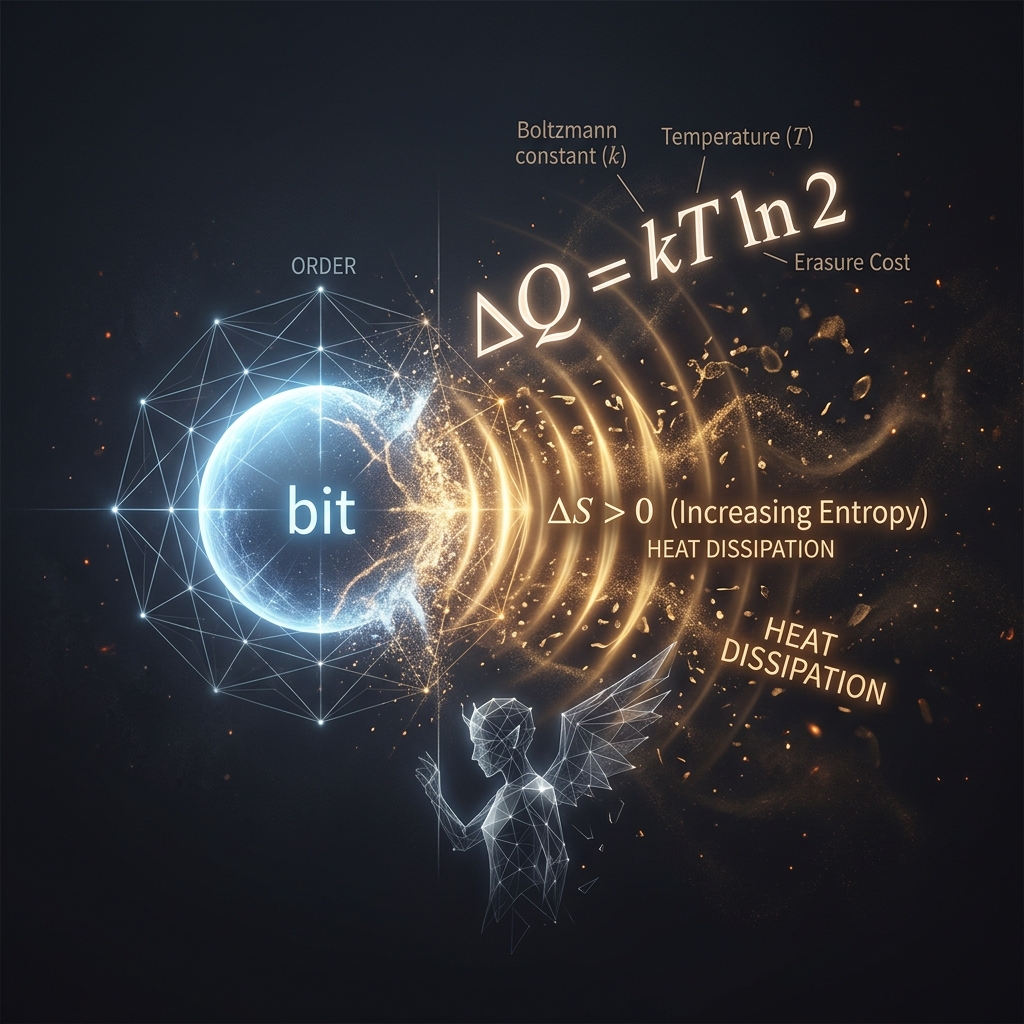
Explore the deep connection between thermodynamics and information: Landauer's principle that erasing a bit costs kT ln 2 in energy, the Maxwell's demon resolution, and the quest for reversible, energy-efficient computing.
Contents
In 1961, an IBM physicist named Rolf Landauer published a paper that would take decades to be fully appreciated. Its claim was audacious: there is a fundamental, inescapable lower bound on the energy cost of computation, rooted not in the limitations of transistors or wires but in the laws of thermodynamics themselves. Specifically, Landauer proved that erasing a single bit of information — resetting it from an unknown state to a known zero — dissipates at least (kT \ln 2) joules of energy as heat into the environment. At room temperature, this is approximately (2.9 \times 10^{-21}) J — so small that it seemed purely academic. But scale matters. Erase (10^{12}) bits per second (a modest figure for a modern processor) and the minimum dissipation is (2.9 \times 10^{-9}) W — still negligible. Scale to (10^{20}) bits per second (the global computational throughput of all data centers), and you reach kilowatts of irreducible heat.
Landauer’s principle is remarkable because it connects two domains that had previously seemed only metaphorically related: thermodynamics (the physics of heat, work, and entropy) and information theory (the mathematics of bits, uncertainty, and communication). The connection, once established, proved to be not just a curiosity but a profound constraint on what computation can achieve and at what cost. This post traces the intellectual journey from Maxwell’s demon through Szilard’s engine to Landauer’s principle, explores the physics of logically reversible computing, and examines what these limits mean for the future of computation in an energy-constrained world.
1. Maxwell’s Demon and the Origins of the Information-Entropy Connection
The story begins not with computing but with thermodynamics, and with a thought experiment that haunted physicists for over a century.
1.1 The Demon That Challenged the Second Law
In 1867, James Clerk Maxwell imagined a tiny being — the “demon” — stationed at a trapdoor between two chambers of gas. The demon observes the molecules and selectively opens the trapdoor: it lets fast molecules pass from the left chamber to the right and slow molecules from right to left. Over time, the right chamber becomes hot (fast molecules) and the left chamber becomes cold (slow molecules). The demon has created a temperature difference from an initially uniform gas, apparently decreasing the total entropy of the system without expending work — a direct violation of the Second Law of Thermodynamics.
The demon puzzle resisted resolution for decades because the proposed solutions missed the essential point. Some argued that the demon itself would generate entropy through its mechanical operations; others that the demon’s measurements required illumination that would heat the gas. But these were engineering objections, not physical ones. The deep resolution came only when physicists began to think about the demon’s information processing — specifically, its memory.
1.2 Szilard’s Engine: One Bit, One (kT \ln 2)
In 1929, Leó Szilárd — a Hungarian physicist better known for conceiving the nuclear chain reaction and drafting the letter Einstein sent to Roosevelt — published a paper that distilled Maxwell’s demon to its simplest form. Szilard’s engine consists of a single molecule in a box, a partition that can be inserted and removed, and a pulley that can extract work from the molecule’s pressure on the partition.
The engine operates in a cycle:
- Insert the partition, dividing the box into two equal halves. The single molecule is now confined to one side, but the demon does not know which.
- The demon measures which side the molecule is on. This measurement produces one bit of information: “left” or “right.”
- The demon uses this information to attach a weight to the appropriate side. The molecule, bouncing against the partition, pushes it and lifts the weight — extracting (kT \ln 2) joules of work from what appears to be thermal noise.
- The partition is removed, the weight is detached, and the system returns to its initial state — ready for another cycle.
On the face of it, Szilard’s engine converts heat directly into work, violating the Second Law. Szilard himself recognized that the resolution must involve the measurement step. He argued that measurement requires dissipation — that the act of acquiring information must cost at least as much energy as the work extracted. But he could not quantify this cost precisely.
1.3 Bennett’s Resolution: Erasure, Not Measurement
The definitive resolution came from Charles Bennett at IBM in 1982. Bennett recognized that Szilard’s argument was almost right but located the dissipation in the wrong place. The measurement itself need not dissipate energy — it can be performed reversibly, in principle, by coupling the measuring apparatus to the system in a way that preserves all information. The dissipation occurs later, when the demon must erase its memory to make room for the next measurement.
The demon, after completing one cycle, has a memory register that reads “left” or “right.” To begin the next cycle, this register must be reset to a neutral state — the bit must be erased. And this erasure, Landauer had shown, is where the thermodynamic cost is paid.
Bennett’s insight resolved the demon paradox completely: the Second Law is not violated because the entropy “decrease” in the gas is exactly compensated by the entropy increase in the environment when the demon’s memory is erased. The demon does not defeat the Second Law; it merely defers the thermodynamic bill to the erasure step. The total entropy of the universe still increases.
2. Landauer’s Principle: The Formal Statement and Derivation
With the historical context established, let us derive Landauer’s principle from first principles. The argument is elegant and relies on only the most basic concepts of thermodynamics and information theory.
2.1 Thermodynamic Entropy and Information Entropy
Consider a physical system that can be in one of (N) distinct states. If each state (i) has probability (p_i), the Gibbs entropy (the thermodynamic entropy) of the system is:
[ S = -k \sum_{i=1}^{N} p_i \ln p_i ]
where (k) is Boltzmann’s constant. This is structurally identical to Shannon’s information entropy:
[ H = -\sum_{i=1}^{N} p_i \log_2 p_i ]
measured in bits. The relationship is (S = k \ln 2 \cdot H): one bit of information entropy corresponds to (k \ln 2) joules per kelvin of thermodynamic entropy.
This identity is not a coincidence. It reflects a deep isomorphism: thermodynamic entropy measures the physical system’s uncertainty in phase space, while information entropy measures the observer’s uncertainty about the system’s microstate. When an observer learns which microstate the system occupies, the observer’s uncertainty decreases by (H) bits, and the system’s thermodynamic entropy (from the observer’s perspective, conditioned on the new knowledge) decreases by (k \ln 2 \cdot H). This is the key to understanding why information processing has thermodynamic consequences.
2.2 The Erasure Operation
Landauer considered the simplest possible computing element: a single bit that can be in one of two states, which we label 0 and 1. Initially, the bit is in an unknown state — it could be 0 or 1 with equal probability, representing one bit of Shannon entropy. The erasure operation resets the bit to a known state, say 0, regardless of its initial state.
Before erasure, the bit’s entropy (from the perspective of an observer who does not know the state) is (S_{\text{initial}} = k \ln 2) (since (p_0 = p_1 = 1/2), giving (H = 1) bit, and (S = k \ln 2 \cdot 1 = k \ln 2)).
After erasure, the bit is in state 0 with probability 1. The entropy is (S_{\text{final}} = 0) (since there is only one possible state, (H = 0)).
The erasure has reduced the bit’s entropy from (k \ln 2) to 0. By the Second Law of Thermodynamics, the total entropy of an isolated system cannot decrease. Therefore, the entropy decrease in the bit must be compensated by an entropy increase of at least (k \ln 2) in the environment — typically through heat dissipation. The minimum heat released is:
[ \Delta Q \geq T \Delta S_{\text{environment}} \geq T \cdot k \ln 2 ]
At (T = 300) K (room temperature), (kT \ln 2 \approx (1.38 \times 10^{-23}) \cdot 300 \cdot 0.693 \approx 2.87 \times 10^{-21}) J. This is the famous Landauer bound.
2.3 What the Bound Applies To — and What It Does Not
A crucial subtlety: Landauer’s bound applies specifically to logically irreversible operations — operations whose output does not uniquely determine the input. Erasing a bit (setting it to 0 regardless of whether it was 0 or 1) is logically irreversible because, given the output (0), you cannot determine whether the input was 0 or 1. The information has been destroyed, and the Second Law exacts a price for this destruction.
Operations that are logically reversible — where the input can be reconstructed from the output — need not dissipate any energy in principle. A NOT gate is logically reversible: given the output (1), you know the input was 0, and vice versa. A CNOT (controlled-NOT) gate is reversible: given the target output and the control bit, you can reconstruct the target input. The Toffoli gate (controlled-controlled-NOT) is also reversible. These gates, and the circuits built from them, can in principle operate with arbitrarily low energy dissipation.
The practical consequence: computation is not inherently dissipative. It is the erasure of information — the discarding of intermediate results, the overwriting of old values, the resetting of registers — that costs energy. This insight, due to Bennett and building on Landauer, launched the field of reversible computing.
3. Reversible Computing: Computation Without Erasure
If truly erasing information is the only thermodynamically costly operation, then a computer that never erases information — that instead decomposes its computation into logically reversible steps and only erases at the very end, or not at all — could operate with energy dissipation far below the Landauer bound per gate operation. This is the vision of reversible computing.
3.1 The Fredkin Gate and Conservative Logic
In 1982, Edward Fredkin proposed the Fredkin gate (also called the CSWAP gate), a three-input, three-output gate that is both logically reversible and conservative — the number of 1s in the output equals the number of 1s in the input. The Fredkin gate operates as a controlled swap: input A is the control line. If A = 0, inputs B and C pass through unchanged. If A = 1, B and C are swapped at the output: B appears on the third output line, C on the second.
Fredkin Gate Truth Table:
A  B  C  →  A'  B'  C'
0  0  0  →  0   0   0
0  0  1  →  0   0   1
0  1  0  →  0   1   0
0  1  1  →  0   1   1
1  0  0  →  1   0   0
1  0  1  →  1   1   0    (B=0, C=1 → swap: B'=1, C'=0)
1  1  0  →  1   0   1    (B=1, C=0 → swap: B'=0, C'=1)
1  1  1  →  1   1   1
Notice that the mapping is a bijection: each distinct input pattern maps to a distinct output pattern. Information is never lost. Moreover, the number of 1-bits is conserved in every case (count the 1s in each row — the total stays the same). This conservation property is aesthetically elegant but not essential for reversibility. The Fredkin gate is universal: any Boolean function can be implemented using only Fredkin gates, supplemented with ancilla bits initialized to known constants and “garbage” outputs that carry the reversibility-preserving information.
3.2 The Toffoli Gate
Tommaso Toffoli proposed a simpler universal reversible gate: the Toffoli gate (controlled-controlled-NOT, CCNOT). It has three inputs (A, B, C) and three outputs (A, B, C XOR (A AND B)). The first two inputs pass through unchanged; the third is flipped if both A and B are 1. The Toffoli gate is easier to implement in quantum computing (where it plays a central role in circuit synthesis), but classically it is equivalent in power to the Fredkin gate.
Both gates share a common feature: they map distinct input patterns to distinct output patterns (bijection), so no information is lost. A computer built entirely from Toffoli gates could carry out any computation without ever erasing a bit — in principle, with zero thermodynamic energy cost.
3.3 Bennett’s Pebble Game and the Trade-off Between Space and Erasure
The catch is that avoiding erasure requires keeping all intermediate results — every partial sum, every temporary variable, every carry bit — indefinitely. For a computation of (N) steps, a naive reversible implementation requires (O(N)) ancilla bits. This is impractical for any nontrivial computation.
Bennett addressed this with the pebble game (1973), an analysis of the space-time trade-offs in reversible computation. The insight: you can decompose a large computation into smaller reversible sub-computations, run each sub-computation to completion, copy its final result (a logically reversible operation) to a safe location, and then reverse the sub-computation to clean up the ancilla bits. The reversal undoes the computation step-by-step, erasing nothing — it simply runs the gates in reverse order, which is always possible with reversible gates. The only “cost” is time: each sub-computation is run twice, once forward and once backward.
By recursively applying this technique, Bennett showed that any computation of space complexity (S) and time complexity (T) can be implemented reversibly with space (O(S \log T)) and time (O(T \log^2 T)) — or, with different trade-offs, space (O(S)) and time (O(T^{1+\epsilon})). The exponential space blowup is avoided at the cost of a polynomial time overhead. Theoretically, this means that irreversible erasure is never strictly necessary — you can always clean up after yourself by running the computation backward.
3.4 Adiabatic CMOS and Charge Recovery Logic
Reversible computing is not just a theoretical curiosity. Researchers have built prototype reversible logic circuits using adiabatic CMOS techniques. The key idea: instead of abruptly switching transistors between 0 and Vdd (the standard CMOS approach, which dissipates (\frac{1}{2}CV^2) per transition), adiabatic circuits use slowly ramped power supplies that recycle charge. Energy flows from the power supply into the circuit capacitance and back, rather than being dumped to ground.
Adiabatic circuits can achieve energy dissipation per operation that is proportional not to (CV^2) but to ((RC/T) CV^2), where (T) is the ramp time. By ramping slowly enough, the dissipation can approach arbitrarily close to zero — consistent with Landauer’s principle (since adiabatic switching is logically reversible: the charge on a capacitor is a continuous variable that preserves information about the circuit’s history).
The practical challenge is that adiabatic circuits are slower (the slower the ramp, the lower the dissipation, trading speed for energy) and more complex (requiring multiphase power clocks and resonant LC power delivery networks). However, for energy-constrained applications — deeply embedded sensors, biomedical implants, or edge AI accelerators — adiabatic logic could offer orders-of-magnitude improvements in energy efficiency.
4. The Landauer Bound in Context: How Close Are We?
It is instructive to compare the Landauer bound to the actual energy consumed by modern digital logic.
4.1 Modern CMOS: Six Orders of Magnitude Above the Bound
A single gate operation in a modern 5nm CMOS process consumes roughly (10^{-15}) to (10^{-16}) J (0.1 to 1 femtojoule) — a remarkable achievement, but still roughly (10^5) to (10^6) times larger than the Landauer bound at room temperature ((2.9 \times 10^{-21}) J). This gap represents the difference between what physics requires and what engineering achieves.
Where does the extra energy go?
- Switching energy ((\frac{1}{2}CV^2)): Charging and discharging gate capacitances dominates. Reducing (V_{dd}) helps (the dynamic power goes as (V^2)), but noise margins and transistor threshold voltages impose lower limits.
- Leakage current: Even when “off,” transistors leak current from source to drain. At 5nm, leakage can account for 30-50% of total power.
- Interconnect capacitance: Wires between gates have capacitance that must be charged and discharged — often exceeding the gate capacitance itself.
- Clock distribution: The clock network distributes a global signal across the entire chip, consuming 20-40% of total chip power.
None of these are constrained by Landauer’s bound; they are all engineering artifacts of the specific technology (CMOS) and architecture (synchronous Boolean logic). In principle, they could be reduced by orders of magnitude.
4.2 The End of Dennard Scaling and the Rise of Dark Silicon
Dennard scaling (1974) observed that as transistors shrink, their power density remains constant because both voltage and current decrease proportionally with dimensions. This allowed clock frequencies to increase for three decades without exceeding thermal limits. Dennard scaling broke down around 2006 at the 90nm node, when threshold voltage could no longer be scaled down without causing unacceptable leakage currents. Since then, transistor density has continued to increase (Moore’s Law continues in some form), but power density has also increased — leading to the phenomenon of dark silicon: the fraction of a chip that can be simultaneously active at full frequency without exceeding thermal design power.
The end of Dennard scaling makes Landauer’s principle newly relevant. If we cannot squeeze more performance out of higher clock frequencies, we must look to energy efficiency as the primary axis of improvement. Reversible computing and adiabatic logic, long dismissed as academic curiosities, are receiving renewed attention as the gap between Landauer’s bound and practical CMOS narrows (from nine orders of magnitude in 1970 to about five orders of magnitude today).
4.3 Superconducting Logic: The Rapid Single Flux Quantum (RSFQ)
An entirely different approach to approaching the Landauer limit uses superconductivity. Superconducting logic families, particularly Rapid Single Flux Quantum (RSFQ) and its energy-efficient variant ERSFQ, encode bits as the presence or absence of single magnetic flux quanta in superconducting loops. A flux quantum is (\Phi_0 = h / 2e \approx 2.07 \times 10^{-15}) Wb.
RSFQ switches at picosecond speeds (hundreds of GHz clock rates) with switching energies of (10^{-19}) to (10^{-20}) J — two to three orders of magnitude below CMOS and only one to two orders of magnitude above the Landauer bound. The catch: RSFQ requires cryogenic cooling to 4.2 K (liquid helium). The refrigeration overhead (cryocooler power) currently swamps the switching energy savings for all but the most specialized applications. However, for applications that already require cryogenic temperatures — quantum computing control electronics, deep-space sensors, superconducting detectors — RSFQ is a natural fit.
4.4 Quantum Computing and the Landauer Bound
Quantum computing introduces a fascinating twist. Quantum gates are inherently reversible (unitary operators are bijections on the Hilbert space and thus logically reversible), so they should, in principle, dissipate no energy. However, quantum error correction requires measuring syndrome qubits, which collapses quantum states and, from the perspective of the classical controller, acquires information — an irreversible operation. The classical processing that accompanies quantum error correction (decoding syndromes, inferring errors) is subject to Landauer’s principle if the classical results are erased. And the quantum-to-classical interface (measurement) is itself an irreversible process in the von Neumann measurement scheme.
There is active debate about whether quantum computation fundamentally requires energy dissipation, and if so, at what scale. The consensus (building on Bennett’s work) is that the quantum computation itself can be reversible and dissipation-free, but the initialization of qubits (setting them to a known state, analogous to erasure) and the readout of results (measurement) must dissipate at least the Landauer bound per bit of information gained or erased. This turns out to be a critical scaling consideration for fault-tolerant quantum computers: each logical qubit requires thousands of physical qubits and millions of syndrome measurements per logical operation. If each syndrome measurement dissipates (kT \ln 2) at millikelvin temperatures (where superconducting qubits operate, (T \approx 15) mK), the per-measurement cost is around (1.4 \times 10^{-25}) J — negligible. But the classical controller that processes the syndromes runs at room temperature, and the decoding algorithms (minimum-weight perfect matching, union-find, belief propagation) erase enormous numbers of bits in the course of identifying errors. A single logical gate in a surface-code quantum computer might require decoding tens of thousands of syndromes, each involving hundreds of classical bit operations. Multiply by millions of logical gates per second, and the classical control electronics could easily consume kilowatts — not for the quantum operations themselves, but for the classical information processing that sustains them. This is an ironic twist: the quantum computer may be thermodynamically efficient in its quantum core, but the classical overhead of error correction could dominate the energy budget, constrained ultimately by Landauer’s principle.
5. The Thermodynamics of Real Data Centers
Landauer’s bound provides a theoretical lower limit, but what about real-world energy costs? Data centers consumed approximately 240-340 TWh in 2022, about 1-1.3% of global electricity demand. How much of this is fundamental, and how much is engineering waste?
5.1 The Hierarchy of Energy Costs
A typical data center’s energy consumption breaks down as:
- Compute (CPUs, GPUs, accelerators): 40-60% of IT load. Each operation is 5-6 orders of magnitude above Landauer.
- Memory and storage: 10-20%. DRAM refresh, SSD writes, HDD spindle motors.
- Networking: 5-10%. Switches, NICs, optical transceivers.
- Power distribution and cooling: 30-40% of total facility power (PUE ~1.3-1.6 for hyperscale data centers; legacy facilities often exceed 2.0).
- Embodied carbon: Manufacturing the servers, chips, and batteries is itself energy-intensive and is amortized over the equipment’s lifetime.
The Landauer bound for the actual useful computation performed by a data center — the logical operations that transform input data into output results — is trivially small: a few milliwatts for the logical transitions alone. The remaining tens of megawatts are spent on practical engineering realities: driving signals across centimeters of wire, refreshing DRAM capacitors, spinning fans, and chilling water.
5.2 Information as a Thermodynamic Resource
An emerging perspective views information not just as an abstraction but as a thermodynamic resource — something that can be spent, saved, and budgeted like energy. Data compression, for example, reduces the number of bits that must be transmitted or stored, which reduces the number of bit erasures required downstream, which reduces the minimum thermodynamic cost. The relationship is indirect (compressing a file by 50% does not halve your data center electricity bill), but it points toward a future where information-theoretic optimization becomes a first-class concern in energy-efficient computing.
Some researchers have proposed thermodynamic computing — designing algorithms not for time or space efficiency but for thermodynamic efficiency, minimizing the number of logically irreversible operations (bit erasures) a computation performs. While largely theoretical today, this perspective may become practical as energy constraints tighten.
6. Experimental Verification of Landauer’s Principle
For decades, Landauer’s principle was a theoretical result without direct experimental confirmation. Measuring (2.9 \times 10^{-21}) J is nontrivial — it requires controlling and measuring energy at the scale of individual atomic transitions.
6.1 The 2012 Experiment: Bérut et al.
In 2012, Bérut, Arakelyan, Petrosyan, Ciliberto, Dillenschneider, and Lutz published a landmark experimental verification of Landauer’s principle in Nature. They used a single colloidal particle trapped in a double-well potential created by a focused laser beam (optical tweezers). The particle’s position in the left or right well encoded a classical bit. The barrier between wells could be lowered and raised, and the entire potential could be tilted to bias the particle toward one well.
The erasure protocol: lower the barrier, tilt the potential toward the target well (say, “0”), then raise the barrier. Regardless of whether the particle started in the left or right well, it ends in the target well. The erasure is logically irreversible. By measuring the work done on the particle during this process across thousands of trials, the researchers found that the mean dissipated work approached (kT \ln 2) in the quasi-static limit (infinitely slow operation), and exceeded it for faster operations — exactly as Landauer predicted.
6.2 Subsequent Experiments and the Quantum Regime
More recent experiments have extended the verification to smaller scales: single-electron transistors, nanomagnetic bits, and even quantum systems where the “bit” is a superconducting qubit. In all cases, the Landauer bound holds: erasing information costs at least (kT \ln 2), and the cost can be approached arbitrarily closely by operating slowly and carefully enough. The bound is not merely a theoretical curiosity — it is a law of nature, as fundamental as the conservation of energy.
7. Beyond Landauer: The Generalized Second Law and Information Engines
Landauer’s principle is a specific instance of a broader connection between information and thermodynamics, now known as the generalized Second Law or information thermodynamics.
7.1 The Fluctuation Theorems
The Jarzynski equality (1997) and the Crooks fluctuation theorem (1999) provide exact relations between work, free energy, and the statistics of nonequilibrium processes. They show that the Second Law ((W \geq \Delta F) for a process connecting equilibrium states) is an average statement; individual trajectories can violate it, but with probabilities that satisfy a detailed fluctuation relation.
When information is incorporated into these fluctuation theorems, we obtain relations of the form:
[ \langle e^{-\beta (W - \Delta F) + I} \rangle = 1 ]
where (I) is the information gained by measurement (in natural units, nats). This identity generalizes Landauer’s principle to arbitrary nonequilibrium processes with feedback control. It provides a precise, quantitative link between the information acquired by a Maxwellian demon and the work that can be extracted.
7.2 Experimental Information Engines
Researchers have built working information engines — real, physical Maxwell demons that convert information about thermal fluctuations into extractable work. A typical setup: a particle undergoing Brownian motion in a harmonic potential. A high-speed camera tracks the particle’s position. When the particle fluctuates upward (against the potential gradient), a feedback controller rapidly shifts the potential center to catch the particle at its new position, extracting work. The work extracted is bounded by the information gained through measurement — exactly as the generalized Second Law predicts.
These experiments close the loop that began with Maxwell in 1867. The demon does not violate the Second Law because it is not a closed system: it acquires information through measurement, and that information has a thermodynamic cost (either paid through measurement irreversibility or deferred to a later erasure step). The resolution is complete, and it is quantitative.
8. Landauer, Entropy, and the Arrow of Time
There is one final connection worth making explicit. Landauer’s principle provides a physical grounding for the arrow of time — the observation that the past differs from the future, that entropy increases, that we remember the past and not the future. When a logical operation is irreversible (many inputs map to the same output), it erases information about the system’s history. This erasure generates entropy, which flows into the environment as heat and cannot be recovered. The forward direction of computation — the direction in which information is discarded and entropy increases — aligns with the thermodynamic arrow of time.
This is not merely philosophical. Some physicists, notably Seth Lloyd and David Deutsch, have argued that the universe itself can be understood as a quantum computation, and that the Second Law emerges from the fact that the universe’s evolution entangles systems and discards information into correlations that are, for all practical purposes, inaccessible. Landauer’s principle is the bridge between the microscopic reversibility of physical law (Newton’s equations, Schrödinger’s equation — all time-symmetric) and the macroscopic irreversibility we experience (eggs break, coffee cools, and bits get erased). Every time a bit is forgotten, the universe moves one (k \ln 2) unit of entropy forward, and the arrow of time advances by one more inexorable tick.
9. Summary
Landauer’s principle sits at the crossroads of physics, information theory, and computer science. It tells us that information is physical — not just in the trivial sense that bits are stored on physical media, but in the profound sense that manipulating information has thermodynamic consequences governed by fundamental physical law. Erasing a bit costs (kT \ln 2) in energy, and no amount of engineering cleverness can circumvent this bound, because it follows from the Second Law of Thermodynamics itself.
Yet Landauer’s principle is also liberating. By identifying erasure — not computation — as the thermodynamically costly operation, it opens the door to reversible computing: the possibility of computation with arbitrarily low energy dissipation, limited only by the patience to run gates slowly enough. Bennett’s pebble game shows that this is theoretically achievable with only polynomial overhead. Adiabatic CMOS and superconducting logic show that it is practically approachable, if not yet commercially viable.
The broader significance of Landauer’s principle extends beyond computing. It resolves the century-old puzzle of Maxwell’s demon. It connects Shannon’s information theory to Gibbs’s statistical mechanics in a precise, quantitative way. It underlies the emerging field of information thermodynamics, which treats information as a thermodynamic resource that can be converted to work and vice versa. And it provides a humbling perspective: even at our most energy-efficient, we are still six orders of magnitude above the fundamental limit. There is room at the bottom — not just for more transistors, but for more efficient ones.
The bit is not just a mathematical abstraction. It is a physical object, with a minimum energy cost for its destruction. Every NAND gate, every flip-flop, every register reset in every computer on Earth is subject to this same irreducible tax, and no amount of technological progress will ever reduce it. The next time you overwrite a variable, delete a file, or reset a register, remember: you are paying a thermodynamic tax, and that tax was calculated by a quiet IBM physicist in 1961, working out the consequences of a thought experiment about a demon and a trapdoor.