
Microarchitectural Attacks: Spectre, Meltdown, and the Transient Execution Apocalypse
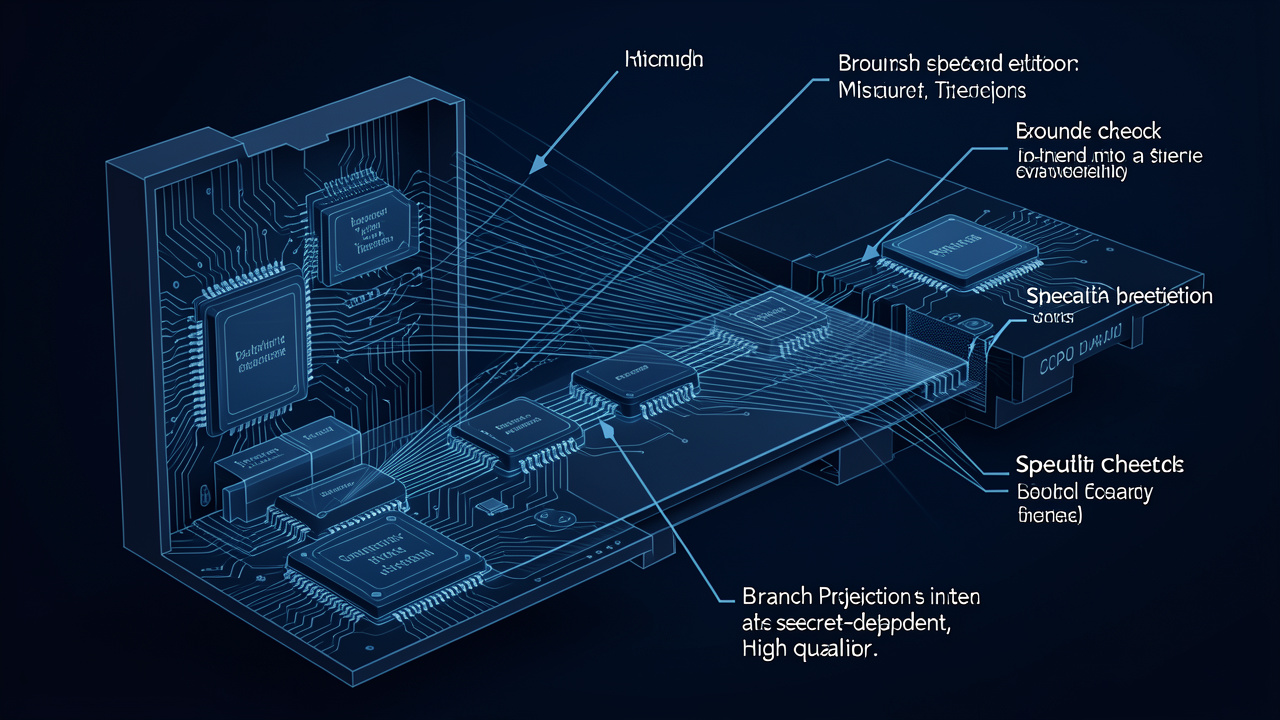
A deep analysis of Spectre v1-v4, Meltdown, and the root cause in speculative execution, covering the endless cycle of mitigations and new attack variants that exploit the microarchitectural state.
Contents
On January 3, 2018, the security world changed. Two papers, “Spectre Attacks: Exploiting Speculative Execution” and “Meltdown: Reading Kernel Memory from User Space,” were published simultaneously by researchers from Google Project Zero, Cyberus Technology, and several universities. They demonstrated that the fundamental performance optimization in every modern processor—speculative execution—could be exploited to read arbitrary memory across every security boundary: user/kernel, process/process, guest/host, even enclave/non-enclave.
The attacks were not bugs in the traditional sense. They exploited a design principle that had been correct for correctness but incorrect for confidentiality. The processor speculatively executes instructions past branches, past bounds checks, past page table permission checks—and then discards the architectural state when the speculation turns out to be wrong. But the microarchitectural state—the cache contents, the branch predictor entries, the TLB—is not rolled back. By measuring the microarchitectural side effects of discarded speculative execution, an attacker can exfiltrate secrets that were never architecturally accessible.
This article explains the root cause (speculative execution and its microarchitectural side effects), walks through the canonical variants (Spectre v1 through v4, Meltdown, Foreshadow, ZombieLoad), describes the mitigation landscape (the performance-costing horror show that is KPTI, Retpoline, and microcode updates), and traces the endless cycle of new attacks and new mitigations that continues to this day.
1. Speculative Execution: The Engine of Performance
The fundamental problem in processor design is the memory wall: main memory is 100-300 cycles away from the CPU. To keep the pipeline full, the processor must predict what instructions will execute next and execute them before the outcome of the current instruction is known. This is speculative execution.
The mechanisms of speculation are multiple and interacting:
- Branch prediction. The processor predicts the direction of a conditional branch based on past history (the branch predictor, typically a TAGE or perceptron predictor in modern cores) and speculatively executes down the predicted path.
- Value prediction. The processor predicts the value loaded from memory (valuing locality: loads to the same address often return the same value) and speculatively uses that value.
- Memory disambiguation. The processor predicts that a load does not alias with a preceding store and speculatively executes the load before the store’s address is known.
- Control flow independence. The processor speculatively executes instructions that are control-independent of an unresolved branch, even if they are past the branch in program order.
When speculation is correct, the results are committed to the architectural state, and the processor has saved the latency of waiting for the branch to resolve. When speculation is incorrect, the architectural state (registers, flags, memory) is rolled back to the last correct checkpoint. But the microarchitectural state—the cache, the branch predictor, the translation lookaside buffer (TLB), the line fill buffers—is not rolled back. The speculative execution leaves persistent traces in the microarchitecture.
2. The Cache as a Covert Channel
The microarchitectural state that is most easily exploited is the cache. A memory access during speculative execution brings data into the cache, and that data remains cached even after the speculation is squashed. An attacker can detect which cache lines are present by measuring access times: a cached access takes ~5 ns (L1 hit), an uncached access takes ~100 ns (DRAM). This timing difference is the covert channel through which speculative execution leaks information.
The attack template is:
- Mistrain the branch predictor (or other predictor) to speculatively execute a “gadget” that accesses a secret-dependent address.
- Trigger the speculation with a carefully crafted input that causes the gadget to access memory at an offset determined by a secret byte.
- Measure the cache state using Flush+Reload or Prime+Probe to determine which cache line was brought in, and thus recover the secret byte.
Repeat for each byte of the secret. The entire process can be automated and can exfiltrate kilobytes per second from a victim process, VM, or kernel.
3. Spectre v1: Bounds Check Bypass
Spectre v1 is the simplest variant and the hardest to mitigate. The victim code contains an array bounds check followed by an array access:
if (x < array1_size) {
    y = array2[array1[x] * 4096];
}
The attacker mistrains the branch predictor so that the processor predicts the bounds check as true even when x is out of bounds. The processor speculatively executes the array access array1[x], which reads a secret byte from out-of-bounds memory. The value of that byte (times 4096, to map to distinct cache lines) is used as an index into array2. The access to array2[secret * 4096] brings the corresponding cache line into the cache. The attacker then probes array2 to determine which line was cached, recovering the secret byte.
The 4096 multiplier (the page size) ensures that each possible secret byte maps to a different cache line, avoiding cache line collisions that would obscure the signal.
Spectre v1 can be exploited in any code pattern where a branch protects a memory access and the attacker can mistrain the branch predictor. This includes JavaScript JIT compilers (where the attacker can write JavaScript that triggers speculative execution in the JITed code), operating system kernels, and hypervisors. The attack can cross any security boundary because the speculation occurs within the victim’s address space; it is the victim’s own code that accesses its own memory and leaks it through its own cache footprint.
3.1 Mitigations
The primary software mitigation for Spectre v1 is the lfence instruction (or csdb on ARM, or a serializing instruction). Placing an lfence after a bounds check and before the guarded memory access forces the processor to wait until the branch is resolved before executing the access, preventing speculation past the bounds check. The performance cost is proportional to the number of bounds checks that are protected and can be 5-20% for security-critical code paths.
Google’s Retpoline (return trampoline) is a mitigation for Spectre v2 (see below) but does not directly address v1. Microsoft and Linux kernels have instrumented critical bounds checks with lfence barriers (the nospec accessor macros), and compilers (Clang, GCC, MSVC) have added flags (-mspeculative-load-hardening) that automatically insert speculation barriers before loads whose addresses depend on conditional control flow.
4. Spectre v2: Branch Target Injection
Spectre v2 exploits indirect branch prediction. An indirect branch (jmp *%rax or call *%rax) uses the Branch Target Buffer (BTB) to predict the target address. The BTB is indexed by the lower bits of the branch instruction’s address. An attacker who can execute code on the same core (or a sibling thread in SMT) can pollute the BTB entry for a victim’s indirect branch, causing the victim’s branch to speculatively jump to an attacker-chosen gadget.
The canonical Spectre v2 attack:
- The attacker identifies a “gadget” in the victim’s address space—a code sequence that performs a secret-dependent cache access and is reachable via an indirect branch.
- The attacker repeatedly executes indirect branches from the same virtual address (or an address that aliases to the same BTB entry) to the gadget, training the BTB to predict that target.
- When the victim executes an indirect branch at that address, the BTB predicts the attacker’s gadget, and the victim speculatively executes the gadget, leaking secrets through the cache.
Spectre v2 is more powerful than v1 because the attacker can redirect control flow to arbitrary gadgets in the victim, not just to code that happens to be after a branch in program order.
4.1 Mitigations
Retpoline (Turner, 2018) replaces indirect branches with a call-ret pair. The ret instruction uses the Return Stack Buffer (RSB) for prediction, which is separate from the BTB and can be protected by stuffing the RSB with safe return addresses. The performance cost of Retpoline on Skylake is roughly 5-15% for workloads that are indirect-branch-heavy (e.g., object-oriented code with virtual function calls). Retpoline has been superseded on newer Intel processors by Enhanced Indirect Branch Restricted Speculation (EIBRS), a hardware mitigation that restricts BTB speculation, with near-zero performance cost.
Branch Target Injection barriers (Intel’s IBRS, AMD’s STIBP) restrict the sharing of BTB entries between privilege levels or between logical processors. Enabling IBRS on every kernel entry/exit imposes a 5-30% performance penalty, which is why it is typically enabled only for security-critical paths or when SMT is disabled.
5. Meltdown: Breaking the User-Kernel Boundary
Meltdown (Lipp et al., 2018) targets a specific implementation flaw: on Intel processors (before Ice Lake and Cascade Lake with hardware mitigations), memory accesses that would fault (page not present, page not accessible) are executed speculatively before the fault is delivered. This allows a user-space attacker to speculatively read kernel memory.
The classic Meltdown attack:
- The attacker allocates a probe array in user space.
- The attacker executes a load from a kernel address. The MMU determines that the access will fault (user mode reading kernel memory).
- Before the fault is delivered, the load completes speculatively, and the loaded kernel byte is used as an index into the probe array, leaving a cache footprint.
- The fault is delivered, the architectural state is rolled back, but the cache footprint remains.
- The attacker measures the probe array timing to recover the kernel byte.
Meltdown can read arbitrary kernel memory at rates of hundreds of kilobytes per second—fast enough to dump the entire kernel address space in seconds. This is catastrophic because the kernel’s memory contains all process credentials, file system buffers, network packet data, and cryptographic keys.
5.1 KPTI: The Page Table Isolation Defense
The defense for Meltdown is Kernel Page Table Isolation (KPTI, formerly KAISER). KPTI maintains two page table sets: one with kernel mappings (used when in kernel mode) and one with only minimal kernel trampoline mappings (used when in user mode). When the processor is in user mode, the kernel’s memory is not mapped at all, so speculative access to kernel addresses cannot even resolve the physical address, preventing the cache-timing leak.
KPTI was developed by the KAISER research group shortly before Meltdown’s disclosure and deployed in Linux, Windows, and macOS within weeks of the public announcement. The performance cost is 5-30% depending on workload (syscall-heavy workloads are most affected), which is why later Intel processors (with hardware Meltdown fixes, called RDCL_NO or “Meltdown-proof”) can run without KPTI.
6. Spectre v3 (Meltdown Variants) and Spectre v4 (Speculative Store Bypass)
Spectre v3 is an alternative name for Meltdown. Variants include Meltdown-P (bypassing the page table permission check), Meltdown-GP (bypassing the guest-physical to host-physical translation in virtualization), and Foreshadow/L1TF (speculatively reading from the L1 data cache during a terminal fault).
Spectre v4 (Speculative Store Bypass, or SSB) exploits memory disambiguation. The processor predicts that a load does not alias with an older store whose address is unknown, and speculatively executes the load. If the prediction is wrong (the load does alias with the store), the load receives stale data from the cache, and that stale data can be used in a cache-timing gadget to leak it. Mitigation: SSBD (Speculative Store Bypass Disable), a microcode update that prevents loads from executing until older store addresses are known, with a small performance penalty (1-5%).
7. The MDS Family: Microarchitectural Data Sampling
In 2019, another class of vulnerabilities was disclosed: Microarchitectural Data Sampling (MDS). Unlike Spectre and Meltdown, which exploit speculative execution, MDS exploits the fact that microarchitectural buffers—the line fill buffer (LFB), the load ports, the store buffer—contain stale data from previous operations. By reading from these buffers (using special instructions or speculative loads that bypass the cache coherence protocol), an attacker can sample data that belongs to other processes, the kernel, or other VMs.
The MDS variants include:
- ZombieLoad (LFB sampling): Reads stale data from the line fill buffer, which holds cache lines being transferred between cache levels.
- RIDL (Rogue In-Flight Data Load): Reads stale data from the load ports, which hold data being processed by the execution units.
- Fallout (store buffer sampling): Reads stale data from the store buffer, which holds data waiting to be written to the cache.
- CROSSTALK (2019): Reads stale data across CPU cores through the shared non-coherent staging buffer.
The mitigation for MDS is to flush the microarchitectural buffers on context switches (kernel entry/exit, VM exit) using the VERW instruction, which overwrites the buffers with zeros. The performance cost is 1-10% depending on the frequency of context switches.
8. The Mitigation Landscape: A Performance Horror Show
The cumulative cost of all speculative execution mitigations on a pre-Ice Lake Intel processor is sobering:
| Mitigation | Target | Performance cost |
|---|---|---|
| KPTI (PTI) | Meltdown | 5-30% |
| Retpoline | Spectre v2 | 5-15% |
| IBRS | Spectre v2 | 5-30% (if always on) |
| SSBD | Spectre v4 | 1-5% |
| L1TF flushing | Foreshadow | 1-10% (VM-heavy) |
| MDS flushing | ZombieLoad et al. | 1-10% |
The combined worst-case impact can be 50% or more for syscall-heavy, branch-heavy, or virtualization-heavy workloads. This is the price of retrofitting security onto a microarchitecture not designed for it.
Intel (since Ice Lake and Cascade Lake), AMD (since Zen 2), and ARM (since Cortex-A76) have introduced hardware mitigations that reduce or eliminate the software mitigation overhead. Intel’s eIBRS and hardware MDS clearing make IBRS/KPTI/VERW flushing unnecessary. AMD’s processors were never vulnerable to Meltdown (because AMD’s MMU checks permissions before speculative execution) and are less vulnerable to MDS (because AMD’s internal buffer management is more conservative), making the AMD mitigation story significantly simpler and cheaper.
9. The Endless Cycle: Why New Variants Keep Appearing
Since 2018, the speculative execution attack surface has been systematically mapped by the security research community, and new variants continue to emerge:
- Spectre-BHI (Branch History Injection, 2022): Exploits the branch history table (distinct from the BTB), which stores a global history of recent branch outcomes and is shared across privilege levels.
- Retbleed (2022): Exploits the return stack buffer on Intel and AMD, showing that Retpoline is not a universal defense.
- Post-Barrier Speculation (2021): Shows that some speculation occurs even past architecturally defined speculation barriers, because the barriers are implemented imperfectly.
- Speculative Denial-of-Service (2024): Uses speculative execution to exhaust shared microarchitectural resources (cache sets, TLB entries), degrading the performance of sibling cores or threads.
The root cause is that speculative execution is a performance optimization that trades architectural isolation for speed, and the microarchitecture has many more internal buffers and predictors than are exposed in the architecture manual. Securing speculative execution requires identifying every microarchitectural structure that can hold stale or speculative data, and either clearing it on security boundaries or preventing speculative access to it—a whac-a-mole game that depends on the processor vendor’s willingness to disclose internal microarchitectural details.
10. The Industry Response: Hardware Vulnerability Disclosure and Patching Infrastructure
Spectre/Meltdown catalyzed a transformation in how hardware vulnerabilities are handled. Before 2018, hardware errata were handled by OEM firmware updates with minimal public disclosure. After 2018, the industry adopted a software-style vulnerability disclosure model: coordinated disclosure, CVE identifiers, CVSS scores, and OS-level mitigations delivered as kernel patches and microcode updates.
The microcode update mechanism, originally designed for patching rare functional bugs, became a monthly delivery channel for speculative execution mitigations. Intel’s microcode is now cryptographically signed, tested against a regression suite of thousands of workloads, and deployed through OS vendor update channels (Windows Update, Linux distribution package managers, cloud provider firmware management).
This is a remarkable shift: the processor’s internal control logic is now routinely reprogrammed in the field to close security vulnerabilities. The boundary between hardware and software has blurred, and the response to speculative execution attacks has been the primary driver of this convergence.
11. Formal Models of Speculative Execution and Speculative Non-Interference
The discovery of Spectre exposed a gap in formal security models. Classical non-interference—the property that high-security inputs do not influence low-security outputs—is defined for the architectural semantics of a program. Speculative execution operates below the architectural semantics, producing microarchitectural effects that are invisible in the standard model. This section develops the formal framework for reasoning about speculative leakage.
11.1 Speculative Semantics
To reason about speculative attacks, we need a speculative semantics: a transition system where each architectural state (\sigma) is paired with a microarchitectural state (\mu), and transitions come in two flavors:
- Speculative transitions: (\langle \sigma, \mu \rangle \rightarrow_{\text{spec}} \langle \sigma’, \mu’ \rangle). These may be later squashed, restoring (\sigma) but not (\mu).
- Commit transitions: (\langle \sigma, \mu \rangle \rightarrow_{\text{commit}} \langle \sigma’, \mu’ \rangle). These are the visible architectural steps.
The key property of speculative semantics is: squashing a speculative transition restores the architectural state but does not restore the microarchitectural state. Formally:
[ \text{If } \langle \sigma, \mu \rangle \rightarrow_{\text{spec}} \langle \sigma’, \mu’ \rangle \text{ and the speculation is squashed, then } \sigma \text{ is restored but } \mu’ \text{ persists.} ]
11.2 Speculative Non-Interference
Cheang et al. (2019) formalized speculative non-interference (SNI) as a security property for programs running on speculative hardware. A program satisfies SNI if, for any two initial states that differ only in secret inputs, the final microarchitectural states (after all speculation has resolved or been squashed) are indistinguishable to an attacker who can observe microarchitectural side effects.
Formally, let (\approxL) denote low-equivalence (indistinguishable to the attacker) and (\sim{\mu}) denote microarchitectural indistinguishability. Then:
[ \forall \sigma1, \sigma_2. ; \sigma_1 \approx_L \sigma_2 \implies \text{exec}{\text{spec}}(\sigma1) \sim{\mu} \text{exec}_{\text{spec}}(\sigma_2) ]
SNI is violated by Spectre gadgets: two inputs that differ in an out-of-bounds value (which the attacker should not know) lead to different cache footprints (which the attacker can observe). The challenge for verification is that SNI must be checked against the speculative semantics, which depends on the specific microarchitecture—a much larger state space than the architectural semantics.
11.3 Model Checking Speculative Leaks
Several tools have been developed for detecting speculative leaks:
- Pitchfork (Cauligi et al., 2022): A symbolic execution engine that explores the speculative execution paths of a program, using a model of the branch predictor, and detects when secret-dependent data reaches a cache-timing-sensitive instruction.
- SpecCheck (Deng et al., 2021): A model checker for RISC-V cores that verifies SNI for specific hardware designs by exhaustively exploring the state space of the microarchitectural pipeline.
- Revizor (Oleksandrov et al., 2022): A fuzzer for CPU implementations that generates random programs, executes them, and detects violations of speculative contract assumptions (like “speculative execution does not access memory beyond the architectural permissions”) using performance counter measurements.
Revizor has found several previously undisclosed speculative execution vulnerabilities in commercial processors, demonstrating that automated testing of hardware is feasible and productive.
11.4 The Provably Secure Hardware Agenda
The long-term response to speculative execution vulnerabilities is provably secure hardware: processor designs where non-interference (including speculative non-interference) is proved as a theorem about the hardware description language (HDL) implementation. The MI6 project (Bourgeat et al., 2021) at MIT demonstrated a RISC-V core designed in Bluespec SystemVerilog and formally verified (using the Coq proof assistant) to satisfy a specification that rules out Spectre-like leaks by construction.
MI6’s approach is to tag all microarchitectural state with the security domain that produced it, and to enforce that tagged data from one domain cannot influence the microarchitectural state visible to another domain—even during speculative execution. The tags are carried through all internal buffers (load queue, store buffer, line fill buffer) and checked at every resource allocation and deallocation. The performance overhead is roughly 5-15% compared to an unsecured baseline—competitive with software mitigations but with formal guarantees.
12. Inside the Branch Predictor: TAGE, Perceptron, and the Exploitation Surface
Spectre attacks depend on the ability to mistrain the branch predictor. Understanding the internal structure of modern branch predictors reveals why they are so vulnerable—and what a secure predictor might look like.
12.1 The TAGE Predictor
The TAgged GEometric (TAGE) predictor, used in Intel’s Core microarchitecture since Sandy Bridge and in ARM’s Cortex-A7x series, organizes prediction tables by branch history length. A TAGE predictor has multiple predictor tables (T_0, T_1, \ldots, T_n), where (T_i) is indexed by a hash of the program counter (PC) and a history of the last (L_i = \alpha \cdot \beta^i) branch outcomes (geometrically increasing history lengths). The prediction is taken from the table with the longest matching history (the “provider component”).
The TAGE is trained by speculative outcomes: if a branch is speculatively predicted, and the prediction is later confirmed or corrected, the provider component is updated. This means that any code that executes on the same logical processor can influence the TAGE state for any branch whose indexing hash collides with its own. An attacker can construct a branch at a carefully chosen address such that its history-PC hash collides with a victim branch, and then execute that branch repeatedly with a specific outcome to train the TAGE entry that the victim will use.
12.2 Aliasing and Collision Attacks
The hashing functions used in TAGE are not cryptographically secure—they are simple XORs and shifts designed for speed and uniform distribution, not for collision resistance. This makes aliasing attacks feasible: the attacker finds an address whose PC-history hash collides with the victim’s branch, then trains the predictor at that address. Spectre v2 (BTB injection) is a special case of aliasing where the indexing function is simply the low bits of the PC.
The security community has proposed keyed hash functions for predictor indexing, where the hash includes a random key (a “predictor nonce”) that is set at boot time and unknown to the attacker. Without knowing the key, the attacker cannot construct a collision with the victim’s branch. This is the hardware analog of ASLR (Address Space Layout Randomization) and has been adopted in some ARM cores (Cortex-A78 and later) for the BTB indexing.
12.3 The Perceptron Predictor and Its Vulnerabilities
AMD’s Zen microarchitecture uses a perceptron branch predictor: a neural-network-inspired design where each branch outcome is predicted by a dot product of a weight vector (learned from past outcomes) and a feature vector (derived from the branch history and PC). The perceptron is trained online using a variant of the perceptron learning rule: weights are incremented when the corresponding feature agrees with the branch outcome, and decremented when it disagrees.
The perceptron predictor is, in principle, more resistant to aliasing than TAGE because the prediction is a global function of many weights, not a single table entry. However, perceptron predictors are still vulnerable to adversarial training: an attacker who can execute code on the same core can supply a sequence of branch outcomes designed to drive specific weights to extreme values, causing the predictor to make a specific misprediction for a subsequent victim branch. This is the analog of adversarial examples in machine learning, applied to the branch predictor.
12.4 Secure Predictor Design Principles
Research on secure branch predictors has identified several design principles:
- Process-keyed indexing: All predictor tables are indexed by a combination of PC, history, and a per-process random key (re-randomized on context switch).
- Speculation-aware training: Predictor updates from speculative execution are deferred until the speculation is committed, preventing transient execution from training the predictor.
- Capacity partitioning: Predictor tables are partitioned by security domain (e.g., by process ID or VM ID), preventing cross-domain interference even if aliasing occurs.
- Deterministic worst-case bounds: The predictor is designed to guarantee that no sequence of attacker-controlled branches can force a specific misprediction for a victim branch—a form of non-interference at the predictor level.
These principles have been adopted to varying degrees in recent processor designs. Intel’s Alder Lake (12th gen) introduced process-keyed BTB indexing, and AMD’s Zen 4 introduced speculation-aware training for the perceptron weights. However, full adoption of all four principles is likely to require a ground-up redesign of the prediction subsystem.
13. Covert Channel Capacity: Information Theory of Speculative Leakage
Understanding the capacity of speculative execution covert channels—how many bits per second can be leaked—is essential for assessing the practical risk and designing effective mitigations.
13.1 Flush+Reload vs. Prime+Probe
The two dominant cache-based covert channel techniques have different characteristics:
- Flush+Reload: The attacker flushes a shared cache line (using
clflushor equivalent), waits for the victim to execute (potentially accessing that line), then measures the reload time. If the reload is fast, the victim accessed the line. This requires shared memory (the attacker and victim map the same physical page), limiting its applicability to same-machine, shared-library scenarios. - Prime+Probe: The attacker fills a cache set with their own data (“priming”), waits for the victim to execute, then measures the access time to their own data (“probing”). If any access is slow, the victim evicted the attacker’s data, indicating which cache set the victim accessed. Prime+Probe does not require shared memory and works across VM boundaries, making it the more general technique.
13.2 Channel Capacity Analysis
Let (T*{\text{hit}}) be the L1 cache hit latency (typically 4-6 cycles, ~1.5-2 ns at 3 GHz) and (T*{\text{miss}}) be the DRAM access latency (typically 200-300 cycles, ~60-100 ns). The timing measurement has a noise distribution due to prefetcher activity, cache replacement policy jitter, and OS scheduling. The Shannon capacity of the channel depends on the signal-to-noise ratio (SNR).
For a binary channel (cached vs. not cached) with Gaussian noise, the capacity is:
[ C = \frac{1}{2} \log2\left(1 + \frac{(T{\text{miss}} - T_{\text{hit}})^2}{\sigma^2}\right) \text{ bits per probe} ]
where (\sigma^2) is the timing noise variance. In practice, (\sigma) is 5-20 cycles on a quiet system, giving an SNR of roughly 10-20 dB and a capacity of ~2-4 bits per probe. With 10^6 probes per second (limited by the cache flush and reload time), the practical leakage rate is 2-4 Mbps—fast enough to exfiltrate cryptographic keys in milliseconds.
13.3 Error Correction and the “Berlekamp-Massey for Cache”
Real-world Spectre and Meltdown exploits use error correction to recover secrets from noisy measurements. The attacker repeatedly probes the same secret byte, collecting multiple noisy observations, and applies a majority vote or Reed-Solomon decoding. The Berlekamp-Massey algorithm, originally developed for decoding BCH and Reed-Solomon codes, has been adapted for cache-based leakage: each probe is treated as a symbol in a noisy codeword, and the secret is recovered by solving for the most likely transmitted codeword given the observed cache line accesses.
This error correction is one reason why even “noisy” speculative execution—where only a fraction of speculations leave a detectable cache trace—can still be exploited in practice. If even 10% of speculative accesses are detectable, coding theory guarantees that the secret can be recovered with enough repetitions.
13.4 The Fundamental Limit: Speculative Window Size
The speculative window—the number of instructions that can be executed speculatively before the branch resolves—places a fundamental limit on the complexity of the leakage gadget. On a modern out-of-order core (e.g., Intel Golden Cove, ARM Cortex-X2), the reorder buffer holds 512-750 instructions, and the processor can speculatively execute ~200-400 instructions past an unresolved branch. This is enough for a multi-step gadget: load a secret, compute a hash of the secret, index into a probe array, and trigger a cache fill.
If the speculative window were reduced to, say, 16 instructions, most Spectre gadgets would not fit within it and the attack surface would be dramatically reduced. However, reducing the speculative window also reduces performance: the processor’s ability to hide memory latency depends on the window size. This is the fundamental tradeoff: larger windows improve performance but increase the Spectre attack surface.
14. Hardware Mitigation Architecture: Microcode, MSRs, and the ISA Contract
The Spectre mitigation ecosystem relies on a complex infrastructure of microcode patches, Model-Specific Registers (MSRs), and new ISA extensions. Understanding this infrastructure illuminates the engineering challenge of retrofitting security onto deployed hardware.
14.1 The Microcode Update Mechanism
Modern x86 processors execute complex instructions by translating them into sequences of simpler micro-operations (uops), which are stored in a microcode ROM. The microcode ROM is patchable: processor vendors can distribute microcode updates that modify the uop sequences for specific instructions. The update is loaded at boot time (by BIOS/UEFI or the OS) and persists until reset.
Microcode updates for Spectre/Meltdown modify:
- The behavior of indirect branch uops (to implement IBRS and IBPB).
- The behavior of
verwandwbinvd(to flush internal buffers for MDS and L1TF). - The speculation control logic (to implement SSBD).
Microcode updates are cryptographically signed with a key that is fused into the processor during manufacturing, preventing unauthorized modification. The signature is verified by the processor’s power-on self-test before the update is applied.
14.2 Model-Specific Registers and the Speculation Control Interface
Intel and AMD expose speculation control through a set of MSRs:
MSR_IA32_SPEC_CTRL(0x48): Bit 0 enables IBRS (Indirect Branch Restricted Speculation), bit 1 enables STIBP (Single Thread Indirect Branch Predictors), bit 2 enables SSBD.MSR_IA32_PRED_CMD(0x49): Write-only. Writing bit 0 triggers an IBPB (Indirect Branch Prediction Barrier), which flushes all indirect branch predictor state.MSR_IA32_FLUSH_CMD(0x10B): Write-only. Writing bit 0 triggers an L1D flush.
These MSRs are accessed via the wrmsr and rdmsr instructions, which are privileged (ring 0). The OS kernel writes to these MSRs on context switches and privilege transitions to enforce speculation boundaries.
14.3 The Speculation Barrier ISA Extensions
Recent ISA revisions have added explicit speculation barrier instructions:
- Intel
lfence: A load fence that also serves as a speculation barrier on processors whereMSR_IA32_SPEC_CTRL[2](SSBD) is set. - ARM
csdb(Consumption of Speculative Data Barrier): Prevents speculative use of data loaded before the barrier in instructions after the barrier. - ARM
sb(Speculation Barrier): A full speculation barrier, preventing any instruction after the barrier from being speculatively executed before the barrier. - RISC-V
fence.tso: A fence instruction that can be used to construct speculation barriers, though RISC-V designs have generally been less vulnerable due to simpler speculation implementations.
14.4 The Verification Gap
The microcode and MSR mitigation architecture has a fundamental problem: there is no formal specification of what the mitigations guarantee. The ISA manuals describe the instructions and MSRs, but they do not provide a formal model of speculation that could be used to prove that a given mitigation prevents a given class of attacks. This verification gap means that each new Spectre variant is discovered empirically (by researchers probing the microarchitecture) rather than being ruled out by a theorem about the mitigation.
Closing this gap requires processor vendors to publish speculative ISA models—formal descriptions of which microarchitectural state is visible across which security boundaries—and to provide machine-checkable proofs that the hardware satisfies these models. The MI6 project and ARM’s Morello capability architecture are early steps in this direction, but the industry as a whole is still operating in a patch-and-pray mode.
15. Speculative Attacks Beyond CPUs: GPUs, NPUs, and the Broader Accelerator Surface
While Spectre and Meltdown targeted CPU speculation, the principle—that accelerated execution that leaves microarchitectural traces creates a side channel—applies to all programmable accelerators.
15.1 GPU Speculation and Thread-Level Side Channels
Modern GPUs (NVIDIA Ampere/Ada Lovelace, AMD RDNA 3, Intel Arc) execute thousands of threads concurrently on streaming multiprocessors (SMs). Threads are grouped into warps (NVIDIA) or wavefronts (AMD), and the warp scheduler speculatively issues instructions from multiple warps to hide memory latency. If one warp accesses memory that another warp’s data depends on, and the access is squashed (e.g., due to a branch divergence), the cache footprint remains.
Jiang et al. (2022) demonstrated GPU Spectre: a malicious GPU compute kernel that mistrains the warp scheduler to speculatively execute memory accesses that leak data from a co-resident victim kernel through the L2 cache. The attack is cross-process: two CUDA kernels from different processes, sharing the same GPU, can leak data through the GPU cache hierarchy. The mitigation is GPU context flushing (invalidating the GPU caches on context switch), which imposes a 5-15% performance overhead for GPU workloads.
15.2 NPU and Systolic Array Timing Channels
Neural Processing Units (NPUs) like Apple’s Neural Engine, Google’s TPU, and Intel’s AMX use systolic arrays—grids of processing elements that rhythmically compute and pass data. The timing of systolic array operations depends on the data values being computed (due to sparsity-aware computation: zero-valued weights or activations can skip MAC operations). An attacker who shares an NPU with a victim can measure the execution time of their own inference jobs and infer properties of the victim’s model weights or input data.
This is the model extraction via timing attack, well-known in the ML literature but newly relevant as NPUs become shared multi-tenant resources in cloud environments. The defense is deterministic scheduling: the NPU is configured to always execute a fixed number of cycles for each operation, regardless of data values, eliminating the timing side channel at the cost of reducing the benefit of sparsity (typically a 10-30% throughput reduction).
15.3 The Unifying Principle: All Acceleration Is Speculation
The broader lesson of Spectre is that any performance optimization that breaks the abstraction of sequential, in-order, isolated execution creates a potential side channel. This includes:
- Prefetchers (cache, instruction, TLB): They speculatively load data before it is requested, leaving cache footprints.
- Out-of-order execution: It reorders instructions, creating transient states that are architecturally invisible but microarchitecturally observable.
- Value prediction and memory dependence prediction: They speculate on data values, creating transient data flows.
- SIMD and vector lanes: They process multiple data elements in parallel, with timing that depends on the alignment and values of the data.
Each of these accelerations has been shown to create exploitable side channels in at least one processor design. The future of secure computer architecture must treat all forms of speculation and acceleration as potential side-channel sources and design them with formal non-interference guarantees from the start.
16. Case Study: NetSpectre — Remote Exploitation of Speculative Leaks
While the initial Spectre demonstrations required local code execution (the attacker runs a program on the victim machine), the NetSpectre attack (Schwarz, Schwarzl, Lipp, and Gruss, 2018) demonstrated that Spectre-style attacks can be mounted remotely over the network, without any code execution on the victim machine. This dramatically expanded the threat model from “malicious co-located process” to “any network adversary.”
The Attack Architecture. NetSpectre targets a network service that processes attacker-controlled data (e.g., a web server, a DNS resolver, or a VPN gateway). The attacker sends specially crafted network packets that cause the victim service to perform a secret-dependent memory access—specifically, data controlled by the attacker is used as an index into a lookup table, and a bit of the victim’s secret (e.g., a private key) influences which table entry is accessed. The key insight is that the attacker need not run arbitrary code; the victim’s legitimate code already contains gadgets that, when triggered with attacker-controlled inputs, leak information via the cache state. NetSpectre implements a bit-by-bit exfiltration strategy: the attacker sends one specially crafted packet, waits for the service response (or lack thereof, in a timeout-based variant), and infers one bit of the secret from the response timing.
The Statistical Challenge. Remote Spectre attacks face a formidable signal-to-noise problem. The timing difference caused by a single cache hit versus miss is on the order of 5–20 ns, while network jitter adds noise of 100–1,000 µs—three to five orders of magnitude larger. NetSpectre overcomes this by repetition: for each bit of the secret, the attacker sends thousands of identical requests and measures the average response time. By the law of large numbers, the average converges to the true mean (plus or minus the cache state effect), and the signal emerges from the noise. The NetSpectre authors demonstrated a bit rate of approximately 0.5 bits per hour for a remote attack over a LAN, recovering a 2048-bit RSA key in approximately 170 days. Over a WAN with higher jitter, the bit rate drops to 0.01 bits per hour, making key recovery infeasible for standard key sizes—but still practical for small secrets like session tokens or passwords.
     Attacker                               Victim Server
        |                                        |
        |-- Crafted HTTP request --------------->|
        |   (contains index into lookup table)   |
        |                                        |
        |    Victim speculatively accesses       |
        |    table[secret_bit * 4096 + attacker] |
        |                                        |
        |<-- HTTP response ---------------------|
        |    (timing leaks cache hit/miss)       |
        |                                        |
        |-- Repeat 10,000 times per bit -------->|
        |   Average response time reveals bit    |
        |                                        |
        |-- After N hours: full secret recovered |
Gadget Discovery in Network Services. NetSpectre’s second key contribution was demonstrating that network-facing code already contains Spectre gadgets. The canonical gadget is a bounds-check bypass in a packet-processing loop: the code receives a length field from the network, checks that it is within bounds, and then (speculatively, before the bounds check resolves) accesses an array at the attacker-controlled index. This pattern appears in virtually every network application—web servers processing HTTP headers, DNS servers parsing query names, VPN gateways decrypting packets. NetSpectre did not require the victim to run a malicious binary; it exploited the victim’s own, legitimate code, triggered by carefully chosen network inputs.
Defenses Against Remote Spectre. NetSpectre can be mitigated at multiple layers:
- At the network layer: Rate limiting and request fingerprinting can detect the repeated, highly similar requests characteristic of statistical side-channel attacks.
- At the compiler layer: Speculative load hardening (see Section 17) can instrument vulnerable code patterns to prevent speculative out-of-bounds accesses.
- At the hardware layer: Microcode updates that restrict speculation across privilege boundaries (IBRS, STIBP) are partially effective, but NetSpectre operates within a single privilege level, bypassing these defenses.
- At the application layer: The most robust defense is to avoid secret-dependent memory accesses entirely—the same constant-time discipline discussed in the side-channel article. For network-facing services, this means ensuring that no attacker-controlled input influences the address of any memory access that depends on a secret.
17. Compiler Defenses: Retpolines, Speculative Load Hardening, and Automated Mitigation
The Spectre era triggered a rapid evolution in compiler-based security mitigations. Compilers occupy a unique position in the Spectre defense stack: they can transform source code to eliminate or contain speculative execution leaks without requiring changes to the hardware or the source language.
Retpolines: The First Line of Defense. A retpoline (return trampoline), introduced by Google’s Paul Turner in January 2018, is a compiler-generated code sequence that replaces indirect branches with a construct that cannot be speculatively predicted by the branch predictor. Instead of jmp *%rax (which the CPU’s indirect branch predictor may speculatively mispredict to an attacker-chosen target), the compiler emits:
    call    set_up_return
capture_spec:
    pause          ; speculation trap
    lfence
    jmp     capture_spec
set_up_return:
    mov     %rax, (%rsp)  ; overwrite return address
    ret                   ; return to the intended target
The ret instruction’s prediction uses the Return Stack Buffer (RSB), not the indirect branch predictor, and the RSB is less susceptible to attacker-controlled poisoning in the Spectre v2 threat model. If the CPU speculatively executes past the call, it enters an infinite pause loop that cannot leak information. Retpolines were deployed in Linux kernel builds, LLVM, GCC, and MSVC within weeks of the Spectre disclosure, and they remain the default mitigation for Spectre v2 on processors that lack hardware IBRS/IBPB support.
Speculative Load Hardening (SLH). SLH, introduced by Google in LLVM (2018), protects against Spectre v1 (bounds check bypass). The compiler instruments every load instruction whose address depends on user-controlled data (identified via taint analysis from function parameters marked as “speculatively unsafe”). The instrumentation inserts a speculation barrier predicate: before the load, the compiler computes a mask that is all-zeros if the access is in-bounds and all-ones if out-of-bounds. The mask is ANDed with the load address, forcing out-of-bounds accesses to target address zero (which is unmapped, causing a fault that aborts speculation). The key engineering challenge is minimizing the performance overhead of mask computation—naive SLH adds 20–40% overhead, but optimization techniques (hoisting mask computation out of loops, reusing masks across multiple loads) reduce this to 5–15% for most workloads.
Automated Gadget Hardening. The LLVM compiler now includes a suite of automated Spectre mitigations:
-mllvm -x86-speculative-load-hardening: Enables SLH for all functions.-mllvm -x86-speculative-load-hardening-lfence: Useslfenceinstead of mask-based hardening (higher overhead but guaranteed to block all speculation).-mretpoline: Enables retpoline generation for all indirect calls and jumps.-mspeculative-load-hardening-data-dependent: Protects against Spectre v4 (SSB) by insertinglfencebetween stores and loads that the compiler cannot prove are independent.
The Limits of Compiler Defenses. Compiler mitigations have two fundamental limitations. First, they are specification-free: there is no formal model of what a “speculatively safe” program is, and thus no machine-checkable proof that a compiler-generated mitigation is correct. The retpoline sequence above was designed by reasoning about the behavior of existing branch predictors, but new predictor designs (e.g., the Itanium-style predictor considered for some server processors) may not respect the same constraints. Second, compiler mitigations are conservative: they introduce barriers on all potentially vulnerable code paths, many of which are not exploitable in practice, incurring unnecessary performance overhead. The ideal is a hardware-software co-design where the hardware provides precise speculation control primitives and the compiler uses them selectively on provably vulnerable paths.
18. Measuring the Mitigation Tax: Benchmarking Methodology and Real-World Performance Impact
The Spectre/Meltdown mitigations collectively constitute one of the largest performance regressions in the history of general-purpose computing. Quantifying this “mitigation tax” is essential for capacity planning and for evaluating the cost-effectiveness of different mitigation strategies. However, measuring it accurately is surprisingly subtle.
The Benchmarking Problem. Naively comparing before-mitigation and after-mitigation performance is not straightforward because:
- Mitigations interact: Enabling KPTI (Meltdown defense) changes the TLB pressure, which affects the performance of retpolines (Spectre v2 defense), which in turn changes the effectiveness of SLH (Spectre v1 defense). The overheads are not additive.
- Workload dependence: System-call-heavy workloads (e.g., web servers, databases) suffer disproportionately from KPTI (10–30% overhead) due to increased TLB miss rates on kernel entry/exit. Compute-heavy workloads with few system calls (e.g., HPC, ML training) see negligible KPTI overhead but may suffer from retpoline overhead in indirect-call-heavy code.
- Microarchitecture dependence: The same mitigation has different costs on different processor generations. Intel’s Cascade Lake added hardware mitigations for some MDS variants, reducing the need for software workarounds. AMD processors were never vulnerable to Meltdown and thus never paid the KPTI tax.
Representative Measurements. The Linux kernel’s /sys/devices/system/cpu/vulnerabilities/ interface exposes which mitigations are active, allowing automated benchmarking across configurations. Representative measurements from Phoronix and the Linux Kernel Performance Project (2020–2023):
- KPTI (Meltdown): 5–30% overhead on system-call-heavy workloads. Database OLTP workloads (PostgreSQL, MySQL) lose 15–20% throughput. Web servers (Nginx, Apache) lose 5–10% throughput. HPC workloads (HPL, HPCG) lose <1%.
- Retpolines (Spectre v2): 3–10% overhead on indirect-call-heavy workloads. Python and Ruby interpreters (which use indirect calls for method dispatch) lose 5–8%. The Linux kernel’s networking stack (which uses indirect calls for protocol handlers) loses 3–5%.
- SLH (Spectre v1): 5–15% overhead when enabled globally, but typically deployed only for specific vulnerable functions (e.g., browser JavaScript JIT compilers), reducing the average overhead to <1% for most workloads.
- MDS mitigations: 5–40% overhead on hypervisor workloads due to L1D flushes on VM exit. Public cloud providers (AWS, Azure, GCP) absorbed this overhead by deploying new hardware with hardware MDS mitigations (Cascade Lake and later).
The Cumulative Tax. For a typical cloud workload (web serving + database) on pre-Cascade Lake Intel hardware with all mitigations enabled, the cumulative overhead is 20–35% compared to unmitigated performance. This represents billions of dollars in additional compute capacity purchased to maintain pre-Spectre service levels. The mitigation tax has been a significant driver of cloud migration to newer hardware generations (Ice Lake, Sapphire Rapids) and to AMD EPYC processors, which have fewer speculative vulnerabilities and lower mitigation overhead.
The Future: Performance-Neutral Mitigations. The goal of the next-generation mitigation architecture is performance-neutral security: hardware that guarantees non-interference between security domains without requiring software workarounds. ARM’s Morello (CHERI-based) and the Capability Hardware Enhanced RISC Instructions (CHERI) project at Cambridge demonstrate that it is possible to eliminate spatial memory safety violations (including speculative ones) with near-zero performance overhead by extending the ISA with hardware capabilities. The x86 ecosystem lags behind, but Intel’s APX extension and AMD’s SEV-SNP include features that reduce the need for software speculation barriers. The long-term vision is a hardware-software contract where the hardware guarantees that speculative execution never violates security boundaries, obviating the need for compiler-inserted speculation barriers entirely.
19. L1 Terminal Fault (L1TF/Foreshadow): When the L1 Cache Leaks Across VMs
While Meltdown targeted the user/kernel boundary and Spectre targeted intra-process isolation, the L1 Terminal Fault (L1TF) attack—disclosed as Foreshadow in August 2018—targeted the most valuable security boundary in cloud computing: the hypervisor-enforced isolation between virtual machines. L1TF demonstrated that a malicious guest VM could read the L1 data cache contents of its host hypervisor, and thereby of co-resident guest VMs, breaking the fundamental confidentiality guarantee of public cloud infrastructure.
19.1 The Physical Mechanism
When a memory access encounters a terminal fault—a page table entry indicating the page is not present (the Present bit is zero), or that the access violates page permissions—the physical address is not resolved, and the processor delivers a fault to the operating system. However, on vulnerable Intel processors, the load micro-operation still accesses the L1 data cache in parallel with the page table walk, using a partial physical address derived from the page table before the fault is recognized. If the L1 cache contains data at that partial physical address, the data is forwarded to dependent instructions speculatively, before the fault aborts execution.
The “terminal” in L1 Terminal Fault refers to the fact that the fault is guaranteed—there is no scenario in which the access would succeed after speculation resolves. Unlike Spectre, where the branch prediction might be correct and the speculative path might commit, an L1TF access always faults. The speculative data that flows from the L1 cache through this guaranteed-fault path can be exfiltrated using the same cache-timing side channels as Meltdown: the leaked value indexes a probe array, and the attacker measures which cache line was brought in.
19.2 The Virtualization Attack Scenario
The most dangerous L1TF scenario is cross-VM leakage. In a virtualized environment, the attacker controls a guest VM running on a vulnerable Intel processor. The hypervisor (KVM, Xen, Hyper-V) maps its own memory and the memory of other guest VMs into the host physical address space. The attacker’s guest repeatedly triggers L1TF accesses to host physical addresses using a gadget in the guest kernel or userspace. Each L1TF access speculatively reads one L1 cache line from the host physical address space. By scanning the L1 cache systematically (at cache line granularity, 64 bytes at a time), the attacker can sample the hypervisor’s and co-resident VMs’ memory. The exfiltration rate is limited by the L1 cache size (32 KB per core on Skylake, 48 KB on Ice Lake) and the cache line fill rate, but the attack can be sustained indefinitely, sampling fresh cache lines as the hypervisor and sibling VMs access memory. Intel confirmed that L1TF could leak data across VMs on all processors from Sandy Bridge through Coffee Lake, encompassing the vast majority of cloud server processors in deployment at the time of disclosure.
19.3 Mitigation: L1D Flushing and Core Scheduling
The primary L1TF mitigation is L1 data cache flushing on VM transitions: whenever the processor exits from a guest VM to the hypervisor (a VM exit), the hypervisor executes the wbinvd instruction or writes to MSR_IA32_FLUSH_CMD to invalidate all L1 data cache lines. This ensures the hypervisor’s subsequent memory accesses do not leave data in the L1 cache that the next guest VM could sample. The performance cost of L1D flushing on every VM exit is severe—a VM exit typically occurs every few microseconds for I/O-bound workloads—amounting to 10-40% throughput degradation for virtualized I/O-heavy applications. An alternative mitigation, core scheduling, dedicates entire physical cores to a single security domain: a core that runs a guest VM never runs the hypervisor or another guest VM’s threads. With core scheduling, there is no cross-domain L1 cache pollution, and L1TF is neutralized without cache flushing. Cloud providers generally use a hybrid approach: L1D flushing for I/O VMs with moderate VM exit rates, and core scheduling for compute-bound VMs where VM exits are rare.
19.4 L1TF Variants and the Broader Lesson
L1TF has variants targeting Intel SGX enclaves (Foreshadow-SGX) and System Management Mode (SMM) memory. Foreshadow-SGX bypasses SGX’s memory encryption by reading L1 cache lines before the SGX memory encryption engine encrypts them on eviction—the data in the L1 cache is in plaintext, even for SGX-protected pages. This was the first practical attack to extract data from an SGX enclave without exploiting software vulnerabilities. The broader lesson is that the L1 data cache—the fastest, most intimate level of the memory hierarchy—is a shared microarchitectural resource that must be flushed or partitioned on security boundaries. This lesson generalizes: every shared resource in the memory hierarchy (L1D, L1I, L2, L3, TLBs, line-fill buffers) must be either flushed on domain transition or statically partitioned between domains.
20. AMD vs Intel: A Comparative Anatomy of the Speculative Vulnerability Surface
The Spectre/Meltdown era revealed a stark asymmetry between the two dominant x86 processor vendors. Intel processors were vulnerable to Meltdown, L1TF, and the full MDS family; AMD processors were not. This section analyzes why, at the microarchitectural level, and draws lessons for secure processor design.
20.1 Meltdown: Permission Check Timing
The root cause of Meltdown on Intel processors is that the load unit speculatively forwards data from the L1 cache before the page table walker has verified the page permissions. On Intel Core microarchitectures (Nehalem through Coffee Lake), the load pipeline issues a cache access in parallel with the TLB lookup. If the TLB hits and the linear-to-physical translation is available, the physical address is used to access the L1D immediately—before the permission bits in the TLB entry (User/Supervisor, Read/Write) are checked. Permission checking occurs later in the pipeline, and if it fails, the load is squashed—but the data has already been forwarded to dependent instructions. On AMD processors, the load pipeline checks permissions before issuing the cache access. The TLB lookup returns both the physical address and the permission bits, and the cache access is gated on the permission check. If the permission check fails, the cache access is never issued. This is a design choice: AMD traded a small amount of load latency for resilience against speculative permission bypass—a fundamentally more conservative approach to speculative execution.
20.2 MDS and Internal Buffer Management
The MDS-class vulnerabilities (ZombieLoad, RIDL, Fallout) stem from Intel’s aggressive sharing of internal microarchitectural buffers. On Intel processors with Hyper-Threading, the line-fill buffer (LFB), load buffers, and store buffers are dynamically shared between the two logical processors on the same physical core. When one logical processor allocates an LFB entry, fills it, and releases it, the entry retains stale data until reallocated. The sibling logical processor can then sample that stale data using a faulting or assist-bound load. On AMD processors, the internal buffers are statically partitioned between logical processors. Each gets a dedicated fraction of the entries, and data from one partition never appears in another. This eliminates the cross-thread MDS attack surface entirely, at the cost of reduced buffer utilization when a sibling is idle. AMD’s choice of static partitioning is again the more conservative design: slightly lower peak throughput, but no cross-thread data leakage.
20.3 The Architectural Lesson: Conservative Speculation Wins
Spectre v4 (Speculative Store Bypass) affects both vendors, but AMD’s memory disambiguator defaults to “may alias” unless addresses are known not to alias, reducing the speculation window. With Zen 2 and Zen 3, AMD introduced proactive hardware mitigations—IBPB for fast BTB flushing, Enhanced IBRS for privilege-level BTB isolation, and ASID-tagged BTB entries—making Retpolines unnecessary. AMD’s strategy was to invest in the hardware to eliminate vulnerability classes, enabled by Zen being a newer microarchitecture (2017) than Intel’s Core (2006). The comparative anatomy teaches a clear lesson: conservative speculation is more secure. AMD’s design choices—checking permissions before cache access, statically partitioning buffers, defaulting to “may alias”—all favored security over peak single-thread performance. Cloud providers have shifted significant fleet fractions to AMD EPYC processors, explicitly citing lower Spectre mitigation overhead. For future processor designs, the mandate is clear: anticipate that any speculated-upon value or permission will be exploited, and build in conservative barriers from the start.
21. Apple Silicon and the ARM64 Speculation Model: M1/M2 Under the Microscope
Apple’s transition from Intel x86 to Apple Silicon brought a new speculation model to the Mac platform. Apple’s processors implement the ARMv8.x-A architecture with custom microarchitectures (Firestorm/Icestorm on M1, Avalanche/Blizzard on M2), and their approach to speculative execution differs from both Intel and AMD.
21.1 The ARM Speculation Model
ARMv8.x-A defines speculation barrier instructions (sb, csdb) but intentionally leaves most speculation behavior implementation-defined. Each ARM core design—Apple’s Firestorm, ARM’s Cortex-X, Qualcomm’s Kryo—has its own speculation policies. Apple’s Firestorm (M1) features a 630-instruction reorder buffer—among the largest in any consumer processor—and an aggressive branch predictor (reportedly TAGE with neural network components). The large speculative window makes Firestorm theoretically a rich target, but Apple implements hardware mitigations: privilege-level speculation restriction prevents speculative memory accesses from crossing EL0/EL1; ARMv8.4-A’s DIT extension guarantees data-d3050e2 timing for designated instructions; and FEAT_CSV2 (ARMv8.5-A) provides hardware BTB tagging by exception level and VMID.
21.2 Rosetta 2 and the Cross-ISA Speculation Surface
Apple’s Rosetta 2 binary translator, converting x86-64 to ARM64, introduces a unique speculative attack surface. Translated code preserves x86-like bounds-check-then-access patterns. If the ARM host CPU speculatively executes past a bounds check in translated code, the original Spectre v1 vulnerability is recreated on ARM hardware. Apple’s mitigation inserts csdb barriers after bounds checks in translated code (~2-5% overhead), and relies on hardware privilege-level restriction to prevent speculative kernel access from user-mode translated code.
21.3 Empirical Research and the Disclosure Gap
Unlike Intel and AMD, Apple Silicon’s speculative internals remain opaque—Apple publishes no detailed microarchitecture manuals. Limited public research (as of 2024) has found: no Meltdown-equivalent (privilege check timing prevents user-to-kernel speculative leakage); Spectre v1 susceptibility within the same privilege level; no known MDS-equivalent (buffer management appears to use static partitioning); and a potential GPU-side channel via the M1’s unified memory architecture. Apple’s vertical integration means vulnerabilities would affect hundreds of millions of devices. The opacity creates a security-through-obscurity risk. The responsible path is to publish speculation models—formal descriptions of cross-boundary microarchitectural leakage—as Intel and AMD do through optimization manuals. Without disclosure, the ecosystem cannot build correct, performant mitigations.
22. Summary
Spectre and Meltdown were not the first microarchitectural side-channel attacks—academic papers had warned of the risk since the early 2000s—but they were the first to breach the most fundamental security boundary in computing: the isolation between user mode and kernel mode. The aftermath has been five years of intensive effort by processor vendors, OS developers, and the security research community to map, mitigate, and monitor the speculative execution attack surface.
The mitigations have been expensive—billions of dollars in aggregate performance degradation—but they have held. No publicly documented real-world exploitation of Spectre or Meltdown has occurred outside of controlled demonstrations, though this partly reflects the difficulty of attributing a cache-timing-based information leak in a production environment. The mitigations have also been incomplete, as each new variant demonstrates. The fundamental tension—speculation trades isolation for speed—cannot be resolved without giving up the performance that speculation provides, which is not an option in the competitive processor market.
For the systems researcher, the speculative execution saga is a case study in the long tail of a design decision. Speculative execution was designed in the 1990s, when single-user systems were the norm and security was not a first-order concern. Thirty years later, the security implications are still being discovered and the mitigation costs are still being paid. The lesson: every performance optimization that breaks abstraction boundaries—whether in hardware, in operating systems, or in language runtimes—is a potential security vulnerability waiting to be discovered. The only question is when.