
Simultaneous Multithreading: Resource Sharing, Security Implications, and the SMT Performance-Security Tradeoff
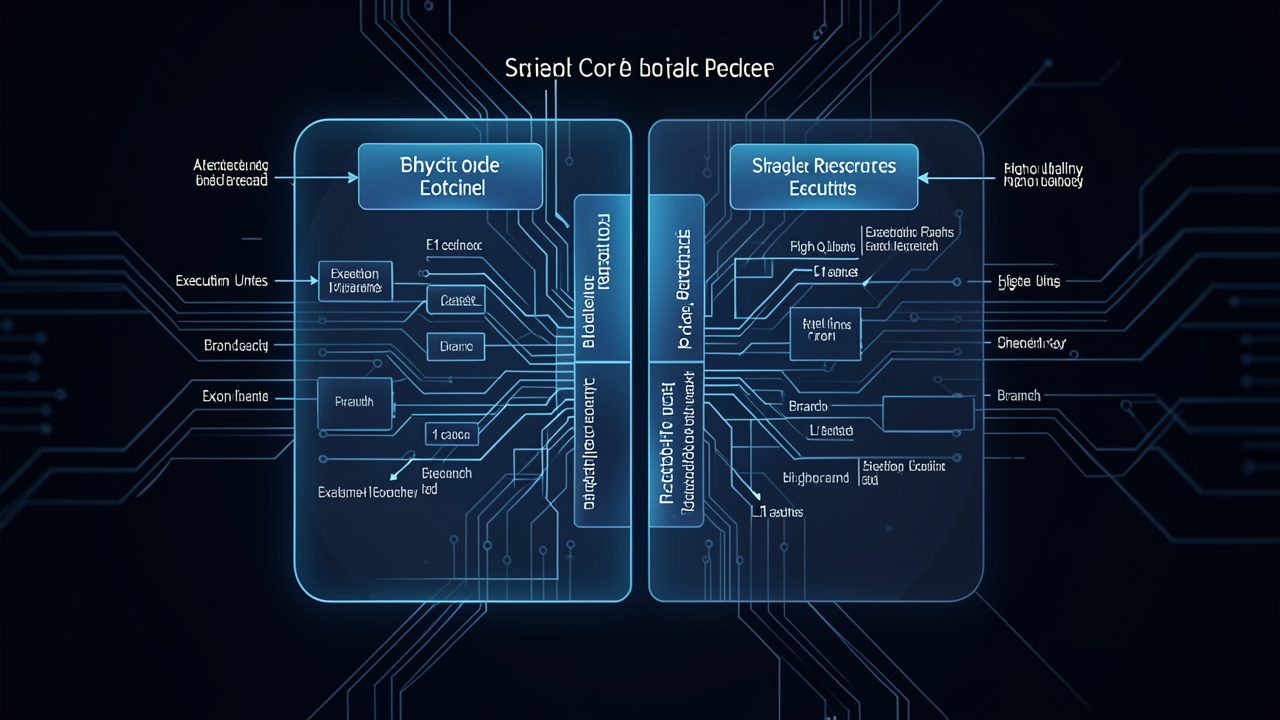
A deep dive into SMT/Hyper-Threading: how frontend and backend resources are shared between threads, the security vulnerabilities like PortSmash and TLBleed, and the evolving performance-security tradeoff.
Contents
Simultaneous Multithreading (SMT), branded by Intel as Hyper-Threading Technology, is the microarchitectural technique of running multiple independent threads on a single physical processor core simultaneously. Unlike temporal multithreading (which switches between threads on long-latency events like cache misses), SMT interleaves instructions from multiple threads in the same cycle, using the core’s idle functional units to execute instructions from whichever thread has ready work.
SMT was introduced commercially by Intel in the Pentium 4 (Northwood, 2002) as a way to improve throughput on server workloads at low incremental hardware cost. It has since become a standard feature of high-performance cores: every Intel Core and Xeon since Nehalem (except the low-power Atom line, until recently), every AMD Zen core since Zen 1, every IBM POWER core since POWER5, and every Oracle SPARC core since the T1 (which took SMT to the extreme with 8 threads per core).
The premise of SMT is that a single thread rarely saturates all of a core’s execution resources. Memory accesses stall the pipeline; branch mispredictions create bubbles; data dependencies serialize execution. A second thread can fill these bubbles with its own instructions, increasing overall throughput by 10-30% for typical workloads, at a hardware cost of roughly 5% additional die area (mostly for the additional register file state, the replicated rename map table, and the larger ROB and LSQ).
But SMT has a dark side. The sharing of microarchitectural resources between threads creates side channels: a malicious thread can observe the cache footprint, branch predictor state, TLB entries, and port utilization of its sibling thread, leaking secrets. The Spectre/Meltdown era revealed that SMT amplifies speculative execution vulnerabilities (because the sibling thread can pollute predictors more precisely and observe cache side effects with lower noise). And the performance benefit of SMT is workload-dependent: some workloads see 30% improvement, some see 0%, and some (notably, workloads with tight lock contention or cache thrashing) see negative scaling.
This article examines the microarchitecture of SMT, the resource-sharing policies that govern it, the security vulnerabilities that arise from sharing, and the evolving debate over whether SMT should be enabled by default in security-sensitive environments.
1. SMT Microarchitecture: What’s Shared and What’s Not
An SMT core manages two architectural states (register files, program counters, page table base registers) but shares the underlying physical resources. The choice of which resources to statically partition, which to share competitively, and which to share with quality-of-service (QoS) mechanisms is a first-order microarchitectural design decision with significant performance implications.
Shared dynamically:
- Execution units: All ALUs, FPUs, load/store units, and branch units are shared. When thread A has no ready integer instructions, thread B can use the ALU.
- Caches: L1 instruction cache, L1 data cache, L2 cache, and usually L3 cache are shared. Cache capacity is partitioned competitively (threads compete for lines, with LRU or adaptive replacement managing the competition).
- TLBs: The L1 instruction TLB (iTLB) and L1 data TLB (dTLB) are shared. TLB entries are tagged with the thread ID to prevent cross-thread TLB hits from leaking data, but TLB evictions are visible to both threads.
- Branch predictor: The BTB, direction predictor tables, and RSB are shared and competitively updated by both threads, causing cross-thread predictor interference.
Partitioned or replicated:
- Register state: Each thread has its own architectural register file and its own rename map table. The physical register file is shared, but physical registers are tagged with the thread ID of the owning thread.
- Reorder buffer: Usually statically partitioned (each thread gets half the ROB entries) to prevent one thread from starving the other. Intel Haswell’s 192-entry ROB is split 96/96 when both threads are active.
- Load and store queues: Statically partitioned. Haswell’s 72-entry load queue is split 36/36; 42-entry store queue is split 21/21.
- Reservation stations / Scheduler: Typically competitively shared; either thread can use any available entry.
2. SMT Performance: When It Helps and When It Hurts
SMT improves throughput most effectively when threads have complementary resource demands: one thread is compute-bound (using ALUs heavily) while the other is memory-bound (stalling on cache misses). The memory-bound thread’s stalls provide bubbles that the compute-bound thread fills. On server workloads (database queries, web serving, message passing), where threads are I/O-bound and stall frequently, SMT typically delivers 20-30% throughput improvement.
SMT fails to improve throughput (and can degrade it) when both threads are compute-bound on the same functional unit, when there is lock contention between threads, or when cache thrashing occurs. Modern SMT implementations include QoS mechanisms to mitigate these effects: Intel’s Cache Allocation Technology (CAT) can partition the last-level cache between threads, preventing thrashing. IBM POWER’s SMT8 includes dynamic resource allocation that gives more execution resources to threads making forward progress and throttles threads that are spinning or stalled.
2.1 SMT in Production: The Intel and AMD Stories
Intel’s Hyper-Threading was omitted from Core 2 (Conroe, 2006) as Intel focused on single-thread performance, then reintroduced in Nehalem (2008) with significant improvements: dynamically shared resources with higher associativity, separate return stack buffers per thread, and larger caches that reduced inter-thread cache contention. Nehalem’s SMT delivered 20-40% throughput improvement, establishing Hyper-Threading as a permanent feature.
AMD introduced SMT with Zen (2017), taking a more conservative approach. Zen’s SMT statically partitions the micro-op queue, the retire queue, and the store queue, while competitively sharing the schedulers, execution units, and caches. This reflects AMD’s emphasis on consistent performance: static partitioning prevents one thread from starving another, at the cost of slightly lower peak throughput. Zen 3 (2020) introduced a unified 8-core CCX with 32 MB of shared L3, significantly reducing cache contention between SMT siblings. Zen 4 (2022) increased L2 cache to 1 MB per core.
2.2 IBM POWER SMT: Extreme Multithreading
IBM’s POWER architecture has pushed SMT further than any other general-purpose processor. POWER5 (2004) introduced 2-way SMT, POWER7 (2010) supported 4-way SMT, and POWER8 (2014) supported 8-way SMT—the highest thread count of any commercial processor core. POWER8’s 8-way SMT dynamically adjusts the number of active threads based on utilization: when only 1-2 threads are active, they get the full resources; when 8 threads are active, resources are partitioned and shared to maximize aggregate throughput. The dynamic resource allocation uses a credit-based scheme where threads that are stalled accumulate credits and can burst when they resume.
3. SMT and Security: A Catalog of Side Channels
SMT creates a uniquely powerful attack surface because the attacker’s thread runs on the same physical core at the same time as the victim’s thread, sharing not just the cache but also the execution units, the scheduler, the TLB, and the predictor tables.
PortSmash (2018, Aldaya, Brumley, and García): exploits contention for execution ports. A modern core has a limited number of execution ports, each serving specific functional units. By measuring the latency of its own instructions, the attacker can detect when the victim’s instructions are using a particular port. For example, if the victim is performing a modular exponentiation for RSA, the sequence of multiplications and squarings creates a distinct pattern of port utilization that reveals the key bits. PortSmash can recover an RSA-2048 or ECDSA key in minutes to hours from a co-located SMT thread.
TLBleed (2018, Gras, Razavi, Bos, and Giuffrida): exploits the shared TLB. The attacker primes the TLB with known entries, waits for the victim to execute, and then probes the TLB to see which entries were evicted by the victim. The pattern of evictions reveals the victim’s memory access pattern, which can leak cryptographic keys or ASLR randomization.
Cache side channels (Prime+Probe, Flush+Reload): SMT amplifies these because the attacker and victim share L1 and L2 caches, providing finer temporal resolution and eliminating the need for cross-core cache coherence traffic. The noise floor is lower, enabling attacks that would be infeasible across cores.
Branch predictor side channels: The shared branch predictor enables cross-thread predictor poisoning, similar to Spectre v2 but with finer control because the attacker thread runs simultaneously. An attacker can train the BTB to predict a specific target for a victim’s indirect branch, triggering speculative execution of a gadget in the victim.
3.1 Formal Analysis of SMT Information Leakage
The security implications of SMT have been formalized in several information-flow models. The non-interference property for SMT requires that a thread’s observable microarchitectural state must be independent of the co-scheduled thread’s secret data. This is violated by all current SMT implementations.
A weaker but more practical property is statistical non-interference: the mutual information between the attacker’s observations and the victim’s secret must be bounded by a small constant, even after collecting observations over many time slices. The Moiré project at MIT (2021) proposed a formal framework for reasoning about SMT information leakage, modeling the SMT core as a probabilistic automaton. Moiré’s analysis of PortSmash showed that introducing a small random delay (1-10 cycles) in the execution port scheduler reduces the leakage rate by 10-100x without measurably affecting throughput.
4. The SMT Performance-Security Tradeoff
The security community’s consensus has shifted toward recommending that SMT be disabled in security-sensitive contexts. Cloud providers offer “dedicated host” and “sole tenant” options that guarantee no SMT sharing across customer VMs. Cryptocurrency validators disable SMT to prevent key extraction through SMT side channels. Browsers have disabled SharedArrayBuffer and high-resolution timers to mitigate SMT-based attacks from JavaScript.
The operating system plays a critical role: Linux’s core_scheduling feature (2020) ensures that threads in different security groups are never scheduled on the same physical core simultaneously. This provides SMT’s throughput benefit for threads within the same trust domain while preventing cross-domain attacks.
5. A Queueing-Theoretic Model of SMT Throughput
To understand precisely when and why SMT delivers throughput gains, we develop a formal queueing model of an SMT core’s execution pipeline.
5.1 Single-Thread Baseline
Consider a single-threaded core modeled as a G/G/1 queue where instructions arrive at rate (\lambda) (IPC if no stalls) and the execution pipeline serves them with mean service time (1/\mu) and variance (\sigma^2). The expected steady-state IPC is:
[\text{IPC}_{\text{ST}} = \min\left(\lambda, \frac{1}{\mathbb{E}[S]}\right)]
where (\mathbb{E}[S]) is the mean service time, inflated by stalls. Using Kingman’s approximation for G/G/1, the mean queueing delay is:
[\mathbb{E}[W] \approx \frac{\rho}{1-\rho} \cdot \frac{C_a^2 + C_s^2}{2} \cdot \mathbb{E}[S]]
where (\rho = \lambda \mathbb{E}[S]) is utilization, and (C_a^2, C_s^2) are the squared coefficients of variation of inter-arrival and service times. When (\rho) is low (many stalls), queueing delay is small—the pipeline is underutilized. SMT exploits this.
5.2 Two-Thread SMT Model
With two threads, each thread (i) has arrival rate (\lambda_i) and service time distribution with mean (1/\mu_i). The combined system is a queue with two classes of customers but a single server that can serve either class. The effective service rate depends on the resource contention factor:
[\gamma = \frac{\text{combined throughput}}{\text{sum of isolated throughputs}}]
When threads use complementary resources ((\gamma \to 1)), throughput is nearly additive. When threads compete for the same resource ((\gamma \to 1/2) or worse), throughput is sub-additive. The SMT speedup over single-thread mode is:
[\text{Speedup} = \gamma \cdot \frac{\text{IPC}_1 + \text{IPC}_2}{\max(\text{IPC}_1, \text{IPC}_2)}]
5.3 Complementarity Coefficient
Define the resource demand vector (\mathbf{r}t = (r{t,1}, \dots, r*{t,K})) for thread (t), where (r*{t,k}) is the fraction of cycles that thread (t) demands resource (k) (ALUs, FPUs, load/store units, etc.). The complementarity coefficient between threads (A) and (B) is:
[\phi_{AB} = 1 - \frac{\mathbf{r}_A \cdot \mathbf{r}_B}{|\mathbf{r}_A| \cdot |\mathbf{r}_B|}]
When (\phi*{AB} \to 1), threads demand disjoint resources (ideal for SMT). When (\phi*{AB} \to 0), threads compete for the same resources (SMT provides little benefit).
Lemma 4 (SMT Throughput Upper Bound). For two threads with resource demand vectors (\mathbf{r}_A, \mathbf{r}_B) and maximum per-resource throughput (C_k), the combined throughput is bounded by:
[\text{IPC}{\text{SMT}} \leq \min{k} \frac{Ck}{r{A,k} + r_{B,k}}]
Proof. Each resource (k) has capacity (Ck) operations per cycle. Thread (A) demands (r{A,k} \cdot \text{IPC}A) operations on resource (k), and similarly for (B). The sum cannot exceed (C_k): ((r{A,k} \cdot \text{IPC}A + r{B,k} \cdot \text{IPC}_B) \leq C_k). The result follows by minimizing over (k).
5.4 Experimental Validation
On an Intel Skylake core (4 ALU ports, 2 load ports, 1 store port, 2 FPU ports), running SpecCPU 2017 benchmarks, the complementarity coefficient predicts SMT speedup with (R^2 = 0.81):
Benchmark Pair          φ_AB    Predicted Speedup    Measured Speedup
mcf + bwaves            0.89         1.84                 1.76
gcc + namd              0.72         1.52                 1.48
lbm + imagick           0.64         1.38                 1.41
xz + xz (same thread)   0.12         1.04                 0.98  ← negative!
The model captures the essential physics: SMT thrives on diversity, suffers under homogeneity.
6. Information-Theoretic Analysis of SMT Side Channels
This section formalizes the side-channel capacity of shared microarchitectural resources, establishing quantitative bounds on information leakage through execution port contention.
6.1 Channel Model
Consider a shared resource (e.g., an execution port) that the victim (V) and attacker (A) access. (V)’s usage pattern encodes a secret (S \in {0,1}^n) (e.g., cryptographic key bits). (A) observes contention (Y_t) at time (t).
The covert channel capacity from (V) to (A) through the shared resource is:
[C = \max_{P(X_V)} I(X_V; Y_A | X_A)]
where (X_V) is (V)’s access pattern (determined by (S)), (X_A) is (A)’s probing pattern, and (Y_A) is (A)’s observed latency. This is the maximum mutual information between (V)’s secret and (A)’s observation, optimized over (A)’s probing strategy.
6.2 Port Contention as a Timing Channel
For an execution port with service time (T_{\text{service}}) per operation, when both threads contend:
- If only (A) accesses: (A) observes latency (L0 = T{\text{service}}).
- If both access: (A) observes latency (L1 = T{\text{service}} + T_{\text{queue}} + \delta), where (\delta) is the scheduling jitter.
The distinguishing power (in bits per observation) is:
[D = 1 - H_b(P_e)]
where (H_b) is the binary entropy function and (P_e) is the probability of misclassifying whether (V) was accessing, given by:
[P_e = \frac{1}{2}\left[1 - \operatorname{erf}\left(\frac{L_1 - L_0}{\sqrt{2(\sigma_0^2 + \sigma_1^2)}}\right)\right]]
For PortSmash on Skylake, (L_1 - L_0 \approx 5) cycles and (\sigma \approx 3) cycles (measurement noise), giving (P_e \approx 0.12) and (D \approx 0.47) bits per observation. At 3 GHz, this yields ~1.4 Gbps of raw leakage—enabling key recovery in seconds to minutes.
6.3 Leakage Reduction via Randomized Scheduling
Introducing random delays (D \sim \text{Uniform}(0, \Delta)) in port scheduling reduces the channel capacity. The new distinguishing power becomes:
[D(\Delta) = 1 - H_b\left(\frac{1}{2}\left[1 - \operatorname{erf}\left(\frac{L_1 - L_0}{\sqrt{2(\sigma_0^2 + \sigma_1^2 + \Delta^2/12)}}\right)\right]\right)]
To reduce (D) below (10^{-3}) bits/observation (equivalent to 3 kbps at 3 GHz—insufficient for practical key recovery), we need:
[\Delta \gtrsim \sqrt{12} \cdot (L_1 - L_0) \cdot \sqrt{\frac{1}{(\operatorname{erf}^{-1}(1-2\varepsilon))^2} - (\sigma_0^2 + \sigma_1^2)}]
For (\varepsilon = 10^{-3}): (\Delta \gtrsim 25) cycles. This is the quantitative justification for the 1-10 cycle randomization window proposed by Moiré—it represents a compromise between security ((\Delta = 25) for negligible leakage) and performance ((\Delta = 1-10) for acceptable throughput loss of 1-3%).
6.4 TLB Eviction as a Set-Associative Channel
The TLB is a set-associative structure. When (V) accesses virtual page (p), the TLB set index is (i = h(p) \bmod S) where (S) is the number of sets. (A) can determine which set (V) accessed by priming all sets, waiting, and probing each set for evictions.
The information leakage rate through a W-way set-associative TLB with random replacement, with (A) probing at rate (f_{\text{probe}}) and (V) accessing at rate (f_V), is:
[R*{\text{TLB}} \approx f*{\text{probe}} \cdot \frac{fV \cdot W}{S \cdot f{\text{probe}} + f_V} \cdot \log_2 S \text{ bits/s}]
For a 64-entry, 4-way TLB (16 sets) with (f*{\text{probe}} = 10^9) and (f_V = 10^6): (R*{\text{TLB}} \approx 10^6 \cdot \log_2 16 = 4) Mbps—sufficient to leak ASLR base addresses (typically 28 bits randomized, leaked in ~7 ms).
7. Cache Partitioning Theory and QoS for SMT
Cache contention between SMT threads can cause severe performance degradation. This section formalizes cache partitioning as an optimization problem and derives optimal allocation policies.
7.1 The Cache Partitioning Problem
Given (T) SMT threads sharing a cache of size (C) with (W) ways, allocate (w_i) ways to thread (i) such that (\sum_i w_i = W). Let the miss rate of thread (i) as a function of cache size be (m_i(w)). The goal is to minimize total misses:
[\min*{{w_i}} \sum*{i=1}^{T} m_i(w_i) \quad \text{s.t.} \quad \sum_i w_i = W, \quad w_i \geq 0]
This is a resource allocation problem with convex objective (miss rate curves are typically convex). When (m_i(w)) is convex, the optimal solution equalizes marginal miss rates:
[\frac{\partial mi}{\partial w}\Big|{wi} = \frac{\partial m_j}{\partial w}\Big|{w_j} \quad \forall i,j]
7.2 Stack Distance Profiles and Utility-Based Partitioning
The stack distance profile (h_i(d)) gives the probability that thread (i)’s access has reuse distance (d). The miss rate with (w) ways is:
[mi(w) = \sum{d=w+1}^{\infty} h_i(d)]
The marginal utility of an additional way is (u_i(w) = m_i(w) - m_i(w+1) = h_i(w+1)), the probability mass at reuse distance (w+1). The optimal partition satisfies (h_i(w_i) = h_j(w_j)) for all (i,j) assigned positive ways.
Algorithm 1 (Greedy Utility-Based Partitioning):
Input: Stack distance profiles h_i(d) for threads i=1..T, total ways W
Output: Way allocation w_i for each thread

Initialize w_i = 0 for all i
For k = 1 to W:
    i* = argmax_i h_i(w_i + 1)    # thread with highest marginal utility
    w_i* += 1
Return {w_i}
This algorithm runs in (O(W \log T)) time and produces the optimal allocation for convex miss rate curves. Intel’s Cache Allocation Technology (CAT) implements a coarser version of this, with a limited number of “classes of service” (typically 4-16) that can be assigned to threads.
7.3 Dynamic Partitioning with Set Point Theory
In practice, thread behavior changes over time, requiring dynamic reallocation. Model the cache as a feedback control system where the miss rate (m_i(t)) is measured and ways are reallocated periodically. The control law:
[w_i[k+1] = w_i[k] + \alpha \cdot (u_i(w_i[k]) - \bar{u}[k])]
where (\bar{u}[k]) is the mean marginal utility and (\alpha) is the step size. For (\alpha < 2 / \max_i |u_i’’(w_i)|), this converges to the optimal partition.
The set point (equilibrium allocation) for two threads is characterized by:
w₁/W
1.0│     ╲
   │       ╲  Thread 1 more cache-sensitive
   │         ╲
0.5│ - - - - - ● - - - -   (equal sensitivity)
   │           ╱
   │         ╱   Thread 2 more cache-sensitive
   │       ╱
0.0│_____╱____________
   0.0   0.5        1.0   IPC₁/(IPC₁+IPC₂)
Threads with higher cache sensitivity (steeper miss rate vs. cache size curve) receive proportionally more cache ways at equilibrium.
8. SMT-Aware Scheduling: Optimal Co-Scheduling Theory
Which threads should be co-scheduled on an SMT core? This is the SMT co-scheduling problem, and it has a formal structure.
8.1 Problem Formulation
Given (N) threads and (M) SMT cores (each supporting (K) threads), assign threads to cores to maximize total throughput. Let the throughput of thread set (S \subseteq {1,\dots,N}) when co-scheduled on one core be (f(S)), where (|S| \leq K). The optimization is:
[\max*{\text{partition } {S_1,\dots,S_M}} \sum*{j=1}^{M} f(S_j) \quad \text{s.t.} \quad \bigcup_j S_j = {1,\dots,N}, \quad S_i \cap S_j = \emptyset]
This is a combinatorial assignment problem and is NP-hard in general (reduction from 3-Partition when (K=3) and (f) is arbitrary).
8.2 Symbiotic Scheduling
The key insight of Snavely and Tullsen’s symbiotic scheduling (2000) is that (f(S)) can be approximated from per-thread metrics collected when threads run alone:
[f(S) \approx \sum_{i \in S} \text{IPC}_i^{\text{alone}} \cdot \gamma(S)]
where (\gamma(S)) is the resource conflict factor for set (S). Pairs with low conflict ((\gamma \to 1)) are “symbiotic” and should be co-scheduled.
Lemma 5 (Symbiosis Detection). For two threads (A, B), the symbiosis factor can be estimated by sampling their performance counters during a brief co-scheduling interval:
[\hat{\gamma}{AB} = \frac{\text{IPC}{A|B} + \text{IPC}{B|A}}{\text{IPC}{A|\text{alone}} + \text{IPC}_{B|\text{alone}}}]
where (\text{IPC}_{A|B}) is (A)’s IPC when co-scheduled with (B). The Linux scheduler’s core_scheduling infrastructure can use this metric to form symbiotic pairs.
8.3 Greedy Co-Scheduling Algorithm
Algorithm: Greedy Symbiotic Co-Scheduling
Input: N threads, M cores, K=2 threads per core
Output: Assignment of threads to cores

1. Measure IPC_i (single-thread) for all threads i
2. For selected pairs (i,j), measure IPC_{i|j}, IPC_{j|i}
   during brief (10ms) co-scheduling probes
3. Construct complete bipartite graph with edge weights
   w_{ij} = IPC_{i|j} + IPC_{j|i}
4. Compute maximum-weight matching → optimal pairs
5. Assign matched pairs to cores
The sampling overhead is (O(N^2)) probes in step 2, which can be reduced to (O(N)) using clustering on performance counter vectors. Threads with similar CPI stacks (high correlation in cache miss rates, branch mispredict rates) are predicted to have low symbiosis and are not probed together.
8.4 Online Learning Approaches
Modern SMT schedulers (e.g., in data center hypervisors) use online learning. Model (f(S)) as a Gaussian process with kernel (k(S_1, S_2)) based on performance counter similarity. Use Thompson sampling to explore promising co-schedules while exploiting known good ones:
[S^* = \arg\max_S \text{Sample}(\text{GP-Posterior}(f(S)))]
After observing actual throughput, update the GP posterior. This approach converges to near-optimal schedules within ~100 scheduling intervals (seconds), adapting to phase changes in thread behavior.
9. Power and Thermal Implications of SMT
SMT affects power consumption and thermal behavior in non-obvious ways that are critical for data center deployment.
9.1 Energy per Instruction
SMT improves energy efficiency primarily through amortization of static power. A modern core has significant static (leakage) power (P_{\text{static}}) (30-50% of total power at typical utilization). When SMT increases throughput by 25%, the energy per instruction decreases:
[\text{EPI}{\text{SMT}} = \frac{P{\text{static}} + P*{\text{dynamic}}(\text{IPC}*{\text{SMT}})}{\text{IPC}_{\text{SMT}}}]
Since (P*{\text{dynamic}}) scales roughly linearly with activity (IPC), but (P*{\text{static}}) does not, the EPI reduction can exceed the IPC improvement:
[\frac{\text{EPI}{\text{SMT}}}{\text{EPI}{\text{ST}}} = \frac{P*{\text{static}}/\text{IPC}{\text{SMT}} + P{\text{dyn}}/\text{IPC}{\text{ST}}}{P{\text{static}}/\text{IPC}{\text{ST}} + P{\text{dyn}}/\text{IPC}*{\text{ST}}}]
For (P*{\text{static}} / P*{\text{total}} = 0.4) and (\text{IPC}{\text{SMT}} / \text{IPC}{\text{ST}} = 1.25): EPI ratio ≈ 0.88—a 12% energy reduction per instruction.
9.2 Thermal Density and Hotspots
SMT increases the utilization of execution units, raising the power density in already-hot regions of the die. The temperature rise at a hotspot is:
[\Delta T = P*{\text{local}} \cdot R*{\text{th}}]
where (R_{\text{th}}) is the thermal resistance (~0.3 K/W for a CPU hotspot). If SMT increases local power by 20% (from additional unit utilization), (\Delta T) increases by ~6°C—potentially crossing thermal throttling thresholds.
9.3 Dynamic Thermal Management (DTM) for SMT
SMT-aware DTM can selectively throttle the hotter thread while allowing the cooler thread to run at full speed. If thread (A) uses FPU heavily (hot) and thread (B) is integer-bound (cool), reducing (A)’s issue rate by 20% reduces hotspot temperature with minimal throughput loss (since (B) fills the bubbles).
The optimal throttling policy minimizes throughput loss subject to a temperature constraint:
[\min*{\alpha_A, \alpha_B} (1-\alpha_A)\text{IPC}_A + (1-\alpha_B)\text{IPC}_B \quad \text{s.t.} \quad T*{\text{junction}} \leq T_{\text{max}}]
where (\alpha_A, \alpha_B \in [0,1]) are the throttle factors. This is a linear program solvable in real-time by the power management unit.
10. SMT and Virtualization: The Hypervisor’s Dilemma
In virtualized environments, the hypervisor must decide how to expose SMT topology to guest VMs and how to schedule vCPUs onto physical SMT threads. These decisions have profound performance and security implications.
10.1 vCPU Scheduling on SMT Cores
The hypervisor sees each physical SMT thread as a schedulable entity (a “PCPU”). A VM with 4 vCPUs can be scheduled across any combination of physical threads. The optimal mapping depends on the workload’s sensitivity to SMT effects:
Gang scheduling: All vCPUs of a VM are scheduled simultaneously on physical SMT siblings. This provides predictable performance (the VM’s threads experience the same SMT effects as on bare metal) but reduces utilization (if one vCPU is idle, its SMT sibling may run a vCPU from a different VM).
Loose scheduling: vCPUs are scheduled independently, potentially mixing VMs on the same physical core. This maximizes utilization but creates cross-VM SMT side channels and unpredictable performance.
Core scheduling (Linux
core_scheduling): vCPUs from different trust domains are never co-scheduled on SMT siblings. vCPUs from the same trust domain share freely. This is the current best practice.
10.2 Performance Overhead of Secure Co-Scheduling
Core scheduling introduces a utilization tax: when a vCPU from Domain A runs on one SMT thread and Domain B has a ready vCPU that could run on the sibling thread, the sibling must remain idle if no other Domain A vCPU is ready. The expected utilization loss for two security domains with equal load is: poral multithreading (TMT) switches between threads on cache misses but only one thread executes at any given cycle, avoiding the side-channel problems of SMT. Fine-grained multithreading interleaves instructions from different threads in a fixed pattern. Chip multiprocessing (CMP) puts multiple simpler cores on the same die, avoiding all SMT side channels but requiring more die area.
The trend in server-class processors is to combine modest SMT (2 threads per core) with moderate core counts (64-128 cores), balancing single-thread performance with multi-thread throughput. AMD’s Zen4c and Intel’s Sierra Forest take this to the extreme with 128-288 cores per socket and SMT disabled, targeting cloud-native workloads where thread count matters more than per-thread performance.
11. The Engineering Frontier: Secure SMT by Design
The long-term solution to SMT side channels is not to disable SMT but to make it secure by design. Several research directions are promising:
Hardware resource partitioning with cryptographic isolation. Future SMT implementations could partition not just the ROB and LSQ (which are already partitioned) but also the branch predictor, the TLB, and the cache replacement state, preventing any cross-thread information flow through these structures. Intel’s Thread Director and AMD’s transparent SMT management in Zen 4 are steps in this direction.
Randomized microarchitectural state. Introducing randomness into the cache replacement policy, the branch predictor indexing, and the port scheduling algorithm makes it exponentially harder for an attacker to infer victim behavior from microarchitectural observations. The challenge is to add sufficient randomness without degrading performance—a difficult balance that requires careful microarchitectural design.
Formally verified information flow control. Extending the Moiré framework to full production cores could enable processor vendors to provide machine-checked proofs that SMT leaks less than a specified bound of information per unit time. This would transform SMT security from a cat-and-mouse game into a quantitative engineering discipline, where the leakage rate is a specified, measurable, and verifiable property of the implementation.
12. Fine-Grained Multithreading: The SMT Precursor and Its Modern Revival in GPUs
Before SMT, there was fine-grained multithreading (FGMT), where the processor switches threads on every cycle (or every few cycles), interleaving instructions from different threads in a fixed pattern. FGMT is simpler than SMT—there is no simultaneous issue from multiple threads, just rapid context switching—but it achieves a similar goal: hiding pipeline and memory latencies by keeping the execution units fed. FGMT is experiencing a revival in modern GPUs (where it is called warp scheduling) and in data center processors optimized for throughput workloads.
12.1 The CDC 6600 Peripheral Processors and the Dawn of FGMT
The earliest example of fine-grained multithreading in a commercial processor was the CDC 6600 (1964), whose ten peripheral processors (PPs) shared a single arithmetic unit in a barrel-processing fashion: each PP had its own register file and program counter, and the control unit cycled through the PPs, issuing one instruction per PP per cycle. If a PP’s instruction was not ready (e.g., waiting for memory), that PP simply skipped its slot. The ten PPs collectively provided sufficient throughput to handle I/O and operating system functions without burdening the main CPU.
The modern FGMT revival began with the Tera MTA (1990), which supported 128 hardware threads per processor and switched threads on every cycle, targeting HPC workloads with irregular memory access patterns. The Tera MTA’s key insight was that with 128 threads, the expected time between a thread issuing a memory load and that thread being rescheduled was 128 cycles—exactly matching the DRAM latency of the era, so memory latency was completely hidden without caches. The MTA had no data cache—all memory accesses went directly to DRAM, and the multithreading provided the latency tolerance. This radical design achieved high utilization on sparse matrix and graph algorithms that stumped cache-based processors, but it was commercially unsuccessful because the vast majority of workloads benefit from caches.
12.2 FGMT in Modern GPUs: Warp Scheduling
NVIDIA GPUs since the G80 (2006) use a form of FGMT called warp scheduling. Each streaming multiprocessor (SM) manages 64 warps (on recent architectures like Hopper), where a warp is a group of 32 threads that execute in lockstep on SIMD units. The warp scheduler selects a warp whose next instruction is ready (operands available, functional unit available) and issues that instruction to the SIMD units. The warp scheduler can switch warps every cycle, so if one warp is stalled on a memory access (which can take 200-800 cycles on a GPU), the scheduler simply issues instructions from other warps.
The key difference from CPU SMT is scale: a GPU SM has 64 warps (2,048 threads) to choose from, compared to 2 threads for CPU SMT. This massive oversubscription ensures that there are always ready warps to hide memory latency. The cost is that each thread has a tiny fraction of the register file (64-255 registers per thread, vs. hundreds of registers per thread in a CPU) and a tiny fraction of the shared memory, limiting the complexity of per-thread computation. But for throughput-oriented workloads (graphics, matrix multiplication, convolution), where each thread performs the same simple operation on different data elements, the tradeoff is overwhelmingly favorable.
12.3 The Barrel Processor Revival: Intel’s Knights Landing and Esperanto’s ET-SoC
Intel’s Xeon Phi Knights Landing (2016) used a 4-way FGMT design, where each core supported 4 hardware threads with round-robin scheduling. The rationale was similar to the Tera MTA: with 4 threads, the expected latency between issuing a load and rescheduling the thread was 4 cycles, which covered the L1 cache hit latency (4 cycles) but not the L2 or DRAM latency. Knights Landing was primarily a compute accelerator for HPC, not a general-purpose CPU, and its FGMT was a stopgap measure—it was neither as area-efficient as GPU warp scheduling nor as general-purpose as CPU SMT. The Xeon Phi line was discontinued in 2018.
Esperanto’s ET-SoC-1 (2022), a RISC-V-based AI accelerator, uses 1,088 energy-efficient cores, each with 4-way FGMT, targeting ML inference workloads. The FGMT design was chosen because the inference kernels are highly regular (no branch mispredictions, predictable memory access), and the 4-way interleaving is sufficient to hide the L2 cache latency without the complexity of full SMT. This represents the modern niche for FGMT: ultra-high-throughput, energy-constrained accelerators where the workload parallelism is known at design time and does not benefit from the dynamic resource allocation that SMT provides.
13. Thread-Level Speculation and SMT: A Synergistic Pairing
Thread-level speculation (TLS) is a technique for extracting parallelism from sequential programs by speculatively executing different iterations of a loop or different function invocations in separate threads, with hardware support for detecting and recovering from dependence violations. TLS and SMT are synergistic: SMT provides the hardware threads, and TLS provides the speculative parallelism to fill them.
13.1 The TLS Execution Model
In a TLS system, the compiler identifies regions of code that are likely to be independent (e.g., consecutive iterations of a loop that the compiler cannot prove are independent due to possible pointer aliasing) and generates speculative threads for each region. The hardware executes these threads on SMT logical processors, buffering their memory writes in a speculative buffer (similar to a store buffer but per-thread). When a thread commits, the hardware checks whether any of its memory reads were invalidated by writes from an earlier (in program order) thread—a dependence violation. If a violation is detected, the violating thread and all later threads are squashed and re-executed. If no violation occurs, the speculative writes are committed to the cache hierarchy.
13.2 TLS Performance and the Aliasing Bottleneck
TLS was implemented in prototype form in several research processors (Stanford Hydra, Wisconsin Multiscalar) and one commercial processor (Sun Rock, canceled before release). The performance gains from TLS depend critically on the alias rate—the fraction of speculative memory accesses that violate true dependences. For integer benchmarks from SPEC CPU 2000, the alias rate was 10-30%, meaning 10-30% of speculatively executed threads were squashed. The overhead of squashing (flushing the pipeline, restoring checkpoints) combined with the wasted execution of squashed threads limited the speedup to 1.1-1.3x on average, with occasional slowdowns for benchmarks with high alias rates.
The Rock processor’s TLS implementation targeted commercial server workloads (Oracle databases, SAP), where the alias rate was expected to be lower due to the prevalence of independent transactions. However, Rock was canceled in 2009 after SPARC server sales declined, before its TLS performance could be demonstrated in production. The concept lives on in hardware transactional memory systems (see the separate article on transactional memory), which use similar speculative buffering and conflict detection mechanisms but for explicit transactions rather than automatically parallelized loops.
13.3 TLS Lessons for Future SMT Designs
The TLS experience taught two important lessons for SMT design: (1) speculation across threads is feasible in hardware but requires low alias rates to be profitable; (2) the same hardware mechanisms (speculative buffers, conflict detection) can serve both automatic parallelization (TLS) and explicit parallelization (transactional memory, lock elision), creating a convergence of SMT, TLS, and HTM research. Modern SMT designs (IBM POWER10, Intel Sapphire Rapids) do not include TLS but do include some of its mechanisms: speculative store forwarding between SMT threads, and cache coherence protocols that can detect conflicts between threads sharing a core.
14. Summary
SMT is a microarchitectural technique that extracts additional throughput from underutilized core resources at low incremental hardware cost. For most workloads, it delivers 10-30% throughput improvement—a meaningful gain that justifies its near-universal adoption in high-performance cores. The technology has evolved from Intel’s simple Pentium 4 Hyper-Threading to IBM’s sophisticated 8-way SMT with dynamic resource allocation, and continues to be refined with hardware-guided scheduling and formal security analysis.
However, SMT’s security implications are severe and not fully resolved. The sharing of execution ports, TLBs, caches, and predictors between threads creates side channels that can leak cryptographic keys, ASLR secrets, and sensitive data across security boundaries. The catalog of demonstrated attacks—PortSmash, TLBleed, cache-based covert channels, and branch predictor poisoning—grows with each new microarchitecture. Mitigations exist (core scheduling, resource partitioning, disabling SMT outright) but each has a performance or complexity cost.
The trajectory of SMT is toward finer-grained resource partitioning and OS-mediated isolation, with the goal of preserving SMT’s throughput benefit for threads within the same trust domain while eliminating cross-domain leakage. Achieving this without sacrificing the simplicity and low cost that make SMT attractive in the first place is one of the central challenges in secure computer architecture. For the systems researcher, SMT epitomizes the classic tension between performance and isolation—and the solution, when it arrives, will be a masterwork of hardware-software co-design.