
Threshold Cryptography: Distributed Key Generation, Threshold ECDSA, and the Validator Use Case
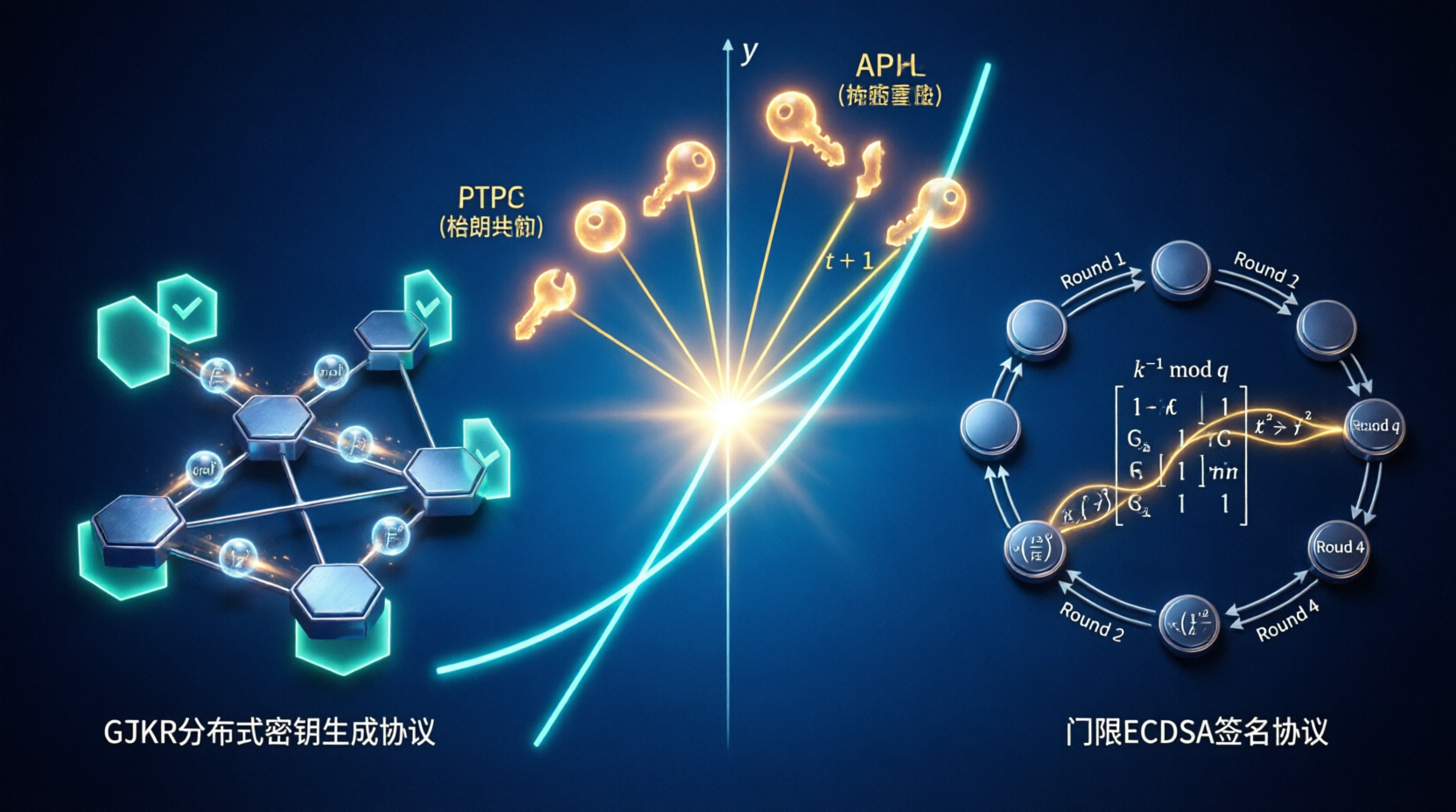
A rigorous look at threshold cryptography from Shamir secret sharing through GJKR distributed key generation to modern threshold ECDSA and BLS signatures for blockchain validators.
Contents
A private key is a single point of failure. If an attacker compromises the server that holds your BLS signing key, they can forge attestations, steal validator rewards, and slash your stake. If an employee accidentally deletes the only copy of a decryption key, the ciphertexts become permanently inaccessible. If a certificate authority’s root key is extracted, the entire PKI hierarchy collapses. The cryptographic answer to this fragility is threshold cryptography: split the key into (n) shares held by independent parties such that any (t+1) of them can collaboratively perform the cryptographic operation (signing, decryption) while any (t) or fewer shares reveal nothing about the key and cannot produce a valid output.
Threshold cryptography is not a single primitive but a design philosophy that has been instantiated for many cryptographic functions. Threshold RSA has existed since the 1990s. Threshold BLS is elegantly simple due to BLS’s linear structure. Threshold ECDSA—the signature scheme used by Bitcoin and Ethereum—is infamously difficult to thresholdize because ECDSA signing requires computing (k^{-1} \pmod{q}), a modular inversion that resists linear secret sharing. The journey from “can we do threshold ECDSA at all?” to “can we do it with sub-second latency for thousands of validators?” is one of the great engineering stories in applied cryptography.
This article covers the full stack: the secret-sharing foundation (Shamir), the distributed key generation protocols that eliminate the trusted dealer (GJKR and its descendants), the specific constructions for threshold ECDSA (the GG18 and GG20 protocols, the CGGMP protocol, and the FROST optimization for Schnorr-like signatures), and the validator use case that has driven so much recent innovation.
1. Why Threshold? The Failure Modes of Single Keys
Before diving into the mathematics, it is worth cataloging the failure modes that threshold cryptography addresses. These are not theoretical; they have caused billions of dollars in losses.
Compromise. A single-key system has a single attack surface. If the key exists in memory on any machine, that machine is a target. Threshold schemes raise the bar: the attacker must compromise (t+1) independent machines, which may run different operating systems, be hosted in different physical locations, and be operated by different organizations. This is the classic “defense in depth” argument.
Insider threat. An employee with access to the key material can exfiltrate it. In a threshold scheme, no single employee holds a full key share that is sufficient to sign or decrypt; collusion of multiple insiders is required. Combined with organizational separation (different shares held by different departments or even different companies), this dramatically reduces the insider-threat surface.
Availability. If the key-holding server goes down, no operations can proceed. In a threshold scheme with (n) parties and threshold (t), the system tolerates up to (n-t-1) unresponsive parties. For a (t = \lceil n/2 \rceil) configuration, the system continues operating even if nearly half the parties are offline. This is critical for validator infrastructure, where downtime results in financial penalties.
Disaster recovery. If a key is stored in a single physical location (a safe, an HSM, a data center) and that location is destroyed, the key is lost. Threshold shares can be geographically distributed across continents, so that no regional disaster can destroy enough shares to lose the key.
Regulatory compliance. Some regulations require that cryptographic operations be performed only with multi-party authorization. Threshold schemes provide cryptographic enforcement of the “two-man rule”: no single person can authorize a transaction, no matter their access level.
2. Shamir Secret Sharing: The One-Time Dealer Model
Shamir’s threshold secret sharing, which we explored in the MPC article, is the foundational building block. To recap succinctly: to share a secret (s \in \mathbb{F}_p) with threshold (t) among (n) parties, the dealer chooses a random polynomial (f(x)) of degree (t) such that (f(0) = s):
[ f(x) = s + a_1 x + a_2 x^2 + \cdots + a_t x^t ]
Party (P_i) receives share (s_i = f(\alpha_i)) where (\alpha_1, \ldots, \alpha_n) are distinct non-zero evaluation points. Reconstruction uses Lagrange interpolation:
[ s = \sum*{i \in S} \lambda_i^S \cdot s_i, \quad \lambda_i^S = \prod*{j \in S, j \neq i} \frac{\alpha_j}{\alpha_j - \alpha_i} ]
Shamir sharing is linear, so if multiple secrets (s^{(1)}, s^{(2)}, \ldots) are shared with the same threshold, linear combinations of the secrets can be computed on the shares without interaction: party (P_i) with shares (s_i^{(1)}) and (s_i^{(2)}) can locally compute (c_1 s_i^{(1)} + c_2 s_i^{(2)}), which is a valid share of (c_1 s^{(1)} + c_2 s^{(2)}).
This linearity is what makes threshold BLS trivial: a BLS signature under secret key (sk) is (\sigma = H(m)^{sk}). If (sk) is Shamir-shared as ([sk]) with threshold (t), parties can locally compute partial signatures (\sigma_i = H(m)^{[sk]_i}). Any (t+1) partial signatures can be combined using Lagrange coefficients to recover (\sigma = H(m)^{sk}). No interaction is needed beyond collecting the partial signatures—no protocol, no MPC, just Lagrange interpolation. This is threshold BLS in its entirety, and it is one reason why BLS is the signature scheme of choice for modern proof-of-stake blockchains (Ethereum included).
3. Distributed Key Generation: Eliminating the Dealer
Shamir secret sharing assumes a trusted dealer who knows the secret, generates the shares, and securely distributes them—then hopefully deletes the secret. But in many settings, no single party should ever know the secret. Distributed Key Generation (DKG) protocols allow (n) parties to collaboratively generate a Shamir sharing of a random secret such that no party (or coalition of up to (t) parties) ever learns the secret, yet at the end, each party holds a valid share.
3.1 The GJKR Protocol
The GJKR protocol (Gennaro, Jarecki, Krawczyk, and Rabin, 1999) is the canonical DKG. It works by having each party act as a dealer in a parallel instance of verifiable secret sharing (VSS), and then combining the contributions.
In the first phase, each party (Pi) chooses a random secret (s_i \in \mathbb{F}_p) and shares it among all parties using Shamir secret sharing with threshold (t), sending the share destined for (P_j) to (P_j) encrypted under a secure channel. Additionally, (P_i) publishes commitments to the polynomial coefficients (a{i,0}, a*{i,1}, \ldots, a*{i,t}) via Pedersen commitments: (C*{i,k} = g^{a*{i,k}} h^{r*{i,k}}) for random blinding factors (r*{i,k}). These commitments allow any party to verify that the share they received is consistent with the committed polynomial, without learning the polynomial itself.
After all parties have published their commitments and distributed their shares, each party (Pj) verifies that for each dealer (P_i), the received share (s{i,j}) satisfies:
[ g^{s*{i,j}} h^{r*{i,j}} \stackrel{?}{=} \prod*{k=0}^{t} C*{i,k}^{\alpha_j^k} \pmod{p} ]
where (r*{i,j} = \sum*{k=0}^{t} r_{i,k} \alpha_j^k) is the blinding factor for the share. If the check fails, (P_j) publishes a complaint against (P_i). If a dealer receives more than (t) complaints, they are disqualified, and their contribution is discarded. If a dealer receives a complaint they believe is unjustified, they can publish the correct share; if they fail to do so, they are disqualified.
After the complaint resolution phase, the set of qualified parties (\mathcal{Q}) (those not disqualified) is determined. The joint secret is the sum of the qualified parties’ individual secrets:
[ s = \sum_{i \in \mathcal{Q}} s_i ]
and each party (P_j)’s share of the joint secret is:
[ sj = \sum{i \in \mathcal{Q}} s_{i,j} ]
By the linearity of Shamir sharing, the (s_j) form a valid Shamir sharing of (s) with threshold (t). No party ever learns (s), because no party knows the individual secrets of the other qualified parties.
The public key corresponding to the shared secret key is (g^s), which can be computed by any party as (\prod*{i \in \mathcal{Q}} C*{i,0}) (the product of the constant-term commitments, after unblinding the (h) component via distributed computation of the aggregated randomness).
3.2 Security and the (t < n/2) Constraint
GJKR is secure against a malicious adversary controlling up to (t) parties, provided (t < n/2) for the synchronous model (and (t < n/3) for the asynchronous model). The (n/2) bound arises because a malicious dealer could distribute inconsistent shares—ones that do not lie on any degree-(t) polynomial—and if the adversary controls (t \geq n/2) parties, the honest parties cannot reliably distinguish “the dealer is cheating” from “the complaining parties are lying” without a reliable broadcast channel.
In practice, DKG is typically run with (n = 3t + 1) or stronger redundancy to provide margin against both malicious and unresponsive parties. For Ethereum’s DVT (Distributed Validator Technology) use case, a common configuration is (n=4, t=2) (or (n=7, t=4)), reflecting the practical reality that validator clusters are small and tightly managed.
3.3 Modern DKG Variants
Several improvements on GJKR have been developed. The Fast DKG of Fouque and Stern (2001) reduces the communication from (O(n^2 \lambda)) to (O(n \lambda)) using packed secret sharing. The New-DKG of Kate and Goldberg (2010) replaces Pedersen commitments with polynomial commitments (Kate-Zaverucha-Goldberg, KZG), reducing the commitment size from (O(nt)) group elements to (O(1)) and enabling efficient batch verification. The AVSS (Asynchronous VSS) protocol of Cachin et al. handles the case where the network may delay or drop messages arbitrarily, at the cost of a higher threshold requirement ((t < n/3)).
4. Threshold BLS: The Easy Case
BLS signatures (Boneh-Lynn-Shacham, 2001) over a pairing-friendly curve (like BLS12-381) are defined as (\sigma = H(m)^{sk} \in \mathbb{G}_1), where (H) hashes to (\mathbb{G}_1) and (sk \in \mathbb{F}_p) is the secret key. The public key is (pk = g_2^{sk} \in \mathbb{G}_2). Verification checks (e(\sigma, g_2) = e(H(m), pk)).
Threshold BLS is trivial because the signing operation is linear in the secret key. With a Shamir sharing ([sk]), each party computes a partial signature (\sigma_i = H(m)^{[sk]_i}). Given a set (S) of (t+1) partial signatures, the combiner computes:
[ \sigma = \prod_{i \in S} \sigma_i^{\lambda_i^S} ]
By Lagrange interpolation, (\sum_{i \in S} \lambda_i^S \cdot [sk]_i = sk), so:
[ \prod*{i \in S} \sigma_i^{\lambda_i^S} = H(m)^{\sum*{i \in S} \lambda_i^S [sk]_i} = H(m)^{sk} = \sigma ]
No interaction is needed among signers. Each signer produces their partial signature independently and sends it to a combiner (who may be untrusted—the combiner cannot forge partial signatures), and the combiner aggregates them.
This simplicity is why Ethereum’s beacon chain uses BLS for validator signatures. Each validator’s secret key is generated via DKG (or, in simpler setups, via a single-party generation with Shamir sharing to a cluster of validator clients running DVT software like Obol or SSV). The threshold BLS aggregation enables the validator to be “always online” even if some of its constituent nodes are down, without ever assembling the full secret key on any single machine.
5. Threshold ECDSA: The Hard Case
ECDSA is the signature scheme of Bitcoin, Ethereum (execution layer), and countless other blockchain and non-blockchain systems. Its mathematical structure makes thresholdization fundamentally more complex than BLS.
An ECDSA signature on message (m) under secret key (sk \in \mathbb{Z}_q) (where (q) is the curve order) consists of a pair ((r, s)). The signing algorithm is:
- Choose a random nonce (k \in \mathbb{Z}_q^*).
- Compute (R = k \cdot G), where (G) is the curve generator. Set (r = R_x \bmod q) (the x-coordinate of (R), reduced modulo (q)).
- Compute (s = k^{-1} \cdot (H(m) + r \cdot sk) \bmod q).
The difficulty for threshold ECDSA is the term (k^{-1} \cdot (H(m) + r \cdot sk)). This is a product of two secret values divided by a third secret value. In the additive secret-sharing model, computing the product of shared values requires interaction (via Beaver triples, as we saw in MPC), and computing the inverse is even harder.
5.1 The GG18/GG20 Protocol Family
Gennaro and Goldfeder (2018, updated 2020) produced the first practical threshold ECDSA protocol that works for any threshold (t < n) with dishonest majority. The protocol uses a combination of additive secret sharing, multiplicative-to-additive share conversion, and oblivious transfer for secure multiplication.
The key insight of GG18 is to precompute additive shares of the nonce (k) and its inverse, and to precompute additive shares of the product (k^{-1} \cdot sk). These precomputed tuples, called MTA (multiplicative-to-additive) shares, are generated via an offline protocol that uses OT and can run continuously in the background, independent of the messages being signed. When a signature is needed, the online phase is lightweight: parties use their precomputed shares to compute additive shares of (s = k^{-1}(H(m) + r \cdot sk)) with minimal interaction.
Let’s walk through the MTA protocol, which is the core subroutine. Suppose two parties hold multiplicative shares (a) and (b) of a product (c = a \cdot b). They want to convert these into additive shares (\alpha) and (\beta) such that (\alpha + \beta = c), without revealing (a) or (b) to each other. The GG18 MTA uses a 1-out-of-(N) OT (or a more efficient variant using Paillier homomorphic encryption): party (P_1) encrypts (a) under an additively homomorphic scheme (Paillier) and sends the ciphertext to (P_2), who computes an encryption of (a \cdot b) plus a random mask, returns it, and both parties derive their additive shares.
GG20 refines GG18 by moving more computation to the offline phase and reducing the online phase to a single round of communication (or two, depending on the configuration). The total signature time for a typical (t=2, n=4) setup is a few hundred milliseconds, dominated by the Paillier or OT operations.
5.2 The CGGMP Protocol
Canetti, Gennaro, Goldfeder, Makriyannis, and Peled (2020) improved GG20 in two significant ways. First, CGGMP achieves universal composability (UC) security, meaning the protocol remains secure even when composed with arbitrary other protocols—the strongest standard security notion for cryptographic protocols. Second, CGGMP optimizes the offline precomputation and reduces the number of rounds in the online phase.
CGGMP is the basis for several commercial threshold signing products (Coinbase’s threshold custody, Fireblocks’ MPC-CMP wallet). The protocol is complex—the specification runs to over 100 pages—but the implemented versions (in Rust and C++) are battle-tested and have protected billions of dollars in assets.
5.3 The FROST Optimization for Schnorr
Schnorr signatures, used in Bitcoin’s Taproot upgrade and in the EdDSA (Ed25519) signature scheme, are significantly easier to thresholdize than ECDSA because the signing equation is linear in the secret key once the nonce is fixed. A Schnorr signature ((R, s)) is computed as:
- Choose random nonce (k), compute (R = k \cdot G).
- Compute challenge (c = H(R \parallel pk \parallel m)).
- Compute (s = k + c \cdot sk \bmod q).
FROST (Flexible Round-Optimized Schnorr Threshold Signatures, Komlo and Goldberg, 2020) exploits this linearity to achieve a two-round signing protocol. In the first round, each party generates and broadcasts a commitment to their nonce share. In the second round, each party reveals their nonce share and computes their signature share. The combiner aggregates using Lagrange interpolation. FROST is remarkably efficient: for a typical (t=2, n=3) setup, signing takes under 50 milliseconds, with no heavy cryptography beyond elliptic curve operations.
The success of FROST has led to its adoption in Internet standards (the IETF CFRG is considering FROST as a threshold signature standard) and in production systems like Zcash’s threshold signing for FROST-based multisig wallets.
5.4 The Performance Landscape
To give a concrete sense of the state of the art, here are approximate signing latencies for a (t=2, n=4) setup on modern hardware over a LAN:
| Scheme | Protocol | Latency (ms) | Crypto operations |
|---|---|---|---|
| BLS | Lagrange combination | < 1 | No interaction; 4 EC mults |
| Schnorr (FROST) | Two-round | 10-30 | EC mults, lightweight commitments |
| ECDSA (GG20) | MTA + online | 100-500 | Paillier/OT, heavy offline phase |
| ECDSA (CGGMP) | UC-secure MTA | 200-600 | Paillier/OT, UC overhead |
The BLS numbers are why Ethereum switched to BLS for the beacon chain. The ECDSA numbers explain why Bitcoin and the Ethereum execution layer have been slower to adopt threshold signing—but the demand is so high (for institutional custody) that even 500 ms latency is acceptable for cold-wallet setups where transactions are infrequent and high-value.
6. The Validator Use Case: Distributed Validator Technology (DVT)
Ethereum’s proof-of-stake consensus requires each validator to run a client that is online and signing attestations roughly every 6.4 minutes (one per epoch). A validator that is offline for more than a small fraction of the time leaks value through missed attestations and, if offline for an extended period, can be slashed. A validator whose key is compromised can be slashed maliciously, losing 1 ETH or more.
DVT uses threshold cryptography to split a validator’s signing key among multiple independent nodes, each running the validator client software. The key is generated via DKG among the DVT cluster nodes. To sign an attestation or block proposal, the nodes run a threshold BLS signing protocol (trivial, as we saw) and the aggregated signature is submitted to the beacon chain.
The operational benefits are significant:
- Fault tolerance: If one node goes down for maintenance, the remaining nodes can still produce valid signatures (provided the threshold is met). This allows zero-downtime upgrades.
- Security: An attacker must compromise the threshold number of nodes, which may be in different cloud regions, different cloud providers, or even a mix of cloud and on-premise hardware.
- Geographic distribution: Nodes can be placed in different legal jurisdictions, mitigating regulatory risk.
- Client diversity: The DVT cluster can run different validator client implementations (Prysm, Lighthouse, Teku, Nimbus) on different nodes, so that a bug in one client does not cause slashing (the buggy node’s partial signatures would be inconsistent and discarded by the aggregation).
The leading DVT protocols are Obol (which uses a custom DKG and threshold BLS implementation), SSV.Network (which uses a similar approach with economic incentives for node operators), and Diva. As of 2025, roughly 5-10% of Ethereum validators use DVT, and the trend is toward universal adoption as the tooling matures.
7. Proactive Security and Share Refresh
A static threshold setup is vulnerable to mobile adversaries: an attacker who slowly compromises nodes over time, one by one, eventually accumulating enough shares to reconstruct the key. Proactive secret sharing (Herzberg, Jarecki, Krawczyk, and Yung, 1995) addresses this by periodically refreshing the shares without changing the secret.
In a share refresh protocol, each party generates a random sharing of zero and distributes the shares to the other parties. Adding these zero-shares to the existing key shares produces a new polynomial that still interpolates to the same secret, but whose shares are independent of the old shares. An adversary who collected (t) shares before the refresh but only (t-1) new shares after the refresh cannot reconstruct the key—the old shares have been rendered useless.
Proactive refresh can be performed on a regular schedule (e.g., once per week) or triggered by events (a node detecting a potential compromise). Combined with DKG, proactive refresh provides forward security: compromise of a node at time (\tau) does not endanger past or future signatures, only signatures during the window when the attacker held sufficient live shares.
The combination of DKG, threshold signing, and proactive refresh is sometimes called proactive threshold cryptography, and it is the gold standard for long-lived distributed keys. It is used in several high-security deployments, including DNS root zone signing (where the root zone’s DNSSEC keys are managed by a geographically distributed set of trusted community representatives using proactive threshold RSA) and in some central bank digital currency (CBDC) prototypes.
8. The Engineering Reality: Deployment Challenges
Threshold cryptography, despite its mathematical elegance, presents formidable engineering challenges in production.
Key generation ceremony. The DKG requires a synchronous setup phase where all participants are online and can communicate securely. For validator clusters, this can be arranged with some scheduling. For larger or more ad-hoc groups, the coordination overhead becomes significant. Some systems use a “bulletin board” (a public append-only log) to decouple the communication from real-time interaction, but this introduces additional trust assumptions.
Secure channels. The DKG requires authenticated and confidential channels between every pair of participants. Setting up (O(n^2)) secure channels is operationally burdensome. In practice, TLS with mutual authentication (mTLS) or Noise protocol channels are used, with public keys exchanged out-of-band.
Identity and access management. Who are the parties? How are they authorized to participate? A DKG is only as secure as the identity system that maps protocol roles to real-world entities. For validator DVT, the parties are typically nodes controlled by the same operator (for a single-validator DVT) or by a consortium (for institutional staking). The trust model must be explicit and auditable.
Software bugs. Threshold cryptography implementations are complex. A bug in the DKG can cause silent key generation failures, where shares appear valid but do not interpolate to a usable key. A bug in the signing protocol can cause inconsistent signatures that lead to slashing in blockchain contexts. Formal verification of threshold protocol implementations is an active research area; the VeriZinc project at UC San Diego and the Tamarin-prover-based analyses of FROST are steps in this direction.
HSM integration. Many deployment scenarios require that each share be stored in a Hardware Security Module (HSM) that enforces access control and rate limiting. Integrating threshold protocols with HSM APIs (typically PKCS#11 or a vendor-specific interface) requires careful protocol design to minimize the number of HSM operations per signature.
9. The Mathematics of Threshold Signatures: A Deeper Look
9.1 Why BLS Is Linear and ECDSA Is Not
The fundamental difference between BLS and ECDSA thresholdization lies in the algebraic structure of the signing equation. BLS signing is (\sigma = H(m)^{sk}), which is a monomial in (sk): if (sk = \sum \lambda_i [sk]_i), then (\sigma = \prod (H(m)^{[sk]_i})^{\lambda_i}). The Lagrange interpolation and the exponentiation commute because exponentiation by a sum equals the product of exponentiations.
ECDSA signing is (s = k^{-1}(H(m) + r \cdot sk)), which involves both multiplication and inversion of secret values. The inversion (k^{-1}) does not distribute over addition: ((k_1 + k_2)^{-1} \neq k_1^{-1} + k_2^{-1}). Therefore, additive shares of (k) cannot be locally inverted to produce additive shares of (k^{-1}). This is why threshold ECDSA requires the MTA protocol—to convert multiplicative shares (which can be locally inverted: ((a \cdot b)^{-1} = a^{-1} \cdot b^{-1})) into additive shares needed for the final signature equation.
9.2 The Inversion Problem and Its Solutions
Several approaches to the inversion problem have been explored. The original threshold DSA paper (Gennaro et al., 1996) used a technique where parties generate shares of (k) and then run a distributed inversion protocol based on the observation that (k^{-1} = (k’)^{-1} \cdot k’ \cdot k^{-1}) for a random mask (k’). The GG18/GG20 protocols refined this with the MTA approach. A more recent alternative uses oblivious pseudorandom functions (OPRFs) to generate the nonce (k) in a way that each party learns an additive share of (k^{-1}) directly, without needing an explicit inversion protocol. This approach, due to Lindell and Nof (2017), reduces the round complexity but increases the computational cost.
10. Beyond Signatures: Threshold Decryption and Threshold PRFs
Threshold cryptography is not limited to signatures. Any cryptographic operation that is linear in the secret key can be trivially thresholdized. Operations that are nonlinear require MPC techniques, as we discussed for ECDSA.
Threshold decryption for public-key encryption schemes like ElGamal is straightforward: given a ciphertext ((g^r, m \cdot pk^r)), each party computes a partial decryption using their share of (sk), and the partial decryptions are combined via Lagrange interpolation. Threshold RSA decryption is more involved because RSA decryption is exponentiation by a secret exponent (d), which is nonlinear in the shares; the standard solution uses a combination of additive sharing of (d) and a distributed exponentiation protocol with a small constant overhead over single-party RSA.
Threshold PRFs (pseudorandom functions) allow a distributed set of parties to evaluate a keyed PRF without any party learning the key. The Naor-Pinkas-Reingold (NPR) PRF and its descendants are the workhorses here. Threshold PRFs are used in the OPAQUE password-authenticated key exchange protocol (which has been adopted as an IETF standard) to split the password-verification key among multiple servers, so that a breach of any single server does not expose the password database.
Threshold oblivious PRFs combine threshold PRFs with oblivious evaluation, so that the client learns the PRF output on their input without the servers learning the input, and the servers cannot evaluate the PRF without cooperation. This primitive underpins Apple’s Private Set Membership protocol (for detecting child sexual abuse material without scanning users’ photos) and several privacy-preserving contact discovery systems.
Threshold fully homomorphic encryption (TFHE) is an emerging frontier: multiple parties hold shares of an FHE secret key, and they collaboratively decrypt the result of an FHE computation without any party learning the plaintext. This enables scenarios where data encrypted under a threshold FHE key is processed by an untrusted server, and the result can only be decrypted with cooperation of a threshold of key holders—combining the privacy of FHE with the availability and security of threshold cryptography.
10. Attack Vectors on Threshold Schemes
Threshold cryptography is not a panacea. It introduces new attack surfaces that must be understood and mitigated.
The combiner as a target. In threshold BLS, the combiner who aggregates partial signatures is a single point of trust for availability (though not for security, since the combiner cannot forge signatures). If the combiner is compromised, the attacker cannot sign but can selectively censor partial signatures, delaying or preventing threshold operations. In practice, the combiner role is typically rotated or duplicated across multiple nodes.
Side-channel attacks on shares. Each share holder performs cryptographic operations using their share. If an attacker can mount a side-channel attack (power analysis, timing, electromagnetic emissions) on a share-holding device, they can extract the share. Since threshold security requires compromising (t+1) shares, side-channel resistance must be implemented on every share-holding device—a multiplicative increase in the engineering burden compared to single-key systems.
Rushing adversaries in DKG. In the GJKR protocol, the complaint phase introduces a subtle timing vulnerability: a malicious party can wait until all honest parties have published their commitments and shares, and only then decide whether to publish their own shares (based on what the eventual key would be) or to complain (aborting the protocol if the key is unfavorable). This “rushing” attack can bias the generated key. Defenses include enforcing strict timeouts and using commitments that hide the eventual key until all parties have committed.
Threshold safety vs. liveness. The choice of threshold (t) is a safety-liveness tradeoff. A high threshold (e.g., (t = n-1)) requires unanimity and provides maximum safety but zero liveness: one offline node halts all operations. A low threshold (e.g., (t = \lfloor n/2 \rfloor)) tolerates more failures but increases the attack surface. The optimal threshold is application-specific and often determined through formal risk analysis rather than cryptographic reasoning.
11. Threshold Cryptography in the Post-Quantum Transition
A question that arises naturally: what happens to threshold cryptography when quantum computers capable of running Shor’s algorithm arrive? The answer depends on the underlying signature scheme. Threshold ECDSA and threshold RSA both rely on the discrete logarithm and factoring assumptions, respectively, which Shor’s algorithm breaks. Threshold BLS over pairing-friendly curves is similarly vulnerable.
However, the threshold paradigm itself is independent of the computational assumptions of the base signature scheme. Threshold hash-based signatures (SPHINCS+, XMSS) are straightforward: the signing operation is linear in the secret key components, and Lagrange interpolation works over any finite field. Threshold lattice-based signatures (Dilithium, Falcon) are more challenging because lattice signatures involve rejection sampling and Gaussian noise that do not distribute cleanly over shares, but MPC-based threshold lattice signatures have been demonstrated (Cozzo and Smart, 2020) with reasonable overhead.
The transition to post-quantum threshold cryptography will require re-engineering the DKG and signing protocols for each new signature primitive, but the foundational building blocks—Shamir sharing, VSS, additive-to-multiplicative conversion via OT—remain applicable. The post-quantum threshold ecosystem is nascent but active, driven by the recognition that the security of distributed keys is only as strong as the cryptography that underpins them.
12. Summary
Threshold cryptography transforms a sharp single point of failure into a distributed system where security degrades gracefully. The mathematics is elegant: Shamir’s polynomial interpolation gives us linear sharing, BLS gives us linear signing, and the combination yields near-trivial threshold signatures. Where the mathematics is less cooperative—as in ECDSA—sustained cryptographic engineering has produced protocols (GG18, GG20, CGGMP) that are practical enough to secure institutional custody of billions of dollars in cryptocurrency.
The trend is unmistakable. Single-key systems are being replaced by threshold systems wherever the stakes justify the complexity. Validator infrastructure is migrating to DVT. Institutional crypto custody is standardizing on MPC-based threshold signing. Root zone DNSSEC uses proactive threshold RSA. The Internet’s critical cryptographic infrastructure is being distributed not because distribution is free—it adds latency, complexity, and operational burden—but because concentration is more expensive in expectation, given the inevitability of compromise.
What makes threshold cryptography intellectually satisfying, beyond its practical importance, is the way it forces us to think adversarially about every aspect of a cryptographic system. A single-key signature scheme must resist key extraction and forgery. A threshold scheme must additionally resist collusion, rushing, selective abort, side-channel extraction of individual shares, and the subtle correlations between shares that can arise from a buggy DKG. The attacker’s job is harder—(t+1) independent compromises instead of one—but the defender’s job is also harder. The reward, when done right, is a system that can survive individual failures, individual compromises, and even individual betrayals. That is a cryptographic promise worth pursuing.
The open problems in threshold cryptography are shifting from “can we thresholdize function X?” to “can we thresholdize function X with sub-100ms latency, UC security, and formal verification of the implementation?” That shift—from existence to optimization, from paper to production—is the mark of a maturing field, and it is a testament to how far threshold cryptography has come since Shamir’s original three-page paper in 1979.
For the systems researcher, threshold cryptography offers a particularly rich set of design challenges at the intersection of distributed systems and cryptography. The DKG is a distributed consensus problem with cryptographic constraints. Proactive refresh is a state synchronization problem with forward-security requirements. Threshold signing is a latency-sensitive interactive protocol where every millisecond counts. The engineering of threshold cryptography is systems research as much as cryptographic research—and the best systems in this space are built by teams that understand both. The practical payoff—keys that survive compromise, signatures that tolerate failure, infrastructure that degrades gracefully rather than collapsing catastrophically—is exactly the kind of resilience that the Internet’s critical infrastructure demands.