
The Implementation Of A Distributed Hash Table Using Chord: Leaf Sets, Stabilization, And Finger Table Maintenance
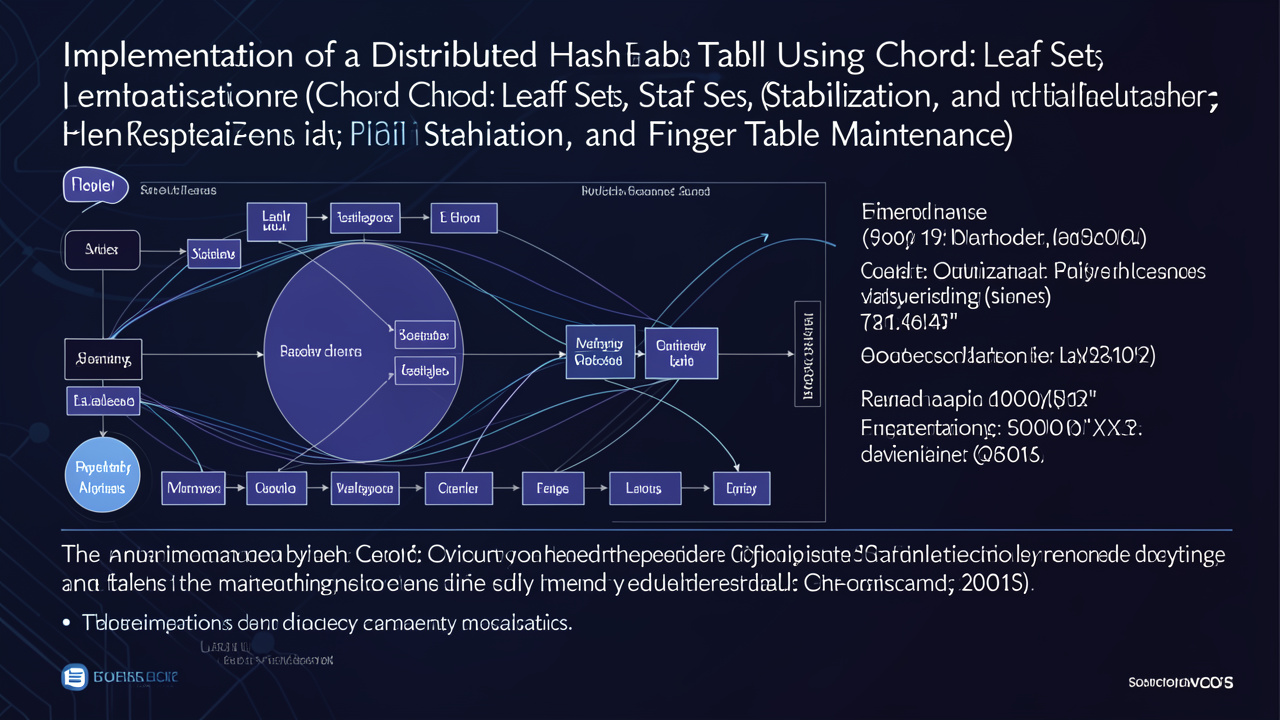
A comprehensive technical exploration of the implementation of a distributed hash table using chord: leaf sets, stabilization, and finger table maintenance, covering key concepts, practical implementations, and real-world applications.
Contents
Here is the expanded blog post, building on your excellent introduction. The goal is to reach a deep, detailed exploration of the Chord protocol, its practical implications, and the gritty engineering realities that turn theory into production-grade systems.
The Silent Betrayal of Distributed Data: Why Log(N) Holds a Gun to Your Head
There is a particular, cold moment of dread every distributed systems engineer knows. It often arrives at 3:00 AM, triggered by a pager alert. You’ve built a beautiful, elegant system. A ring of nodes, each holding a slice of a key-space. You’ve tested it in a simulated environment. The worst-case latency for a lookup is, theoretically, ( O(\log N) ). The mathematics is flawless. The code is pristine.
Then, the first node fails.
Not with a graceful shutdown, but with the messy, undignified crash of a power spike or a kernel panic. Immediately, the ring is broken. Another node, the successor in the ring’s topology, inherits the fallen node’s data. But somewhere, across the cluster, another node is trying to find a key. It looks at its finger table—a map of shortcuts across the network that should have guided it to the correct location in a few hops. The destination finger is pointing at the dead server. The lookup fails.
Then, a second node joins the network. In its enthusiasm to join the ring, it claims a chunk of the key space that overlaps with an already existing node. Two nodes now believe they are responsible for the same keys. Data written to the first node is never found by the client querying the second. You have a partial outage. Data is not lost, but it’s hidden. In a distributed system, a hidden key is worse than a lost key; it implies consistency failure without a clear error.
This is the brutal reality of building a Distributed Hash Table (DHT) . The underlying principle—the Chord protocol—is one of the most elegant algorithms in computer science. It promises a decentralized, scalable, and fault-tolerant way to store and retrieve data across thousands of machines, all without a central coordinator. The math is, in fact, beautiful. By organizing nodes in a logical ring and maintaining a small, logarithmic set of routing information, Chord delivers on its core promise: any node can route a lookup to any key in ( O(\log N) ) hops.
But mathematics is not software engineering. The clean, abstract ring of the academic paper is a cruel mistress when she meets the real world. The ( O(\log N) ) promise is a loaded gun, held to the head of your latency and availability guarantees, and it fires the moment a network partition splits your ring, a garbage collection cycle pauses your JVM for 50 seconds, or a misconfigured firewall silently drops a critical stabilization message.
This blog post is not a mere tutorial. It is an autopsy of the Chord protocol. We will dissect its elegant mechanisms—the ring, consistent hashing, finger tables, and stabilization—but we will spend equal time on the bloody details: the race conditions, the edge cases in node joins and failures, the hidden costs of replication, and the performance pitfalls that separate a classroom exercise from a production-grade distributed system. We will walk through the algorithm, then we will hold it under a harsh light. By the end, you will understand not just how Chord works, but why it is simultaneously a brilliant solution and a source of its own unique class of nightmares.
Part I: The Anatomy of Order - The Chord Ring and Consistent Hashing
Before we can understand the betrayal, we must understand the oath. The foundation of Chord is a logical ring overlaid on a flat network topology. Every node (server) and every key (data identifier) is assigned an m-bit identifier. This identifier is typically the output of a consistent hash function, like SHA-1. The hash space is a circle from 0 to ( 2^m - 1 ).
import hashlib
import sys

def hash_to_ring(value: str, m: int = 160) -> int:
    """Maps a string to a position on the Chord ring."""
    # SHA-1 produces a 160-bit (20-byte) hash
    hash_bytes = hashlib.sha1(value.encode()).digest()
    # Truncate to m bits for smaller rings, or use the full hash
    if m < 160:
        # Take the first m bits
        hash_int = int.from_bytes(hash_bytes, byteorder='big') >> (160 - m)
        return hash_int
    else:
        return int.from_bytes(hash_bytes, byteorder='big')

# Example: Mapping a node (by IP) and a key (by filename)
node_id = hash_to_ring("192.168.1.10:8000", m=10)  # ID: 0..1023
key_id = hash_to_ring("my_data_file.txt", m=10)
print(f"Node ID: {node_id}, Key ID: {key_id}")
This simple mapping creates a deterministic, non-hierarchical space. The core rule of the ring is: A key is stored on the first node whose identifier is equal to or follows the key’s identifier in the clockwise direction on the ring. This node is called the key’s successor. If the ring is from 0 to 1023 (10-bit space), and a key hashes to 500, it belongs to the node with the next highest ID (e.g., 510, 800, or wrapping around back to 0). This is consistent hashing.
Consistent hashing is the secret sauce that makes Chord robust to node changes. In a traditional hash table, if you change the number of buckets (nodes), almost all keys are remapped. In consistent hashing, when a node joins or leaves, only the keys that are neighbors of that node on the ring need to be remapped. For a ring with N nodes, the expected fraction of keys that move is only ( K/N ) (where K is the number of keys). This is a seismic shift in operational stability.
The Problem of the Naïve Lookup
The simplest way to find a key is to start at any node and walk clockwise around the ring, asking each node, “Is this key yours?” This is the successor walk. In a ring of N nodes, a lookup could require ( O(N) ) steps. In a cluster of 100,000 nodes, this is catastrophic. A lookup could take seconds or minutes. The ring, by itself, is not scalable.
This is where the genius of the finger table enters.
Part II: The Decay of Distance - Finger Tables and Logarithmic Hops
A node ( n ) maintains a routing table called a finger table with at most ( m ) entries (where ( m ) is the number of bits in the identifier). The ( i )-th finger of node ( n ) is the first node on the ring whose identifier is at least ( n + 2^{i} ) (modulo ( 2^m )).
Let’s make this concrete. Consider a 6-bit ring (0 to 63). A node at position n=10 will have fingers for:
i=0:10 + 2^0 = 11. Finger points to the first node on or after 11.i=1:10 + 2^1 = 12. Finger points to the first node on or after 12.i=2:10 + 2^2 = 14.i=3:10 + 2^3 = 18.i=4:10 + 2^4 = 26.i=5:10 + 2^5 = 42.
These fingers are not random. They form a set of exponentially increasing lookaheads. The first finger covers the next node. The second finger covers a node roughly twice as far away. The third, four times as far. The last finger covers half the ring.
The Lookup Algorithm: Divide and Conquer
When a node n receives a lookup request for key k, it does the following:
- Check itself. Is
kbetweennand its successor? If so, the successor has the key. - Find the closest preceding finger. Look in its finger table for the largest finger
fsuch thatfis betweennandkon the ring (i.e.,fis the closest node it knows of that is still behind the key). - Delegate. Send the lookup request to that finger
f. The finger will repeat the process.
This is pure logarithmic greed. At each step, the lookup cuts the remaining distance to the key roughly in half. The maximum number of steps is ( O(\log N) ). For a 160-bit identifier space (using SHA-1), the maximum number of hops is 160. In theory, you can find any piece of data in any cluster of ( 2^{160} ) nodes in at most 160 network round trips.
A Detailed Lookup Walkthrough
Let’s simulate a lookup on a 6-bit ring (IDs 0-63). Assume nodes exist at: 1, 10, 20, 30, 40, 50, 60.
- Client: Wants key
k=46. It contacts any node, say node1. - Node 1: Checks successor. Its successor is node
10. Is46between1and10? No. It checks its fingers.- Node 1’s fingers point to successors for
1+1,1+2,1+4,1+8,1+16,1+32. 1+32=33. The successor of 33 is node40(since 33 is between node30and40).- Is
40the closest preceding finger to46? Yes. It sends the lookup to node40.
- Node 1’s fingers point to successors for
- Node 40: Checks successor. Its successor is node
50. Is46between40and50? Yes! The key belongs to node50. - Node 40 returns the identifier of node
50to node1, which returns it to the client. 2 hops.
Without finger tables, this would have required 5 hops (1->10->20->30->40->50). The logarithmic promise is fulfilled.
The Code of a Finger Table Lookup
class ChordNode:
    def __init__(self, node_id: int, m: int = 160):
        self.node_id = node_id
        self.m = m
        self.finger_table = [None] * m  # List of (start, node) tuples
        self.successor = None
        self.predecessor = None
        self.data_store = {}  # Local storage

    def closest_preceding_finger(self, key_id: int):
        """Find the closest finger node that is before the key."""
        # Iterate from the largest finger down to the smallest
        for i in range(self.m - 1, -1, -1):
            finger_node = self.finger_table[i]
            if finger_node is None:
                continue
            # Is the finger node strictly between self and the key?
            # On a ring, we need to handle wrap-around.
            if self._is_in_interval(finger_node.node_id, self.node_id, key_id, exclusive_start=True, exclusive_end=True):
                return finger_node
        # If no finger is closer, return self (or successor)
        return self.successor if self.successor else self

    def find_successor(self, key_id: int):
        """Route a lookup to the node responsible for key_id."""
        # Check if the key_id is between self and our successor
        if self.successor and self._is_in_interval(key_id, self.node_id, self.successor.node_id, exclusive_start=False, exclusive_end=True):
            return self.successor
        else:
            # Delegate to the closest preceding finger
            n_prime = self.closest_preceding_finger(key_id)
            if n_prime.node_id == self.node_id:
                # Should not happen, but return successor as fallback
                return self.successor
            # In a real system, this would be an RPC call to n_prime
            return n_prime.find_successor(key_id)

    def _is_in_interval(self, value: int, start: int, end: int, exclusive_start: bool, exclusive_end: bool):
        """Check if value is in (start, end) or [start, end) on the ring."""
        if start < end:
            if exclusive_start:
                return start < value < end
            else:
                return start <= value < end
        else:  # Wrap-around interval
            if exclusive_start:
                return value > start or value < end
            else:
                return value >= start or value < end
This is the core of Chord. It’s deceptively simple. But the simplicity is a mirage. The algorithm assumes that the finger table is correct and up-to-date. This is where the betrayal begins.
Part III: The Cathedral in the Storm - Joining the Ring
A node cannot simply “join” the Chord ring by broadcasting its presence. The ring is a distributed data structure. Joining is a multi-step, race-condition-prone operation that must be executed with surgical precision to avoid data loss, inconsistency, and lookup failures.
Let’s trace the life of a new node, n, joining a ring where a known node, n', already exists.
Step 1: Initialization
Node n contacts n' and asks it to look up n’s own identifier. n' performs a find_successor(n.node_id) and returns the successor node, which we’ll call s. Node n sets n.successor = s. This is the first fragile link.
def join(self, known_node: 'ChordNode'):
    if known_node is None:
        # We are the first node in the ring
        self.successor = self
        self.predecessor = None
        return

    # Ask the known node to find our successor
    successor_node = known_node.find_successor(self.node_id)
    self.successor = successor_node
Step 2: Claiming a Predecessor and Transferring Data
At this point, node n knows its successor s. But s still thinks its predecessor is the old node (call it p). Node n must now notify s that it is the new predecessor. This is done via a notify message.
When s receives a notify from n, it checks: Is n between s.predecessor and s? If yes, s sets its predecessor to n. This is the critical update that splits the key-space.
Now, the key-space that used to belong to s is split. Keys from n to s now belong to n. s must transfer those keys to n. This transfer is a bulk network operation. If it fails, data is lost. If s crashes during the transfer, the data may be duplicated or lost.
def notify(self, potential_predecessor: 'ChordNode'):
    """Called by another node claiming to be our predecessor."""
    if self.predecessor is None or self._is_in_interval(potential_predecessor.node_id,
                                                        self.predecessor.node_id,
                                                        self.node_id,
                                                        exclusive_start=True,
                                                        exclusive_end=True):
        # Accept the new predecessor
        old_pred = self.predecessor
        self.predecessor = potential_predecessor
        # Transfer keys that now belong to the new predecessor
        # Keys in (potential_predecessor.node_id, self.node_id)
        keys_to_transfer = [k for k in self.data_store if self._is_in_interval(hash_to_ring(k),
                                                                               potential_predecessor.node_id,
                                                                               self.node_id,
                                                                               exclusive_start=True,
                                                                               exclusive_end=False)]
        for key in keys_to_transfer:
            value = self.data_store.pop(key)
            # In real system: RPC call to potential_predecessor to store the key
            potential_predecessor.store_key(key, value)
Step 3: Building the Finger Table
Now that n knows its successor, it can begin to build its finger table. The naïve approach is to ask the successor for help, but the successor may not have the correct fingers for n’s position. The correct way is to use the original node n' to look up each finger entry.
For each i from 0 to m-1, node n asks n' to find_successor(n.node_id + 2^i). This is an expensive initialization phase. A new node joining a large ring must perform m lookups (e.g., 160 lookups for SHA-1). Each lookup takes ( O(\log N) ) time. This burst of network traffic is a scalability concern in high-churn environments.
The Race Condition: The Transient Split-Brain
The most dangerous moment is between when n sets its successor to s and when s acknowledges n as its predecessor. During this window:
- Client A: Looks up a key
kthat should now belong ton. It starts atn'.n'has an old finger table that points tosfor keys in that range. Client A is routed tos.sstill thinks it owns the key.sreturns the data. Success (by luck). - Client B: Looks up the same key
k. It starts at a different node that has a slightly more recent finger table, which points ton. Client B is routed ton. Butndoesn’t have the keys yet (they haven’t been transferred froms). Key not found!
We have a transient inconsistency. The system is not fully available during the join. This is why production systems use virtual nodes and lazy key transfer, accepting that there will be a brief period where a lookup might fail or return stale data, relying on the application layer (e.g., a read-repair) to fix it.
Part IV: The Cold Calculus of Failure - Handling Node Departures
If joins are fragile, failures are an earthquake. A node can fail at any time: crash, network partition, hardware failure. Chord is designed to handle this, but only if the failure is detected.
The Stabilization Protocol: The Heartbeat of the Ring
Chord does not rely on a centralized failure detector. Instead, it uses a periodic stabilization protocol. Every node runs a background thread that does the following:
- Check Predecessor. Is my predecessor still alive? If not, set predecessor to
None. - Check Successor. Ask my successor for its predecessor. Is my successor’s predecessor me? If not, I may have a new node between us. Update my successor.
- Notify Successor. Send a
notifymessage to my successor, letting it know I exist (or giving it a chance to correct its predecessor).
import threading
import time

class ChordNode:
    def __init__(self, node_id, m=160):
        # ... other init ...
        self.successor = None
        self.predecessor = None
        self.running = True
        self.stabilize_thread = threading.Thread(target=self._stabilize_loop, daemon=True)
        self.fix_fingers_thread = threading.Thread(target=self._fix_fingers_loop, daemon=True)

    def _stabilize_loop(self):
        while self.running:
            self.stabilize()
            time.sleep(1)  # Every second

    def stabilize(self):
        """Periodic stabilization routine."""
        if self.successor and self.successor.node_id != self.node_id:
            try:
                # Ask successor for its predecessor
                x = self.successor.get_predecessor()  # RPC call
                if x and self._is_in_interval(x.node_id, self.node_id, self.successor.node_id, exclusive_start=True, exclusive_end=True):
                    # x is a better successor than ours
                    self.successor = x
                # Notify our successor that we are its predecessor
                self.successor.notify(self)
            except Exception as e:
                # Successor is dead!
                print(f"Successor {self.successor.node_id} failed: {e}")
                self._handle_successor_failure()

    def _fix_fingers_loop(self):
        """Periodically refresh a random finger."""
        while self.running:
            i = random.randint(0, self.m - 1)
            self.finger_table[i] = self.find_successor(self.node_id + 2**i)
            time.sleep(1 / self.m)  # Refresh one finger per second
This periodic maintenance is the price of fault tolerance. Without it, finger tables become stale and the ring disintegrates. With it, the ring can self-heal.
The Catastrophe of Consecutive Failures
Chord relies on its immediate successor. If a node n fails, its successor n+1 becomes the new anchor for the data of n. But what if n+1 fails at the same time? Or what if two nodes in a row fail?
Consider a ring with nodes at positions 10, 20, 30, 40. Nodes 10 and 20 fail simultaneously. Node 30 thinks its predecessor is 10 (because 10’s notification was missed). Node 10’s data is lost because Node 30 doesn’t know it should inherit it. The ring is fractured.
The solution is to maintain a successor list of k successors (e.g., k=3). Instead of relying only on the immediate successor, each node knows the next k nodes on the ring. If the immediate successor dies, the node can fall back to the next one in the list.
def _handle_successor_failure(self):
    """Handle the failure of our current successor."""
    if self.successor_list:
        # Shift the list: remove the dead successor, promote the next
        dead_succ = self.successor_list.pop(0)
        if self.successor_list:
            new_succ = self.successor_list[0]
            print(f"Promoting {new_succ.node_id} to successor.")
            self.successor = new_succ
            # Re-initialize successor list from new successor
            self.successor_list = [new_succ] + self.successor.get_successor_list()[:-1]
        else:
            # We are the last node alive
            self.successor = self
    else:
        # Truly alone
        self.successor = self
This adds ( O(k \log N) ) overhead to lookups, but it provides a crucial safety net. In production, you must configure k carefully. Too low, and a chain of failures breaks the ring. Too high, and your successor list becomes stale and costly to maintain.
Part V: The Practical Horror Show - Production Pitfalls and Mitigations
The academic paper ends here. You have the algorithm. It works in a simulator. But the real world is a simulator of its own design.
1. The Network Partition: The Ring Becomes Two Rings
Imagine a network switch fails, splitting your 100-node Chord ring into two separate rings with no connectivity between them. In the original algorithm, each half of the ring continues to function independently. Nodes in Partition A can only find keys in Partition A. Nodes in Partition B can only find keys in Partition B.
This is a split-brain scenario. Data cannot be replicated across the partition. If the partition heals, the two rings must merge, which is a complex operation involving comparing and merging disjoint key spaces, potentially resolving conflicts.
Mitigation: Use a strongly consistent coordination service (like ZooKeeper, etcd, or Consul) to store the definitive list of live nodes. The Chord ring is then rebuilt based on this membership list. This reintroduces a centralized point of trust, but it provides a single source of truth for membership. Alternatively, use a gossip protocol for membership, but this is eventually consistent and can lead to transient inconsistencies during partitions.
2. The Straggler and the Tail Latency
The finger table lookup is a series of synchronous RPC calls. The ( O(\log N) ) promise assumes that each hop takes a fixed, low latency. In reality, network latency has high variance. A single node that is experiencing a garbage collection pause, a slow disk, or network congestion can cause a single hop to take 10-100x longer than normal. The tail latency of a Chord lookup is not ( O(\log N) ); it is ( O(\log N \cdot \text{max_hop_latency}) ).
Mitigation:
- Speculative Parallelism. Instead of making one hop at a time, send the lookup request to the top two or top three closest fingers in parallel. The first one to respond wins. This introduces redundant network traffic but dramatically reduces tail latency.
- Timeout with Fallback. Set aggressive per-hop timeouts. If a finger does not respond in 50ms, fall back to a less optimal finger (or even the successor).
- Caching. Cache the results of lookups locally (e.g., “Key X is at Node Y”). This is the most powerful latency reduction technique, but it introduces staleness.
3. The Data Replication Problem
Chord, in its pure form, does not define how data is replicated. It only defines where the primary copy lives. For fault tolerance, you must store the key on multiple successor nodes. The standard approach is to replicate the key on the next r successors (the successor list again).
If r=3, a key is stored on the node that is its successor, plus the next two nodes on the ring.
The Write Path:
- Client calculates key identifier.
- Client finds the primary successor (Node S).
- Client sends the write to Node S.
- Node S forwards the write to its
r-1successors.
The Read Path:
- Client finds the primary successor.
- Client reads from the primary. If that fails, it reads from the next successor in the list.
Consistency Nightmares: What if the write succeeds on Node S but fails on the replicas? You have a partial write. What if a client reads from a replica that hasn’t received the write yet? You have a stale read. Chord is inherently eventually consistent without additional mechanisms like vector clocks, read-repair, or quorum-based reads (e.g., write to all r replicas, read from r/2 + 1).
4. The Cost of Finger Table Maintenance
Each node must periodically refresh its m fingers. For a 160-bit ring, that’s 160 lookups. If the stabilization interval is 1 second per finger, it takes 160 seconds to refresh the entire table. During that time, the table is partially stale. In a high-churn cloud environment (nodes joining/leaving often), the finger table is always slightly wrong. The error is bounded, but it introduces additional hops for lookups.
Mitigation:
- Lazy Finger Refresh. Only refresh a finger when it is used and found to be stale. This is a form of LRU cache maintenance.
- Smaller m. You don’t need a 160-bit ring for a 1000-node cluster. Adjust
mto be just enough to cover the expected membership. This reduces the size of the finger table and the maintenance overhead. - Use Virtual Nodes. Map multiple virtual nodes to each physical node. This helps with load balancing but also increases the effective size of the ring, requiring larger finger tables.
Part VI: Chord in the Wild - Real-World Implementations and Comparisons
Chord is not a relic. It is the theoretical backbone of several real-world systems, though most have been heavily modified.
Amazon Dynamo (the predecessor to DynamoDB): Dynamo uses a ring-based DHT very similar to Chord. However, it replaced Chord’s strict finger table routing with a gossip-based topology where each node knows the entire ring membership (for small to medium clusters, up to a few hundred nodes). This made lookups ( O(1) ) in practice but sacrificed the theoretical ( O(\log N) ) scalability to millions of nodes. Dynamo also introduced vector clocks for conflict resolution and quorum-based replication (sloppy quorums with hinted handoff).
Cassandra: Cassandra is heavily inspired by Dynamo and uses a DHT ring. It uses a Gossip Protocol (Seed Nodes) for membership, not Chord’s stabilization protocol. Lookups are often ( O(1) ) because each node maintains a full view of the ring. This is a pragmatic decision to trade off scalability for simplicity and latency.
BitTorrent’s Mainline DHT: This is perhaps the most successful large-scale deployment of a pure Chord-like DHT. Millions of nodes (peers) use a kademlia-based DHT (a variant of Chord) to find peers for file sharing. The scale is enormous, and the churn is extreme (peers come and go constantly). It works because the lookup success rate is good enough for a best-effort application (file sharing). It is a testament to Chord’s robustness, but also to the tolerance for failure in non-critical systems.
Chord vs. Kademlia
Kademlia is the most famous cousin of Chord. In Chord, a lookup finds the successor of a key. In Kademlia, a lookup finds the node with an ID closest to the key (using XOR distance). Kademlia’s XOR metric is symmetric and uniform, making it easier to implement and more resilient to certain attacks. Modern DHTs (like IPFS, Ethereum, BitTorrent) almost always use Kademlia or a variant, not pure Chord. This is because:
- Simplicity: Kademlia’s XOR distance is easier to compute than Chord’s interval checks.
- Parallelism: Kademlia encourages sending lookups to multiple nodes in parallel (“alpha” parameter), which is more natural than Chord’s linear hop-by-hop approach.
- Self-correcting: Stale entries in a Kademlia routing table are naturally evicted when newer, better nodes are discovered. Chord’s finger table requires explicit stabilization.
Conclusion: Beyond the Logarithmic Promise
The Chord protocol is a masterpiece of distributed algorithm design. It solves the fundamental problem of decentralized data location with a mathematical elegance that is rare in our field. The ( O(\log N) ) lookup is not marketing; it is a proven property under stable conditions.
But as we have seen, the engineering reality is a constant battle against the forces of entropy: network partitions, node failures, race conditions, and tail latency. The clean ring of the academic paper is a mirage. The real ring is a broken, fragmented, and constantly healing organism.
So, should you build your own Chord-based distributed hash table?
Probably not.
The protocol is deceptively simple. The devil is in the details of stabilization, replication, failure detection, and consistency. The standard advice holds: Do not implement your own distributed consensus or DHT if you can avoid it. Use battle-tested systems like Cassandra, Redis Cluster, or DynamoDB. They have already paid the price for every race condition and partition scenario we have discussed.
However, if you are building a custom, large-scale system, or if you simply want to understand the deep underpinnings of the databases you already use, studying Chord is invaluable. It gives you a mental model of the fundamental trade-offs: scalability vs. consistency, latency vs. fault tolerance, simplicity vs. correctness.
The ( O(\log N) ) promise is a loaded gun. It can be a precise tool for swift, efficient routing. But if you neglect the safety mechanisms—the successor lists, the stabilization timers, the replication factors, the timeouts—it will fire, taking your availability and data consistency down with it.
The next time your pager goes off at 3:00 AM, and you suspect your DHT ring is broken, remember the cold calculus of logarithm. It demanded a price. And it always collects.