
Designing A Consistent Hashing Ring With Virtual Nodes For Load Balancing
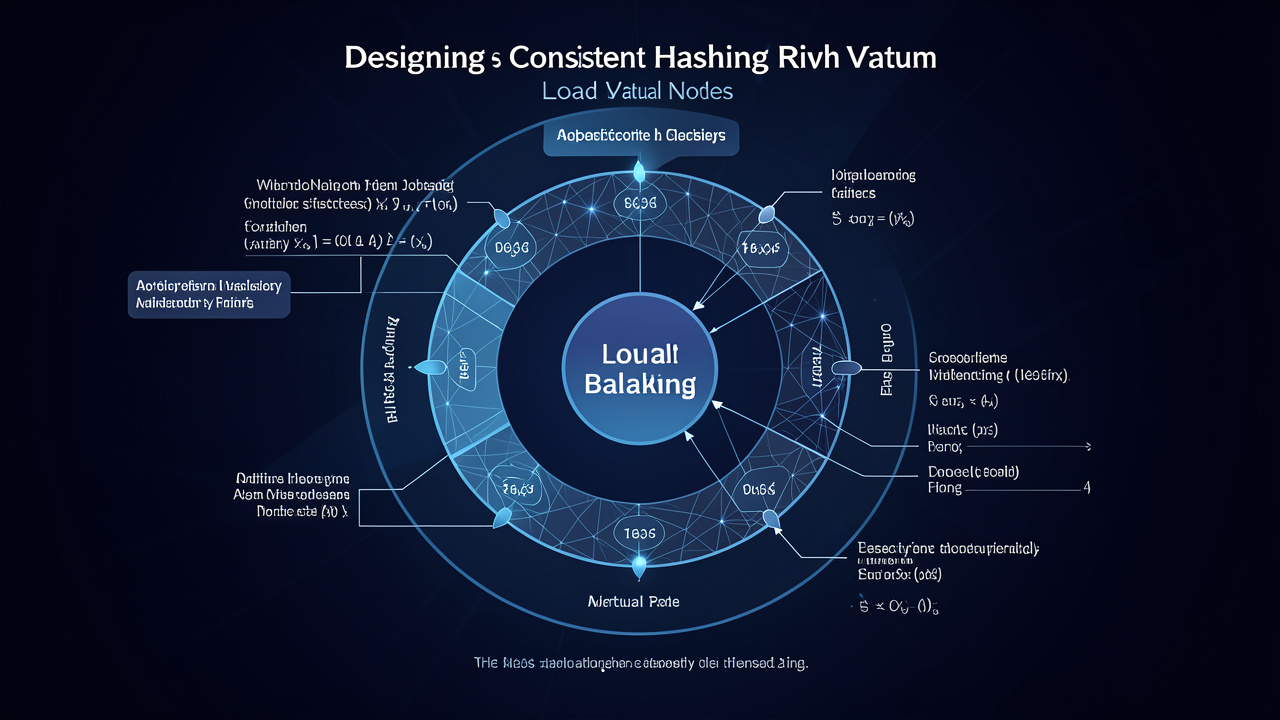
A comprehensive technical exploration of designing a consistent hashing ring with virtual nodes for load balancing, covering key concepts, practical implementations, and real-world applications.
Contents
The Hidden Complexity of Consistent Hashing: From Theory to Production
The 3 AM phone call is a rite of passage for any engineer managing a distributed system. The alert is always the same: cache hit ratios have cratered, database latency is spiking, and users are staring at loading spinners. The cause is rarely a mystery—a server died, or you finally hit capacity and had to spin up a new node. The fix, however, is what separates a resilient architecture from a brittle one. You push the button to add a new cache server, expecting relief. Instead, the system groans. The immediate aftermath of that simple scaling event is often a cascading failure. Why? Because you just invalidated the location of every single piece of data in the cluster.
This is the dirty secret of naive hash-based partitioning. If you are using a simple hash(key) % N strategy to decide which server holds which piece of data, you have built a system that hates change. When N changes—whether incrementing by one or decrementing by one—the modulus changes for every key. Suddenly, server 4 wants data that it now believes lives on server 7, but server 7 thinks it belongs to server 2. The result is a chaotic “thundering herd” as every client scrambles to re-map its entire data set, leading to cache misses, database overload, and a system that is arguably more broken after the fix than it was before the failure.
We have a term for this in distributed systems: “rehashing shock.” It is the primary enemy of availability and performance at scale. For decades, the standard solution to this specific pain point has been Consistent Hashing. Introduced by David Karger et al. in 1997, this algorithm was a breakthrough precisely because it minimized the chaos. Instead of a full re-map, consistent hashing ensures that when you add or remove a node, only 1/N of the keys need to be moved. This is a monumental improvement over the 100% disruption of the modulus approach.
But here is the curveball: theory and practice are rarely perfect bedfellows. The original “vanilla” consistent hashing algorithm, while elegant, suffers from its own set of practical problems that engineers must address to build a truly resilient caching or data partitioning layer. In this deep dive, we will unpack the algorithm from the ground up, explore its hidden complexities, and examine the modern techniques that turn a nice academic idea into a battle‑tested production system.
1. The Problem: Naive Hashing and Rehashing Shock
Before we celebrate consistent hashing, let’s fully understand the pain it was designed to cure. Imagine a distributed cache with four nodes. A naive sharding rule might be:
node_index = hash(key) % 4
This works wonderfully as long as the number of nodes remains four. But the moment you scale to five nodes, the modulus changes to 5, and every key’s ownership is recomputed. The result is a catastrophic cache invalidation: all data that was stored under the old modulus is now considered “wrong” by the application, even though the data itself is perfectly fine. The system experiences 100% cache misses, and the database must handle the resulting flood of queries.
The root cause is that the mapping from key to node is completely dependent on the size of the cluster. This creates a tight coupling between the partitioning schema and the physical topology—any change to the topology forces a remapping of all data.
1.1 The Thundering Herd Effect
When a naive cache cluster experiences a full remap, every client simultaneously tries to fetch the same missing keys from the database. This “thundering herd” can easily overwhelm the database, leading to increased latency, timeouts, and even cascading failures as the database crashes under the load. Meanwhile, the new cache node is idle because the clients have not yet populated it with the newly remapped keys. The system is in a state of chaos for minutes or even hours, depending on the size of the dataset.
1.2 Real‑World Anecdote: The Cost of Rehashing
A well‑known e‑commerce platform once experienced this exact scenario during a Black Friday sale. Traffic was at an all‑time high, their caching layer was near capacity, and an automatic scaling policy added a new Memcached node. The naive hash(key) % N sharding caused a near‑instantaneous 90% cache miss rate, which in turn caused the database cluster to saturate its connection pool. The site went partially read‑only for 45 minutes, costing millions in revenue. The incident was traced directly to the “rehashing shock” of a simple modulo‑based shard.
2. Enter Consistent Hashing
David Karger’s 1997 paper introduced consistent hashing as a way to decouple the mapping from the cluster size. Instead of mapping a key directly to a node using a modulo operation, we map both keys and nodes onto a circular space—the “hash ring.”
2.1 The Basic Algorithm
- Choose a hash function that produces a large, uniformly distributed output (e.g., SHA‑1, MurmurHash, or MD5).
- Hash each node’s identifier (e.g., its IP address or a unique name) and place it on the ring.
- To locate a key, compute its hash, then walk clockwise around the ring until you find the first node. That node is the owner of the key.
This is beautifully simple. The key insight: when a node is added or removed, only the keys that fall in the arc between the new node and its clockwise neighbor need to be remapped. All other keys remain untouched.
import hashlib
import bisect

class ConsistentHashRing:
    def __init__(self, nodes=None, hash_fn=hashlib.md5):
        self.ring = {}
        self.sorted_keys = []
        self.hash_fn = hash_fn
        if nodes:
            for node in nodes:
                self.add_node(node)

    def add_node(self, node):
        key = self._hash(node)
        self.ring[key] = node
        bisect.insort(self.sorted_keys, key)

    def remove_node(self, node):
        key = self._hash(node)
        del self.ring[key]
        self.sorted_keys.remove(key)

    def get_node(self, key):
        if not self.ring:
            return None
        hash_key = self._hash(key)
        idx = bisect.bisect(self.sorted_keys, hash_key)
        if idx == len(self.sorted_keys):
            idx = 0
        return self.ring[self.sorted_keys[idx]]

    def _hash(self, key):
        return int(self.hash_fn(str(key).encode()).hexdigest(), 16)
2.2 Why It Reduces Rehashing
When a node is added, it takes over a contiguous segment of the ring from its clockwise neighbor. Only the keys that were previously mapped to that neighbor now belong to the new node. In a ring with N nodes, the expected fraction of keys that must move is 1/N (assuming uniform distribution of both node hashes and key hashes). That is a dramatic improvement over the 100% movement of naive hashing.
3. The Curse of Vanilla Consistent Hashing
The basic version described above is elegant but has a dark side: non‑uniform distribution and hot spots. The problem stems from the fact that the hash function’s output is random, and node positions on the ring are also random. With only a few nodes, the ring segments can be very unevenly sized.
3.1 Non‑Uniform Distribution
Imagine we have three nodes. Their hash positions are random points on a circle. The arcs between them are random variables that are not guaranteed to be equal. In fact, the expected size of the largest arc is much larger than 1/N. For example, with three nodes, the largest gap is expected to be about 45% of the ring, meaning one node will receive almost half of all keys, while the other two split the rest. This imbalance violates the whole purpose of distributed caching: to balance load evenly across nodes.
3.2 Hot Spots and Cascading Effects
Uneven load leads to hot spots. One node gets hammered with requests while others sit idle. The hot node may become latency‑bottlenecked, causing timeouts. Worse, if the hot node fails, its keys get reassigned to the next node clockwise, which may already be overloaded, leading to a chain reaction. In the real world, this is often the “second order” failure that makes system engineers curse consistent hashing.
3.3 Adding a Node Can Make Imbalance Worse
Suppose you add a new node to a ring that already has uneven gaps. The new node will often land in a large gap, relieving the busiest node. But which gap? Since node positions are random, it’s possible that the new node lands in a small gap, offering little relief, or even splits a gap in a way that creates two moderately sized gaps but leaves the biggest gap untouched. Deterministic node placement doesn’t help because the “random” positions are fixed.
4. The Virtual Node Revolution
The core fix for the non‑uniform distribution problem is the introduction of virtual nodes (also called “vnodes”). The idea is simple: instead of placing one point per physical node on the ring, place many points. Each physical node is represented by a set of virtual nodes, each with its own hash. When a key lands on a virtual node, it is mapped to the corresponding physical node.
4.1 How Virtual Nodes Balance Load
By using many virtual nodes per physical node (e.g., 100 or 1000), the gaps on the ring become much more uniform. The law of large numbers ensures that, with enough virtual nodes, each physical node will own a nearly equal share of the ring. Furthermore, when a physical node is added or removed, the number of virtual nodes that change ownership is proportional to the number of virtual nodes per node times 1/N. The load balancing is dramatically improved.
4.2 Implementation Details
In practice, we often combine the virtual node identifier with a suffix:
def virtual_node_key(physical_node, vnode_index):
    return f"{physical_node}:vnode{vnode_index}"
Then we place all of these virtual keys on the ring. The client lookup algorithm remains the same: hash the key, walk clockwise to find the nearest virtual node, then retrieve its physical node.
4.3 The Trade‑Off
More virtual nodes mean more entries in the ring, which increases memory consumption and lookup cost (since the sorted list of keys grows). However, modern systems typically use a few hundred virtual nodes per physical node, resulting in rings with a few thousand to tens of thousands of entries. Lookups remain O(log N) via binary search (or even O(1) with a ring size of 2^32 and a binary tree). The memory overhead is acceptable for 99% of use cases.
4.4 Example: Why 200 Virtual Nodes Work
Let’s run a quick simulation. Suppose we have 3 physical nodes, each with 200 virtual nodes. The ring has 600 points. The expected standard deviation in the number of keys per physical node is roughly sqrt(1 / (N * V)), where V is the number of virtual nodes per physical node. With N=3, V=200, the coefficient of variation (standard deviation / mean) is about 0.04, meaning each node gets roughly 33% of keys ±1.3%. In contrast, with no virtual nodes, the coefficient of variation is about 0.5, meaning large imbalances.
5. Replication and Data Redundancy
So far we have focused on locating data on a single node. But in a distributed system, we often want replication for fault tolerance and availability. Consistent hashing naturally extends to support replication by walking the ring beyond the first node.
5.1 Replication Factor
In a distributed key‑value store like Amazon Dynamo or Apache Cassandra, you specify a replication factor R (e.g., 3). When writing a key, the system locates the first node on the ring, then also writes to the next R‑1 distinct physical nodes along the ring. This ensures that the data survives node failures: even if the primary owner goes down, the data is available on a replica.
5.2 Handling Node Failures
When a node fails, its keys are still available on the replicas that lie further clockwise. The system must, however, adjust the mapping for reads and writes because the failed node should be skipped. This is typically done in one of two ways:
- Hinted handoff: The coordinator temporarily writes the data to the next available node (or even stores a “hint” locally) until the failed node recovers.
- Read repair: When a read discovers that the primary is unavailable but a replica is present, it may update the primary after recovery.
5.3 Tunable Consistency
The consistent hashing ring can be combined with consistency levels (e.g., write one, read three) to provide tunable trade‑offs between availability and consistency. This is the foundation of Amazon’s Dynamo paper and later Cassandra.
6. Client‑Side vs Server‑Side Coordination
A critical design decision is who maintains the ring state. Two common models exist:
6.1 Client‑Side Partitioning
The client (e.g., a library like Memcached’s libketama) embeds the consistent hashing algorithm, the list of nodes, and often a configuration file. The client computes the hash ring locally and connects directly to the node that owns a key.
Pros: No central coordinator, low latency, high throughput.
Cons: Client must be updated whenever nodes change. If the update is not atomic across all clients, they may see different rings and misroute requests.
6.2 Server‑Side Partitioning (Proxy or Coordinator)
A proxy layer (like Redis Cluster’s proxy or a custom load balancer) holds the ring state, receives all requests, and forwards them to the correct backend node. Clients are unaware of the partitioning scheme.
Pros: Clients are simpler; ring updates are centralised.
Cons: The proxy becomes a single point of failure and a potential performance bottleneck.
6.3 Hybrid Solutions
Many modern systems use a gossip protocol (like in Cassandra or Consul) to disseminate ring membership changes. Each client or node maintains its own copy of the ring and updates it asynchronously via gossip. This provides eventual consistency of the ring view while avoiding both full centralisation and manual client updates.
7. Ring Management and Stabilization
When nodes join or leave, the ring must be updated consistently. In a dynamic environment, this is non‑trivial. Below are some key challenges and common solutions.
7.1 Handling Concurrent Joins and Failures
Two nodes might join at almost the same time, each inserting virtual nodes into the ring. Without proper coordination, the ring could become inconsistent. Many systems use a versioned ring (e.g., a “token ring” version number) that is incremented on each change. A node that receives a newer ring version re‐computes its map. Some systems (like Cassandra) use a gossip protocol to propagate ring updates, ensuring eventual consistency.
7.2 Transition Periods: “Rebalancing”
When a new node joins, data must be transferred from existing owners to the new node. This transfer can take time. During that period, both the old owner and the new owner may have the data. Systems often use a two‑phase approach:
- The new node announces its presence and begins accepting writes for keys that will eventually be its responsibility.
- The old node continues to serve reads (and also forwards writes to the new node if it has already committed).
- After a safe period, the old node removes the transferred keys.
7.3 Avoiding Data Loss During Failures
If a node fails abruptly, the replicas along the ring must handle reads and writes. The system must ensure that the quorum formula (for read/write consistency) still holds even when one or more replicas are down. Consistency hashing with replication helps, but engineers must also implement anti‑entropy mechanisms (like Merkle trees) to repair inconsistencies.
8. Practical Implementations and Case Studies
8.1 Amazon Dynamo (DynamoDB precursor)
Amazon’s Dynamo paper (2007) was a landmark in distributed systems. It used consistent hashing with virtual nodes to partition data across hundreds of machines. Each virtual node was called a “token”. Dynamo also introduced the concept of sloppy quorum and hinted handoff to handle temporary failures.
Key lessons from Dynamo:
- Virtual nodes are essential for load balancing.
- Gossip protocol is used for membership and ring propagation.
- Hinted handoff ensures writes are not lost during failures.
8.2 Apache Cassandra
Cassandra builds heavily on Dynamo’s design. It uses consistent hashing with a configurable number of tokens per node (default is 256). Nodes are assigned tokens (virtual nodes) that are stored in a system table. When a node joins, it picks random tokens, computes the ring, and begins data migration.
Cassandra’s replication strategy:
- SimpleStrategy: Places replicas on the next N nodes clockwise.
- NetworkTopologyStrategy: Ensures replicas are placed across different racks or datacenters.
Cassandra also handles vnode ownership with a vmover tool and nodetool commands for manual rebalancing.
8.3 Redis Cluster
Redis Cluster uses a variation of consistent hashing known as hash slots. Instead of a continuous ring, the keyspace is divided into 16,384 fixed slots. Each node is responsible for a subset of these slots. The mapping of slots to nodes is stored in a cluster state that is gossiped among nodes.
Why slots instead of virtual nodes? Fixed slots simplify data migration: you can move individual slots between nodes without needing to rehash the entire ring. Redis Cluster uses the CRC16 hash of the key modulo 16,384 to determine the slot. This design provides deterministic routing and makes rebalancing explicit.
8.4 Memcached with Ketama
The Ketama library is a classic implementation of consistent hashing for Memcached. It uses 160 virtual nodes per server (derived from the server’s IP and port) and a 2^32‑bit ring. Ketama is considered the de facto standard for consistent hashing in Memcached deployments.
8.5 Google’s Maglev
Google’s Maglev network load balancer uses consistent hashing to assign flows to backend servers. However, Maglev introduces a twist: it uses a jump consistent hash (see Section 9) that has zero memory overhead and O(log N) time, but only works for a static set of backends. For dynamic changes, Maglev computes a new, stable assignment table.
9. Alternative Approaches: Rendezvous Hashing, Jump Consistent Hash, CRUSH
While consistent hashing is the most widely known algorithm, it is not the only solution to the problem of minimizing movement during resizing. Below are notable alternatives.
9.1 Rendezvous Hashing (Highest Random Weight)
Also known as the “highest random weight” (HRW) algorithm, each client computes a weight function w(key, node) = hash(key + node) and chooses the node with the highest weight. When a node is added or removed, only keys for which that node’s weight was the maximum are remapped. This yields perfect stability (only fractions of 1/N keys move) and achieves nearly perfect load balance.
Pros: No rings or virtual nodes needed, good load distribution.
Cons: For each key, you must compute the weight for all nodes, making lookup O(N) in the number of nodes (though optimizations exist using caching or chunking).
9.2 Jump Consistent Hash
Developed by Google engineers (Lamping and Veach), jump consistent hash is a fast, O(log N) algorithm that produces a pseudo‑random assignment that is consistent under node additions. It works by treating the hash as a random process that “jumps” to a new node as the number of nodes increases. The result is minimal movement (exactly 1/N), no memory overhead, and excellent performance.
Limitation: It only supports the use case where nodes are numbered sequentially (0 to N-1). It is not directly usable for arbitrary node identifiers or removal of nodes (unless you treat it as a renumbered set). However, for many caching tiers where nodes are homogeneous and can be treated as a list, jump consistent hash is a perfect fit.
9.3 CRUSH (Controlled Replication Under Scalable Hashing)
Used by Ceph, CRUSH is a sophisticated algorithm that computes data placement based on a hierarchical description of the storage cluster (racks, rooms, failure domains). It ensures that replicas are placed in different failure domains and that data moves minimally when devices are added or removed. CRUSH does not use a ring; instead, it uses a pseudo‑random combination of hashes and cluster topology.
Pros: Excellent replica placement, failure domain awareness, low overhead.
Cons: More complex to implement; requires careful parameter tuning.
10. Trade‑offs and Considerations
When choosing a partitioning algorithm for your system, you must weigh several factors:
| Factor | Consistent Hashing | Virtual Nodes | Rendezvous | Jump Hash | CRUSH |
|---|---|---|---|---|---|
| Lookup complexity | O(log N) | O(log M) (M=virtual nodes) | O(N) | O(log N) | O(log depth) |
| Memory overhead | Low | Moderate (M entries) | None | None | Low |
| Load balance | Poor without vnodes | Good with many vnodes | Excellent | Good (but depends on node numbering) | Excellent |
| Handling removal | Yes | Yes | Yes | Not directly | Yes |
| Replica placement | By walking ring | Same | Not built‑in | No | Very flexible |
| Simplicity of implementation | Moderate | Moderate | Simple | Simple | Complex |
10.1 When to Choose Which
- Simple caching: Jump consistent hash (if nodes are homogeneous and you don’t need removal) or Ketama‑style consistent hashing with virtual nodes.
- Distributed key‑value store with replication: Consistent hashing (Dynamo/Cassandra model) with virtual nodes and replication by walking the ring.
- Data storage with strict failure domain constraints: CRUSH (Ceph) or a hierarchical variant.
- Small clusters (<10 nodes): Rendezvous hashing can be acceptable because O(N) lookup is cheap.
11. Production Pitfalls and How to Avoid Them
Even with a perfect consistent hashing implementation, real‑world systems can still fail. Here are common pitfalls and their mitigations.
11.1 Hash Function Collisions
If the hash function produces collisions (e.g., MD5 is practically collision‑free, but a poor one might cause), two nodes may map to the same ring position, causing one node to be invisible. Use a good hash like MurmurHash or SHA‑1, and handle collisions gracefully (e.g., treat duplicate hashes as ordered by secondary identifier).
11.2 Ring Instability During Rebalancing
When nodes are added or removed, the ring view can diverge among clients. This leads to “split brain” where different clients consider different nodes as owners. Use versioned ring tokens, gossip protocols, or a reliable consensus store (like etcd or ZooKeeper) to coordinate changes.
11.3 Data Transfer Overhead
Moving data between nodes during rebalancing can saturate network links. Use throttling (e.g., rate‑limited streaming), perform transfers in parallel only after verifying health, and always maintain read replicas during the transition.
11.4 Uneven Load After Additions Even with VNodes
Virtual nodes greatly improve balance, but if the hash function is biased or the number of virtual nodes per physical node is too low, imbalance can reappear. Monitor the standard deviation of key ownership and adjust the virtual node count accordingly. Some systems (Cassandra) allow tool‑driven token allocation to ensure even coverage.
11.5 Ignoring Weighted Nodes
Not all nodes are identical—some have more CPU, memory, or network capacity. You can apply weighted consistent hashing by giving those nodes more virtual nodes than others. For example, a node with twice the capacity should have twice as many virtual tokens. This is done by modifying the virtual node count per physical node.
12. Putting It All Together: A Production‑Ready Implementation
Let’s design a small but complete consistent hashing library with virtual nodes, replication, and weight support. We’ll use Python for clarity (though production systems would use C/C++/Java for performance).
import hashlib
import bisect
from collections import defaultdict

class VirtualNode:
    __slots__ = ('physical_node', 'vnode_index')
    def __init__(self, physical_node, vnode_index):
        self.physical_node = physical_node
        self.vnode_index = vnode_index

    def __repr__(self):
        return f"{self.physical_node}:v{self.vnode_index}"

class WeightedConsistentHashRing:
    def __init__(self, nodes=None, vnodes_per_weight=160, hash_fn=hashlib.md5):
        self.ring = {}
        self.sorted_keys = []
        self.vnodes_per_weight = vnodes_per_weight
        self.hash_fn = hash_fn
        self.weight_map = defaultdict(int)  # physical node -> total vnodes
        if nodes:
            for node in nodes:
                self.add_node(node, weight=1)

    def _generate_vnodes(self, physical_node, weight):
        count = int(weight * self.vnodes_per_weight)
        for i in range(count):
            key = self._hash(f"{physical_node}:v{i}")
            vnode = VirtualNode(physical_node, i)
            self.ring[key] = vnode
            self.sorted_keys.append(key)
            self.weight_map[physical_node] += 1

    def add_node(self, physical_node, weight=1):
        self._generate_vnodes(physical_node, weight)
        self.sorted_keys.sort()

    def remove_node(self, physical_node):
        # Remove all virtual nodes for this physical node
        keys_to_remove = [k for k, v in self.ring.items() if v.physical_node == physical_node]
        for key in keys_to_remove:
            del self.ring[key]
            self.sorted_keys.remove(key)
        del self.weight_map[physical_node]

    def get_node(self, key):
        if not self.ring:
            return None
        hash_key = self._hash(key)
        idx = bisect.bisect(self.sorted_keys, hash_key)
        if idx == len(self.sorted_keys):
            idx = 0
        return self.ring[self.sorted_keys[idx]].physical_node

    def get_nodes(self, key, replicas=1):
        """Return a list of distinct physical nodes for replication."""
        if not self.ring or replicas == 0:
            return []
        result = []
        seen = set()
        hash_key = self._hash(key)
        start_index = bisect.bisect(self.sorted_keys, hash_key)
        if start_index == len(self.sorted_keys):
            start_index = 0
        for i in range(len(self.sorted_keys)):
            idx = (start_index + i) % len(self.sorted_keys)
            node = self.ring[self.sorted_keys[idx]].physical_node
            if node not in seen:
                result.append(node)
                seen.add(node)
                if len(result) == replicas:
                    break
        return result

    def _hash(self, key):
        return int(self.hash_fn(str(key).encode()).hexdigest(), 16)
Usage example:
nodes = ["cache1", "cache2", "cache3"]
ring = WeightedConsistentHashRing(nodes, vnodes_per_weight=100)

for i in range(20):
    key = f"user:{i}"
    node = ring.get_node(key)
    print(f"{key} -> {node}")
This code implements virtual nodes, weighted distribution, and replica lookup. It is a solid foundation for a production caching layer.
13. Conclusion
Consistent hashing transformed the landscape of distributed caching and data partitioning. From the late‑night panic of rehashing shock to the elegant simplicity of the hash ring, it gave engineers a tool to scale systems with minimal disruption. Yet, as we have seen, the devil is in the details. Vanilla consistent hashing suffers from poor load balance; virtual nodes fix that. Replications adds fault tolerance; but careful ring management is required to avoid data inconsistencies. Real‑world systems like Dynamo, Cassandra, Redis Cluster, and Ceph each have their own flavor, refining the algorithm to meet their specific reliability and performance goals.
Understanding these nuances is what distinguishes a junior engineer, who knows “we use consistent hashing,” from a senior engineer who knows exactly how many virtual nodes to use, how to handle node failures, and how to prevent the next 3 AM phone call.
The next time your team considers building a distributed cache or database, don’t just reach for consistent hashing. Reach for a deep understanding of its hidden complexity—and arm your system with the battle‑tested techniques that turn theory into a resilient, production‑grade reality.
Further reading: David Karger et al., “Consistent Hashing and Random Trees” (1997); Amazon Dynamo paper (2007); Cassandra documentation; Redis Cluster specification; Google’s Jump Consistent Hash paper (2014).